HOME AND FIRESIDE

3%

Pacific Press Publishing Association · Mountain View, California · Jul 23, 1912

FromSigns of the Times, Vol. 39, No. 28.

Read the full edition

HOME AND FIRESIDE

Dress Atrocities

SINCE Eve in Eden donned her costume of fig-leaves and thus ushered in the era of clothes, the vagaries of woman's apparel have been little short of amazing. And as the responsibility for the necessity of that first primitive costume was of direct satanic origin, so his diabolical majesty has ever since enacted the rôle, tho behind the scenes, of chief designer of female fashions. In no other way can the extraordinary vogue of absurd styles and freakish fads in feminine attire be accounted for.
In this consequence of the original transgression, it would seem that our erring mother had paid full toll for her folly, if, scanning the on-coming ages, her sorrowing sight beheld the shame and suffering of her children, those daughters of doom who, in every time and clime adown the years, have been the brunt of ridicule, of pity and commiseration, of chaff and scorn, even fit subjects for quip and cartoon, for burlesque and caricature, on account of the nonsensical garb the fashion fixers have ever foisted upon them.
If you think this an extravagant statement, just take a backward glance at some of the relics in this regard, along the path of history.
If I were to write a modernized dictionary of English in the light of facts, one of the definitions would be, in part: "Fashion—a system of torture for the female sex."
Let us conduct a sort of inquisition, and see if this be not so.
Begin at the foot of the ladder. Take the savage tribes supposedly least restricted by the demands of conventional attire. True, there is ample waist room, and the feet go—and grow—unrestrained. But there is the fatal idea of adornment. Nature is not to be let alone. Hence we hear of hideous nose-rings—not to mention ears—O, no, for that fashion is quite civilized(!). Also we are told of lip-sticks, thrust through in the same manner that dainty ladies endure in the ordeal of ear piercing—only the latter is less barbarous, you say, while those horrid savages—how crude and vulgar they are!
Then have you read of the neck-stretching rings—how in one tribe of Africa a belle is not considered "finished" in her accomplishments for the required social entrée until she has enhanced her personal charms by the addition of several inches of neck, this effect being produced by wearing a series of snugly fitting rings, adding one above another as the process of elongation progresses?
In civilized countries, the equivalent for these barbarous implements is known simply as the high collar, or stock, being further designated as "stiff," and still more aptly described by some as a "choker," and differs from the savage sample in that it is worn by both sexes. But in the degree of discomfort afforded, the two articles are quite equal.
There have been some attempts also at improving the shape of the skull, as evidenced by the Flathead Indians, who cause the frontal bone to look like a Dutch roof, too familiar to require further description.
Still barbarous, you exclaim. But I have seen in late years, upon the heads of the most highly(!) cultured ladies, a certain form of hat that, while it does not in reality change the size of the skull, in effect produces just that appearance. I refer to the hat of a few seasons past with a superimposed crown—a hat upon a hat, the under crown fitting the head, as necessity demands, and the extra or upper story resembling nothing more than an inverted milk-pan, or butter-bowl, according to the shape,—whether flat on top, or rounding upward like a beehive. Let a visitor from the planet Mars look at such a hat from above, and his first impression of earth dwellers would be that the wearer belonged to a race of big-heads.
The hat of large brim, if it be not overly wide, has some points in its favor—it makes an excellent sun-shade, for instance. But the absurdly enlarged crown—what can you say for it? I'll tell you the thought that used always to force itself upon my mind when those hats first came in—What consternation would seize Miladi if her cranium should suddenly develop in circumference to fit the measurements suggested by her hat! And worse yet—what horror if to madam expecting motherhood a child should be born with a head of dimensions proportionate to her new spring hat!
Shocking suggestion! you exclaim, and indelicate, too. But let us see. Is truth ever indelicate? Have you never read of Jacob's experiment with the "ring-straked" rods and the cattle of Laban?
Surely here is a physiological law—"By beholding we become changed into the same image;" and I tell you honestly that I think it behooves us as women, especially as mothers, shaping human destinies, to "be not high-minded, but fear" lest in our mad pursuit of folly, we bring some dreadful judgment upon ourselves and on our children.
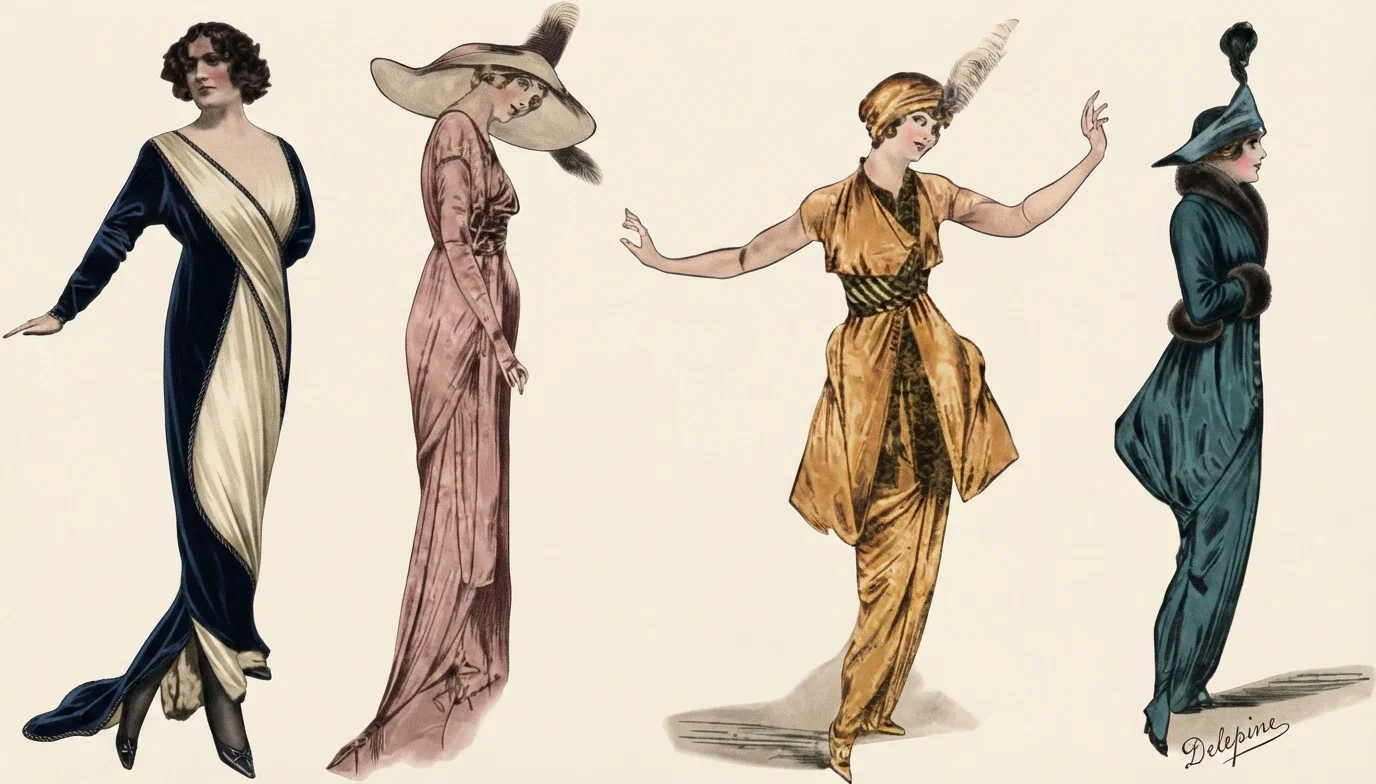
The above illustrations are from regular descriptions of fashion plates. The one on the left suggests a hanging stocking foot; but, reader, it is only a part of a "lovely" train. And these things are called "art," and are considered graceful and lovely and—indecent.
By an easy transition, we may pass here to another instrument of torture, the arch-contrivance, perhaps, of designing demons, for destroying human health and hence happiness. Name it?—The corset, of course. Why "an easy transition" from the paragraph above?—Because of a certain mother, criminally foolish in her devotion to fashion and the corset—it was in the days of the deadly old hour-glass shape now happily passing, praises be—who brought into the world a poor little knock-kneed child, a cripple all his life, tho otherwise a most beautiful boy, and possessed of unusual brilliance of mind. O, the shame of it, and O, the sin! And such are the whimsical moods of old Dame Fashion, that she would now inform Mrs.—that her poor, pinched-in waist was not good style at all, only hideously ugly and unnatural. Thus far has the world progressed. So this devotee was worshiping only a wooden idol after all; but the sacrifice to her false god still survives, eking out his days in anguish,—sad memorial of his mother's folly.
It is a comfort to know that tight lacing is no longer fashionable—so many simple souls are thus saved from torture and disease, since for no other cause could they be induced to abandon the practise, tho their very lives were crushed out in the process.
Let the skilled physician tell you, in his superintendency of a great hospital for women, how many capital operations he has performed, how many treatments administered for displaced viscera, all due to the curse of the corset.
But thanks to athletics, and the agitation of the hygienists, as well as of a few real artists in the matter of dress, the free flowing lines of the human form, erect and untrammeled, have become the foundation for most of the newer fashions.
But opposite forces are clearly at work in the matter of fashion as elsewhere. The pendulum swings swiftly to and fro. You think it is all certainly getting better, then up bobs the old dragon again!
We have surely gained on the corset question; but what of our skirts?
Lately the skirt seems to be the favorite point of attack for the arch-enemy of sound sense and simple beauty. We have survived the hideous "hoop" affair of our grandmothers, happy to see the failure of a recent attempt at its revival. We have outlived the indecent "harem" or trousers skirt, and disengaged our steps from the entanglements of the "horrible hobble," as it has been well named. We have even rid ourselves of the voluminous folds of the old "gathered" garment, fulled into a tight belt at the waist, also the many "gores" of the now obsolete "bell" and "fan" shapes. Through all these evolutions we have gradually thrown off our shackles, until, for a year or two now, the sex has enjoyed that highest product of the designer's skill in the skirt line—the modified straight skirt, of medium length—not the tight-as-the-skin, top-of-your-high-top-boots absurdity—O, no! but the straight cut, yet wide enough for comfort, short enough for cleanliness, but sufficiently long for modesty. These beautiful and beneficent elements may Heaven preserve. And we say it reverently; for the freedom, and lightness, the simplicity and economy in construction, and the neat and trim effect in appearance, are all genuine blessings, and blessings may be very properly prayed for.
But the forces of evil are not content to concede the vantage-ground thus gained. Things are really getting too good to last. We need taking down a peg or two from our position of comfort and common sense.
Since corsets—at least the worst sort—are gone out, and low necks are most universally worn, so that at two vital points freedom for the sex seems really accomplished, and the present skirt is, the best yet, and also we have the lovely high-waist, one-piece costumes, with their simple flowing lines, built on the model of the classic Grecian draperies, really something must be done—thus the enemy cogitates. So what now!
The pannier skirt! "Hip-bags," Lady Duff Gordon calls them. And let it only be whispered—the return of the hideous old bustle is hinted. Horrors! What are we coming to? But the panniers—of all the senseless, absolutely useless, and inexcusable attempts at ornament for civilized womankind, this seems to lead. Useless? Not quite.My little daughter tells me of a cartoon I wish I had seen—perhaps you have caught its lesson already—one fair lady blossomed forth in her new spring gown a la pannier, but practical soul, she put them to good use, for instead of a perambulator, safely tucked away, one on a side, with only curly heads in view, were her two youngest offspring. So here you have fashion allied to utility—a good combination, surely, and all the more commendable because so rare.
Lady No. 2 had been on a shopping tour, and came home with a pannier load of bundles on each hip—certainly convenient, if not graceful. Mrs. Malone found herself at the market, having forgotten her basket. "Sure," said she with a broad Irish grin, "now it's me kin be tellin' me ould man what's the use in thim new-fangled panniers, afther all." So saying, her purchases were safely stowed away, protruding carrot tops and onion stems gaily waving in the breeze as the good soul ambled homeward.
Amusing? On the surface, yes. But how does it set, my sisters, as a sex, to furnish the material for those cheap jokes? We may protest, but we never seem to improve, at least to the extent of becoming exempt from such shafts of ridicule.
From waste-basket hats with feather cluster trimming, we progress only in a circle, soon to arrive at some newer foible, to furnish another text for the jester. So long as this is so, do we deserve anything better? When one recalls the various fashionable extremes of past and present, might we not well consider that we get no more in this line than our follies earn for us?
Take the recent styles in hair-dressing, to say no more of the absurd hats, as their character is pretty generally recognized now, on their merits, and a wave of decided improvement seems to be setting in, tho the freaks still flourish.
Then those fish-tail trains—tho why a train of any sort, especially as a street-sweeper, the use formerly made of that accessory? and the half-and-half effects—one side of a costume in white, say, and the other side black, or other contrasting colors; and as to sleeves, we have escaped the old four-yards-apiece balloons of two decades ago, but now they are tiring of the dainty and sanitary short and demi-short length, and are making them down to the knuckles again, with sundry puffs and frills.
Thus the zigzag. Prevent it?—Of course not—no more than we can prevent the Chinese from binding their baby-women's feet. But we can protest. And we needn't bind ours, nor even stalk around on our toes in Parisian stilts, which is much nearer home.
To be sure, these extremes are for the ultra-fashionable, and many of them do not reach the blessed plain people at all—so much the more blessed thereby. But they have an influence, and ultimately work radical changes.
Now the question is, To what extent will you allow yourself to be swayed by these arbitrary and unnatural efforts to invent eternally some new thing, so that there is little rest or peace or comfort in living, only one new thing after another, destroying all poise and stability of character, and threatening bankruptcy to the ordinary purse whose holder attempts to keep the fearful pace?
The plea and purport of this article is that every woman, while not despising true beauty of apparel, and fully appreciating the importance of good style, will take a firm stand against these freak innovations and revivals of antiquated fashions of less enlightened ages, and by her example and her voice emulate the principles of sanity and simplicity, of genuine comfort and convenience, in all matters of dress, to the end that the best in present-day styles be preserved, and that such new developments as may come shall be along the lines of nature and true art, as to cut and finish, as well as to adornment and color harmony. What say you?