AS the thread of silk interwoven in the meshes of our paper currency enables the expert to distinguish the true from the counterfeit money, so throughout the history of the world there has been a system of education of which God was the fountain head. At times this stream of true and living knowledge had dwindled to the merest thread, which the great rushing tide of error seemed to almost wholly conceal. Then again the current would broaden, swollen by some outpouring of truth in the higher sources of the stream, and for a season it would seem that the turbid waters of unbelief, of heathenism, would be forced into narrower channels and the pure waters of Lebanon would sweep through the valleys of civilization, cutting deep, clean channels, carrying to the sea beyond and burying in its depths the accumulated filth of previous ages and giving nature a chance to again put forth leaf and bear the fruit of righteousness.
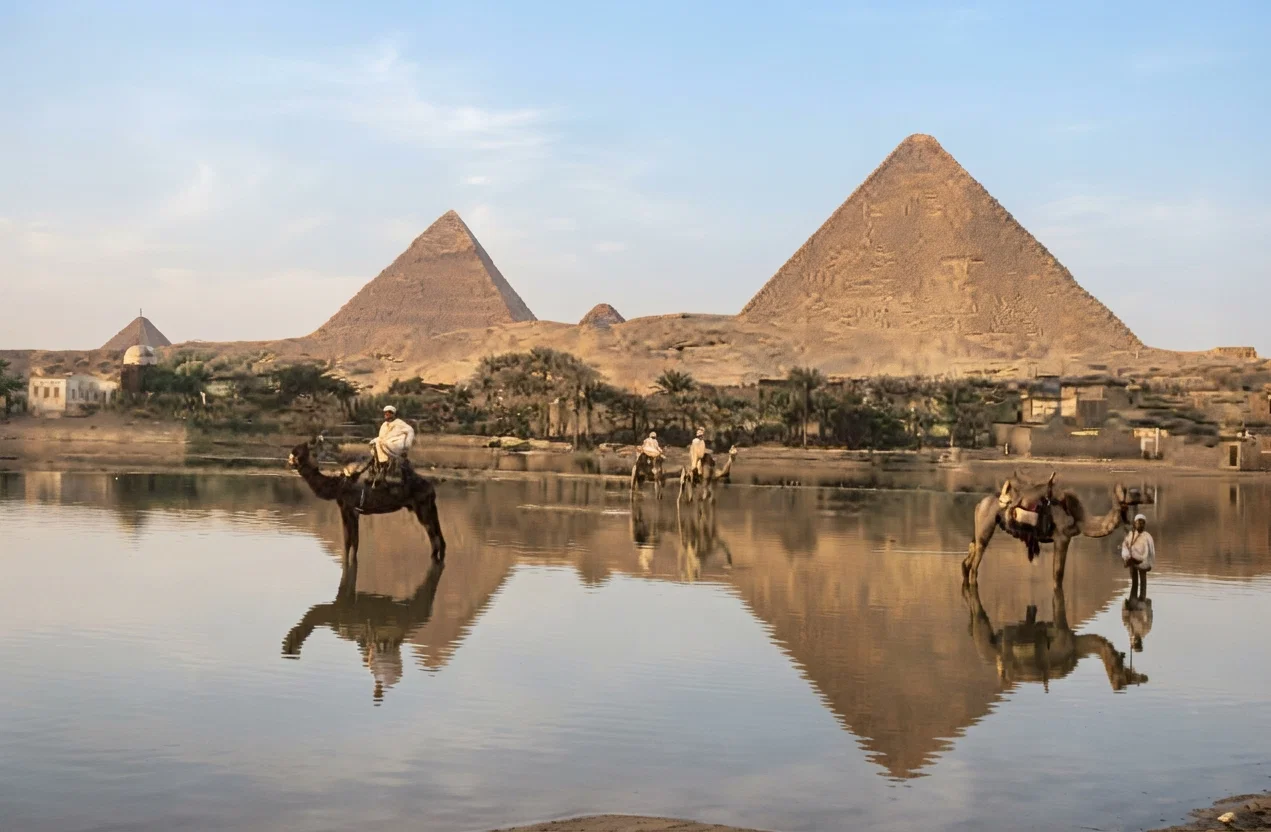
ON THE NILE. EGYPTIAN PYRAMIDS. Egypt's Monuments Are Witnesses of Both Her Ephemeral Greatness, and the Idolatry That Wrought Her Ruin.
Nevertheless, let the river of knowledge be broad or narrow; let it apparently be lost to earth, there was at all times an Eye that never sleeps which guarded the remnant of truth, and an all powerful arm, which, at the opportune moment, would cause circumstances to so adjust themselves that right, which ever bears in its bosom the elements of triumph, would again rear its head in glory above its enemy.
Thus, in tracing the history of education, we are obliged to plunge into deepest shadows, and then emerge gradually into the full blaze of sunlight.
One of the oldest forms of civilization is that found on the banks of the Nile. From this source come principles of education which still sway the world, as enduring, one would say, as the very pyramids near whose rocky bases it had its birth. True, but a time is not far distant when principles older than the pyramids will take the place of those the world now reveres because of their antiquity.
Holding, as we must, that the Bible record of the founding of nations is correct, it was but a few years after the flood, a few years perhaps after the building of the tower of Babel, that some of those inhabitants of the Euphrates valley found themselves in the fertile delta of the Nile. Lovers of ease, determined to supply the calls of nature with the least exertion possible, they devoted their energies to the building of cities and the development of a religion, of all religions the vilest,—that form of which the frog, the bull, and the reptile were fit emblems. Having known the true God at one time, having ever above them in the starry heavens the constant reminder of the Creator of all things, and in the annual rise of their river the clearest assurance of the mercies of the Saviour, they nevertheless worshiped the creature instead of the Creator, and as Paul says, when writing to the Romans, who had acted very much the same, "professing themselves to be wise, they became fools, and changed the glory of the uncorruptible God into an image made like to corruptible man, and to birds, and four-footed beasts, and creeping things." So low had they fallen in the manner of worship that God, when wishing to deliver the Israelites who had lived 400 years in the land, was obliged to meet the Egyptian2ideas of the gods by sending upon the nation all sorts of loathsome insects and animals.
It is often argued that this was the condition of the poorer classes only, and it may be true that the priests had a knowledge far surpassing this degradation, but so much the worse for them if they kept the masses in such a state of ignorance and corruption as these religious ideas engendered.
From such a festering mass of iniquity what system of education would one expect to see developed? And yet it is to this country and to such conditions that the world turns and with pride points out the birthplace of its mental growth. Here, in the Alexandrian schools, mathematics, philosophy, logic, and other branches found their noblest patrons, and the atmosphere, murky with those heathen ideas of the Deity, laden with pestilential vapors of infidelity, was wafted over southern Europe to be furthered by Greece and Italy.
In judging of the value of an educational system one cares not so much for the actual things taught, or left untaught, as to ascertain the character which was developed as a result of the train of thought constantly kept before the mind. Did the soul grasp the higher day-springs of knowledge, or rather was the result debasing? The writer of "Arius the Libyan" puts these words into the mouth of an ancient Egyptian hermit, and one need not read long to feel the truthfulness of the picture. "I, that have mastered all the arts, sciences, and religion of ancient Egypt,—a land that was wrinkled with age centuries before the era of Moses; I, that know both all that the priests of Kem [an Egyptian god] ever taught the people, and also the higher and more recondite forms of ignorance in which the priests themselves believed—I verily know nothing! I can scarcely believe in anything save universal darkness, for which no dayspring cometh, and universal wretchedness, for which there is no cure. O wretched man that I am, who shall deliver me from this body of death?"
Think of the children born to such an inheritance when a God of light and truth was ready to enlighten them. Moses had been taught in all the learning of the Egyptians, but Israel's God must needs lead him into the wilderness and there teach him with the shepherd's crook, a flock of sheep, and only nature with which to commune, before he was fitted to lead an enslaved nation into the light; before true principles of education could be presented to his mind. It was not that teachers were lacking, it was not that books were not written. Sciences were taught, but taught to lead away from God. Mathematics, in some of its branches, there reached its highest earthly development, but there was in it all no index pointing to the throne of God.
Egypt was the battle-ground, and for centuries the enemy of truth seemed to triumph. Through lack of true knowledge the nation fell, and still those principles of darkness struggled on. Light seemed forever gone, man groped about in utter darkness, but God had said, "Thus far but no further," and the proud waves of iniquity were stayed before the whole world was engulfed.
And yet, while there was a hidden truth not far from the land of Egypt which should one day enlighten the world, it is painful to realize that men and women of to-day hold with such tenacity to ideas and methods which bear upon their face the stamp of Egyptian darkness. While professing to be light, it nevertheless leads to destruction. The Passover is near at hand. Those who will heed the call will be gathered out and sheltered behind the blood-sprinkled portals before the death angel wings its flight over the land. To the world is again offered the opportunity of choosing between the Egyptian darkness and the light of the Eternal One. Let us be satisfied only when we awake in His likeness.