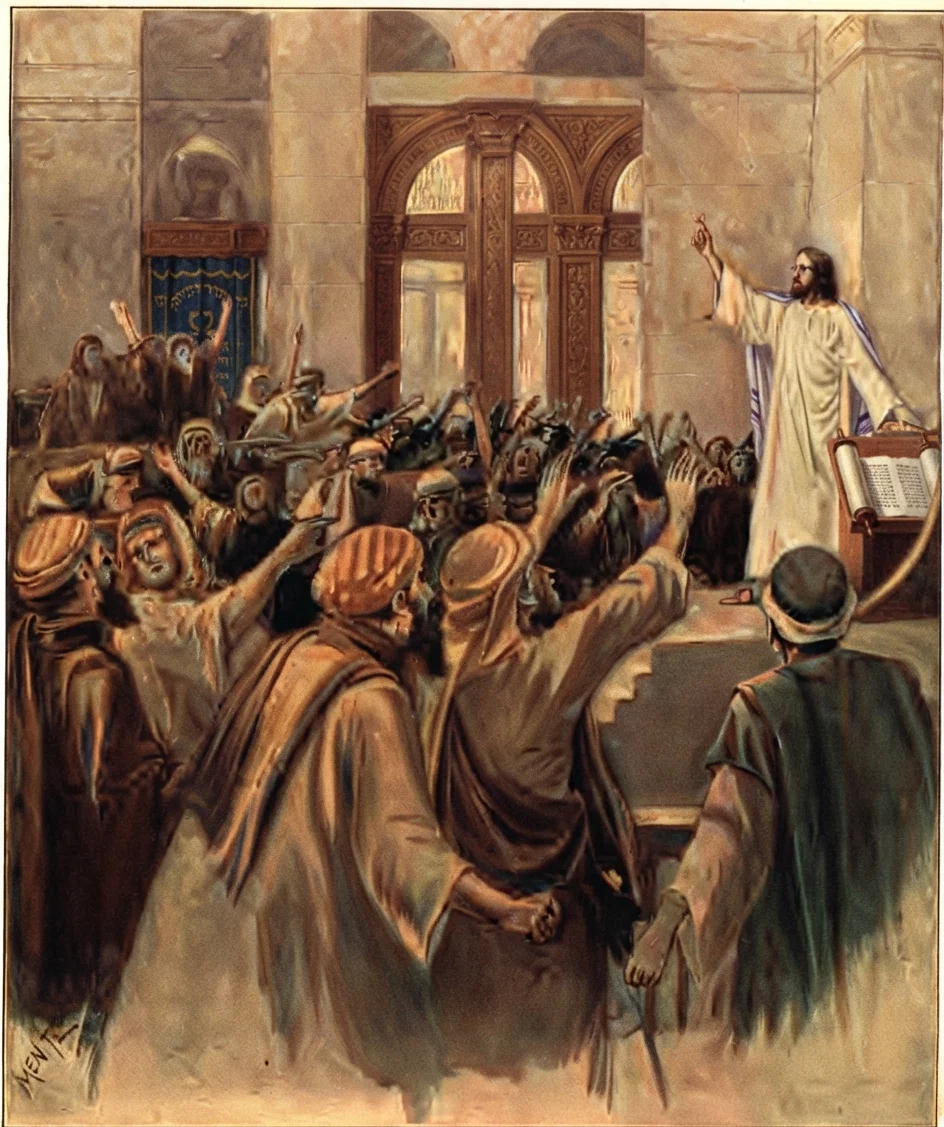
OUR Lord had well begun His ministry. He had called His first disciples. He had wrought His first miracle at Cana of Galilee. He had, with divine authority, driven out from the temple courts those who profaned its hallowed precincts by their unholy barter. He had stirred Samaria with His mission. He had preached in Galilee, and had "taught in their synagogs, being glorified of all." He had at Capernaum healed the son of the nobleman. His ministry everywhere bore witness that He was the Anointed of God.
"AND He came to Nazareth, where He had been brought up; and He entered, as His custom was, into the synagog on the Sabbath day, and stood up to read. And there was delivered unto Him the book of the prophet Isaiah. And He opened the book, and found the place where it was written:—
"The Spirit of the Lord is upon Me,
Because He anointed Me to preach good tidings to the poor;
He hath sent Me to heal the broken-hearted;
To proclaim release to the captives,
And recovering of sight to the blind,
To set at liberty them that are bruised,
To proclaim the acceptable year of the Lord.
"And He closed the book, and gave it back to the attendant, and sat down; and the eyes of all in the synagog were fastened on Him. And He began to say unto them, To-day hath this scripture been fulfilled in your ears. And all bare Him witness, and wondered at the words of grace which proceeded out of His mouth."
JESUS did not ask the people of Nazareth to accept Him the first of any. He went out to unknown fields, to strange faces; but wherever He went, God witnessed to His work. With this record behind Him, Jesus came to His own city. Faithful in His life to all God's precepts, an attendant at divine service on the Sabbath, no fault could be found as respects His character.
Jesus in the Synagog at Nazareth.
THE message He bore to Nazareth was not one of condemnation. A more blessed message could not be given. For over seven centuries the gracious words had remained a dim mystery in the roll of the wonderful prophet; here was their unfolding. If He had said, "The Spirit of the Lord is upon Me to condemn you, to punish you, to govern, rule, or direct you," they might well have questioned. But Jesus came not to force Himself upon a single soul. He would oppress none. He would not quench the smoking flax nor break the bruised reed.
BUT what a gracious message He brought! God has sent "Me to preach good tidings to the poor." Surely they needed it. Oppressed by despotic Rome, despised by their wealthy Pharisaical brethren, the way to life hedged and clouded by the traditions of their ecclesiastical teachers, why should not good tidings be gladly received?
"To HEAL the broken-hearted,"—hearts broken by sin and wo and misery and disappointment—Jesus came to heal them all. He has balm for every bruise, healing for every hurt.
"RELEASE to the captives" of sin. In that synagog at Nazareth there were many bound ones, those held for long years in the fetters of sin, the bondage of Satan.
"SIGHT to the blind," not alone physically blind, but, more than this, the spiritually blind; for better a thousand times is blindness of physical eyes to him who sees and knows God, than the clearest of physical vision and blindness of soul. When the mission of the Anointed of God is finished, there will be blindness in neither; for all shall see. The heart that knew God in the flesh shall see Him through undimmed eyes. "Thine eyes shall see the King in His beauty."
"LIBERTY to them that are bruised." There is no more glorious word. Slavery and bondage are the cruelest of words. Liberty and freedom are blessed. Men and governments may secure to man a desirable and comparative degree of freedom; yet, possessing this, souls may be in worse bondage than the galley-slaves of ancient Rome,—in the spiritual bondage of sin, bruised by the enemy, helpless from the bruises, hopeless in the misery. But Jesus proclaims liberty from sin. He gives freedom from Satan's bondage. If the Son "make you free, ye shall be free indeed." He gives power to "stand fast in the liberty" wherein He has made us free." Read His miracles, and know that just as He set free the men whose souls were bound by demons, women2bound by incurable disease, so will He set you free, sinner, if you will but yield your sins and your ways to Him. "If we confess our sins, He is faithful and just to forgive us our sins, and to cleanse us from all unrighteousness."
"THE acceptable year of the Lord." It was then; it is now. What a glorious opportunity opened before the people of Nazareth on that blessed Sabbath morning! It was the acceptable time for them to receive the Lord Jesus Christ; it was the acceptable time for them to join with Jesus in giving the blessed message to others. It is even so now to us. "Behold, now is the acceptable time; behold, now is the day of salvation."
STUDY the whole message, reader; it is all good tidings; and we need not marvel that as the people listened to that wonderful Teacher, filled with the Spirit, as He read in tones of infinite tenderness the words He had inspired the prophet to speak, the eyes of all were fastened upon Him, and that all bore witness in their hearts to the graciousness of His words. At this we need not wonder. How could they do otherwise?
BUT they did. Satan came in to close the opening hearts, to shut their souls against the truth. They were turned from the message to the Messenger. The message was gracious, sweet, and powerful; and every longing of their heart witnessed to its truth, as Jesus told them that it then and there applied. But this Man Jesus! "Why," says Satan, "who is He?" Ah! their selfish, envious hearts respond, "Is not this Joseph's son?" He is only one of us. We know His father and mother. He came up with us, in our presence. What has He told that we have not? And prejudice, always selfish prejudice, closed the door. The gracious Gospel was forgotten; they saw only one of themselves whom they were judging by their own selfish motives.
AND then He showed them, in reading aloud the thoughts of their hearts, that He knew them. He showed them from the Scriptures, which they professed to believe, that the messengers of God, of which Elijah and Elisha were examples, had been rejected by their own, till God was forced to send His message to the poor and lame and bound and blind without, who were longing to receive it. Of course He would send it anyway, but He wanted that His professed people should share the labor and the blessing.
HEARTS shut against the truth of God grow hard, critical, and then revengeful. So at Nazareth. And finally they were filled with wrath, and rose up and thrust Him out of the city, and led Him unto the brow of the hill, whereon their city was built, that they might cast Him down headlong. But God interposed, sent His angels to the rescue, and Jesus passed through their midst, unseen by their wrath-blinded eyes, and went His way, leaving them to their choice,—blindness, bondage, and death. Did He ever return to Nazareth?
THE lesson to us is obvious. God sends His wonderfully gracious message to us, full of life and light and liberty and healing and salvation. It comes by an uncultured acquaintance, maybe, one not educated in our schools. We supposed we had known him all our lives, and we question. We lose sight of the message for our need in our criticism of the feeble instrument God has honored. Sometimes the message comes by a person who does not bear the certificate of the schools. He does not come heralded with sound of trumpet or flattering newspaper notice,—only a humble messenger of God. He is not known to fame, and prejudice closes our heart's door to life. Sometimes it is a humble tract, sometimes a humbling duty, a cross for crucifixion. Our souls acknowledge the reasonableness and truth of all, but pride closes the door; hardness of heart follows; Christ is rejected, in His truth, and we drive home ourselves the hand-piercing nails of His crucifixion.
O READER, ponder the lesson! Receive every message of God that is according to His Word. Let the messenger be lost sight of in the message. Honor him only for the message's sake, receiving him in Christ's name. But do not shut your heart against the Gospel of Jesus Christ. X.