PRODUCTS, INDUSTRIES, AND RESOURCES OF THE PHILIPPINES.
By Eugene G. Wood
THE products, industries, and resources of the Philippines are many and varied. The soil is fertile and adapted to all semi-tropical and tropical products. The woods abound with a great variety of fruits; oranges, lemons, bananas, pineapples, mangoes, chicos, etc., are found growing uncultivated in great abundance, and may be gathered in their season. Tomatoes and a peculiar kind of potato are found in quantities, but of an inferior quality.
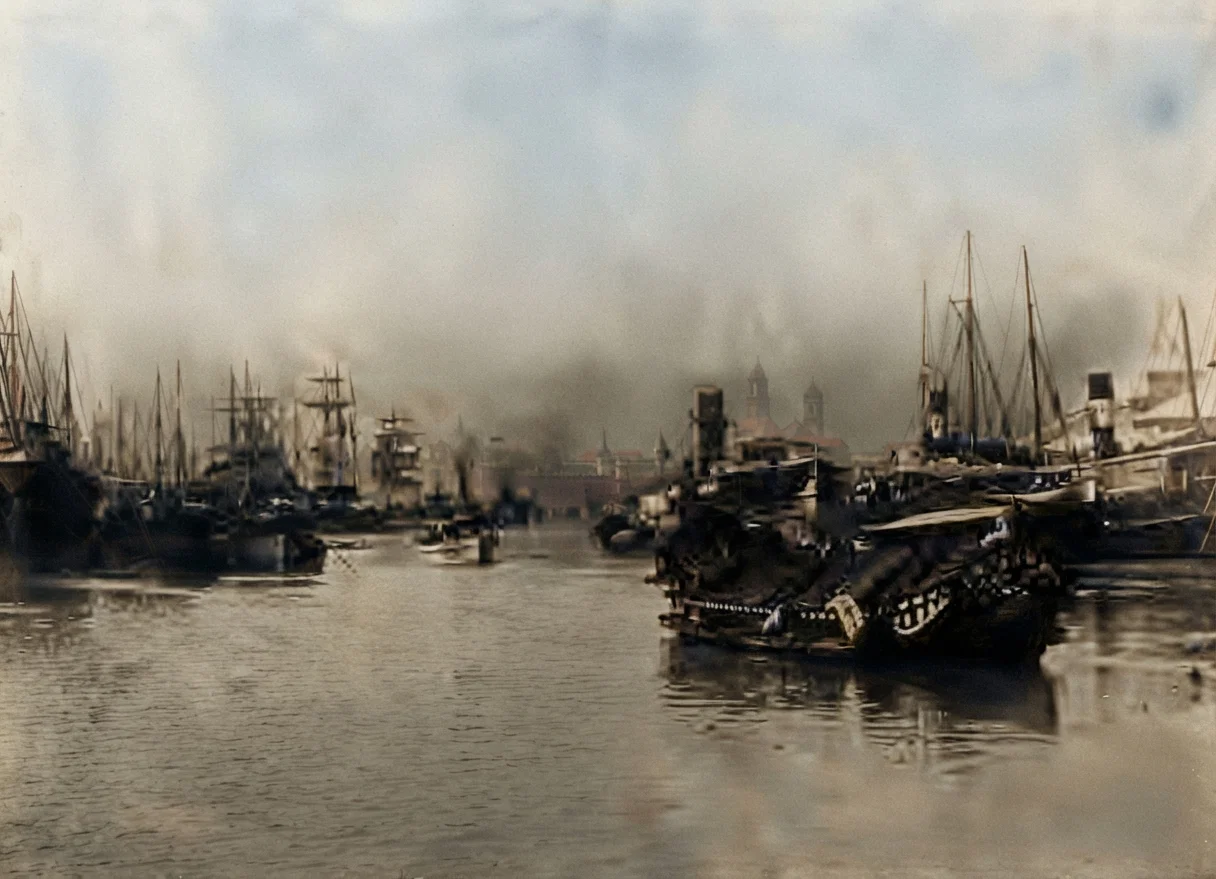
Shipping on the Pasig River.
Many varieties of sweet-potatoes, also radishes and peanuts, grow with very little cultivation. Sugar-cane, hemp, tobacco, rice, coconuts, coffee, indigo, and rubber are the chief products of the Philippines.
Sugar-cane is grown extensively throughout the entire Philippine group; but around the towns of San Fernando, Malolos, and Malabon, on the island of Luzon, and the entire island of Negros, one of the Vasayan group, it is one of the principal agricultural products. The soil produces but one crop a year, and there is but one crop at a planting.
The method of extracting the sugar and molasses from the cane is quite crude. The cane is ground between huge wooden rollers, turned by the caraboo, or water buffalo, and the juice is boiled down in large cast-iron kettles. When sufficiently boiled it is poured into earthen jars and left to stand for some weeks. It is then emptied out onto mats and divided into three parts, according to color, depending upon drainage. The contents of the upper portion of the jar are fairly light, the middle quite dark, and the bottom as black as tar. The sugar from the upper and middle portion of the jar is dried and bleached, and packed for market, while that in the lower portion is stored in mats to redrain. Such sugar is sold in the home markets from at 1 3/4 to 2 1/2 cents per pound, according to the grade. The molasses is sold at the distiller's, to be manufactured into alcohol and rum.
With such primitive methods it would be impossible to do much in the United States with the sugar industry; but in the Philippines they can work on a crop of cane for months.
The wages of the day laborer on these plantations are from $1.25 to $1.50 per week. There is an overseer to each twelve of these laborers, who receives about $3.00 per week.
The Vasayan group of islands produces about 19,650,000 pounds of sugar annually. In Manila hemp the Philippines possess a unique product, but this is a misnomer, as it is no relation to the hemp plant. Its native name is abaca, and it is a product of a species of plantain or banana which differs very slightly from the edible variety. It is a hardy plant, growing from twelve to fifteen feet in height, and suffers very little from any enemy except drought. It grows best in the hilly volcanic formation in the eastern part of the islands. It is a perennial plant, like its fruit-bearing relative, giving out new shoots month after month from the original root. A large tract of land is necessary to form a successful plantation, as it takes about three years for a stalk to reach maturity. As yet the crude native implements are used in the harvesting of the hemp.
Tobacco is raised in large quantities throughout the interior of Luzon and the southern islands.
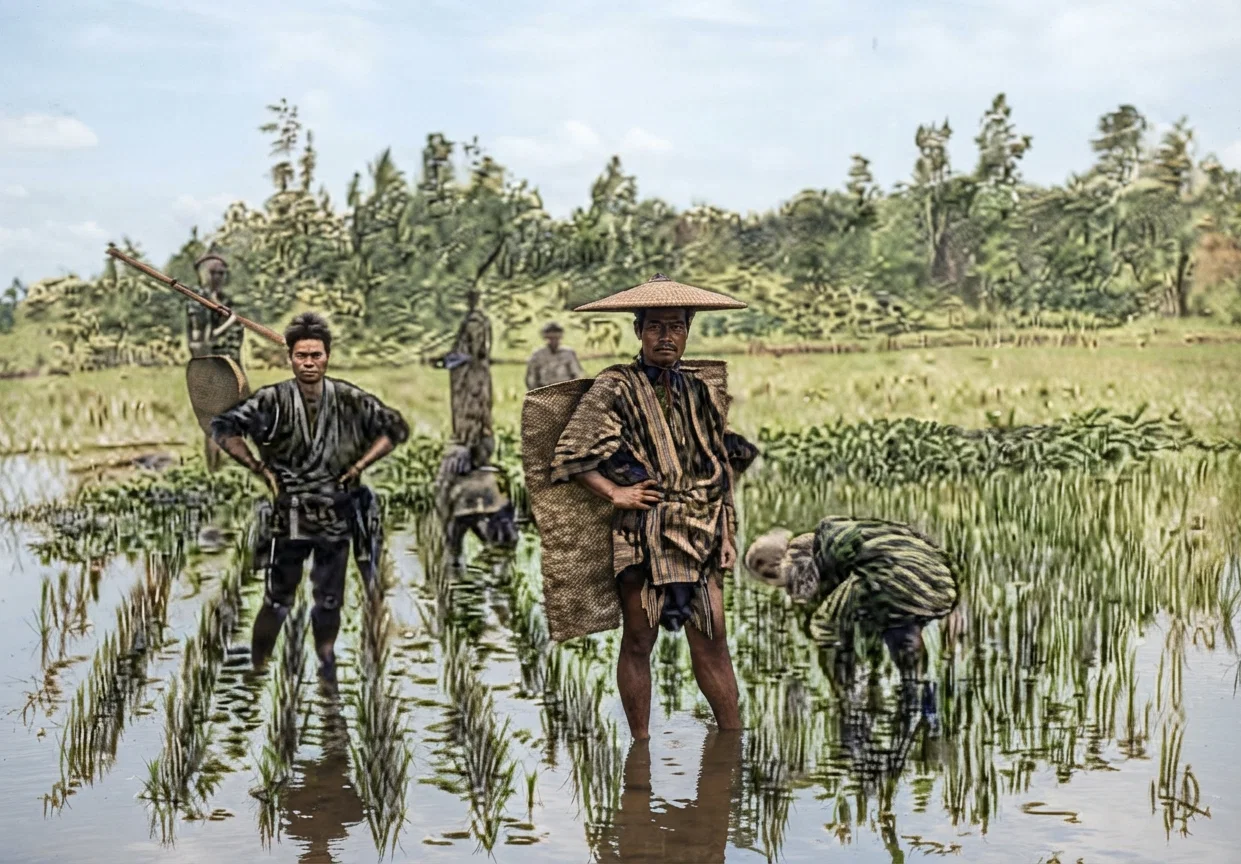
Rice, the principal article of food, is raised in large quantities throughout the entire Philippine group. It is planted in beds and when about six inches high it is transplanted in rows in the fields. Unirrigated rice fields produce but one crop a year and produce about one-sixth the quantity per acre of irrigated rice land. When the land is irrigated it will produce two crops a year of about 2,000 pounds each per acre. One man is supposed to cultivate about two acres under the present system of cultivation.
The cultivation of the coconut tree is general throughout the islands. The nut is used for food purposes and the making of oil, while cloth is made from the fiber of the leaf of the tree, pinia cloth being the finest grade. It sells for more than silk in the home markets.
It is said for many years a superior grade of coffee has been grown on the mountain slopes of the interior, and that coffee plantations are quite profitable.
The rubber plant is met with in many parts of Luzon and Mindanao. Of the profitable species two or three are native of Philippine soil. It is thought that no industry in the archipelago could excel the cultivation of rubber, if proper attention be devoted to it.
The products of the islands are brought into Manila, the chief center of commerce, by the Pasig River, a line of small steamers running to all the different islands of the group, and the railroad running from Manila to Dagupan. This road runs around the western coast of the island through the fertile valleys and a succession of rice and sugar fields intercepting Caloocan, Malolos, Pampanga, Tarloc, and11finally terminating at Dagupan, on the shallow gulf of Lingayen.
Much is said about the mineral resources of the Philippines, and many odd reasons are given why the mines have not been developed,—one, a superstition of the natives who think it is mortal sin to disturb the earth, but the principal reasons being the hostile condition of natives in the interior of the islands, and the Spanish Government, who imposed such heavy revenue that no foreign government would invest their capital.
The rock formation is largely of volcanic origin. Large beds of almost pure sulphur are deposited near Cavite. The iron deposits are said to be of pyrites, limonite, or bog iron ore, and hemitite, or red iron ore. At Augot is found one of the richest deposits known in the Philippines. This property was once worked by an English firm, who, after the heavy tax imposed upon them by the Spanish Government, were unable to make it profitable, so eventually had to abandon the property. At the present time the mine is worked by native Filipinos, who are said to make enough in one day to sustain them for a week.
Petroleum is found in Luzon and Mindanao. It is used by the natives as medicine and for household use, but not industrially.
Among the metals which have been found are quicksilver, zinc, tin, copper, platinum, and lead. Whether they exist in paying quantities is not known as yet.
Gold is said to exist in large quantities throughout the islands; but the Spanish would not work the mines, or allow foreigners to come in and carry off the profit. At the present time no mining is being done by Europeans in the Philippines. There is said to be about five hundred square miles where placer gold can be found, and about fifty places where exists gold-bearing quartz in true fissure veins. One ledge worked by natives in Northern Luzon has been examined by English assayists of Hongkong and said to average from ten to one hundred dollars per ton.
Most every scientist who has visited the Philippines has given his belief that a great mining future is in store for the islands. And the Chinese yellow book speaks of the island as abounding with precious metals.
A dark-looking ore containing gold, copper, lead, and silver, called serpentine rock, has been brought into Manila.
The most of the rock found in the Philippines is not what is called free-milling ore, but assays very high, and with proper machinery would afford a great source of income to the country if systematically worked.
The prospector will meet many almost insurmountable obstacles when going into the interior, but nothing will form a barrier to the energetic man. Large deposits of soft coal are found in the island of Luzon. The coal is said to be of good steaming quality and quite accessible. These mines were shut down some time ago by the insurrectors.