The Evolutionary Theory as Stated by Its Disciples—Its Failure to Account for Creation—Power Inseparably Connected with Intelligent Cause
EVOLUTION is a man-made substitute for a literal creation according to the God-given record in the first chapter of Genesis.
"The theory of evolution teaches that the creation of this earth was not accomplished in six days of twenty-four hours; that the divine method occupied ages and ages of immense duration; that nothing, of all the treasures of the globe as they now stand, was created at first in its present perfectness; that everything has grown, through the lapse of ages, into its present condition; that the whole earth, with the development in it, was, as it were, an egg, a germ, a seed; that the forests, the fields, the shrubs, the vineyards, all grasses and flowers, all insects, fishes, and birds, all mammals of every gradation, have had a long history, and that they have come to the position in which they now stand through ages and ages of gradual change and unfolding; also that the earth itself went through a period of long preparation, passing from ether by condensation to a visible cloud form with increasing solidity, to such a condition as now prevails in the sun; that it condensed and became solid; that cold congealed its vapor; that by chemical action and by chemical grinding of its surface by ice, a soil was prepared fit for vegetation, long before it was fit for animal life; that plants simple and coarse came first, and developed through all stages of complexity to the present conditions of the vegetable kingdom; that aquatic, invertebrate animals were the earliest of animals, according to the testimony of fossils in the earth. Fishes came next in order, then amphibians, then reptiles. 'All these tribes were represented by species before the earliest of the mammals appeared. The existence of birds before the first mammal is not proved, though believed by some paleontologists, upon probable evidence. The early mammals were marsupial, like the opossum and the kangaroo, and lived in the same era called by Agassiz the reptilian period. True mammals came into geologic history in the tertiary era. Very long after the appearance of the first bird, came man, the last and grandest of the series, it is doubtful whether in the tertiary period or immediately sequent. It is not established whether his bones or relics occur as far back as the tertiary era.'"
"This is a very brief statement, not my own, but that of Professor Dana, of renown. No man is more trusted, more careful, more cautious, than he, and this brief history of the unfolding series I have taken bodily from his writings."—"Evolution and Religion," by Henry Ward Beecher, pages 49, 50.
Mr. Beecher adds:
"As thus set forth, it may be said that evolution is accepted as the method of creation, by the whole scientific world, and that the period of controversy is passed and closed. . . . The theory of evolution is the working theory of every department of physical science all over the world. Withdraw this theory, and every department of physical research would fall back into heaps of hopelessly dislocated facts. . . . This science of evolution is taught in all advanced academies, in all colleges and universities, in all medical and surgical schools, and our children are receiving it as they are the elements of astronomy or botany or chemistry. . . . Evolution is held by men of profound Christian faith. . . . Evolution is certain to oblige theology to reconstruct its system."—Ibid., pages 50-52.
The foregoing is a fair statement of the evolutionary theory. It is the evolutionary record of creation without a Creator. It presupposes the origin of the material universe without an Originator. It undertakes to account for the stupendous miracle of creation without miracle.
SHOULD PRESENT SUBSTANTIAL FACTS
It must be admitted that when science breaks from the Bible account of creation, and introduces a theory that is to be accepted not only by the scientific world, but by eminent Christian men, and taught the students in all leading academies, colleges, and universities, necessitating the reconstruction of Christian theology, it should present as substantial a demonstration of facts in support of its claims for the origin of life and the elements of the material universe, as for the rotundity of the earth and the laws of gravity.
To say that all life sprang from a "seed" or "germ" does not answer the question of the origin of life. It merely removes the question to the origin of the germ. How did the first germ originate? Mr. Darwin's "Origin of Species" does not pretend to account for the origin of life. He contents himself with assuming origin, rather than proving it. Huxley began life history with protoplasm. But protoplasm is life in an ameboid or germ form. This does not account for the origin of protoplasm.
ADMITTEDLY IT DOES NOT SOLVE
Tyndall, one of the greatest of evolutionists, admits that evolution—
"does not solve—it does not attempt to solve—the ultimate mystery of the universe. It leaves, in fact, that mystery untouched. For granting the nebula and its potential life, the question whence they came would still remain to baffle and bewilder us. At bottom, the hypothesis does nothing more than transport the conception of life's origin to an indefinitely distant past."—"Fragments of Science," page 133.
AVOIDS THE MIRACLE
Thus according to the statements of its greatest leaders, evolution avoids the miracle of creation by admitting that science does not know how to account for the origin of life or of the material universe. It is therefore not a science that justly claims to be a rival of the God of creation. God explains the origin of both matter and life. Evolution relegates that question to the distant past and leaves it unexplained.
When evolution has accounted for the origin of its first elementary life germs without a Life-giver, the world will be confronted with the greatest miracle in its history. This is a counterfeit science, and like all other counterfeits, it does not bear the test. Genuine science is founded on fact. Evolution is founded on assumption. To reason that because things now exist they always have existed, is as unscientific as to reason that because a modern cannon found on a deserted battle-field is capable of lasting a thousand years, it must therefore have been manufactured a thousand years ago.
CREATION ONLY BY A CREATOR
Did the world create itself, or did it have a Creator? Either God created the heavens and the earth, or the Bible is absolutely unreliable in its first statement.
It was at one time announced by some astronomers that they had found clouds, or nebulae, or gas uncompounded with anything else, many millions of miles away in the heavens. They were so far away that it was supposed no one would be able to secure specimens for analysis. The astronomers therefore felt quite confident that their theory, that they had found in the nebulae the elementary "homogeneous gas" from which a world is made by first forming itself and then forming a world, without a Creator, would stand.
The invention of the spectroscope changed the supposed elemental gas to fire. But fire is the result of combustion, and the elementary nebular hypothesis was spoiled. The theory of elementary matter being self-existing from eternity was therefore left unsupported9by demonstrable facts, and this false science had failed to dethrone the Creator.
EVOLUTION COLLIDING WITH RECOGNIZED LAW
The first law of mechanics is that "to every action there is an equal and opposite reaction." Machinery can never, therefore, create power. For this reason, all human attempts at perpetual motion are a failure; but in the operation of the machinery of the material universe there is an illustration of perpetual motion. This demonstrates that a power outside of itself is balancing, guiding, and moving every part of the machinery of the universe on its onward course continually. No machine can create itself nor lift itself. Such a work can only be done by the application of some power from without. This proposition is so simple that one can easily test it by an attempt to lift himself by his boot straps. That common illustration is a refutation of all attempts to produce a universe and swing it in space without a Creator.
One might test the principle by attempting to run a locomotive without applied steam or electricity. Since matter can not originate itself now, and machinery can not run without applied power, what logic can show that such a thing ever happened? How remarkable it is that evolutionists who dare not assert that matter as it now exists can reproduce itself or generate its own power for poise, should assert such power for a single atom of matter! What philosophy has revealed a substance that was less powerful than the atoms composing it?
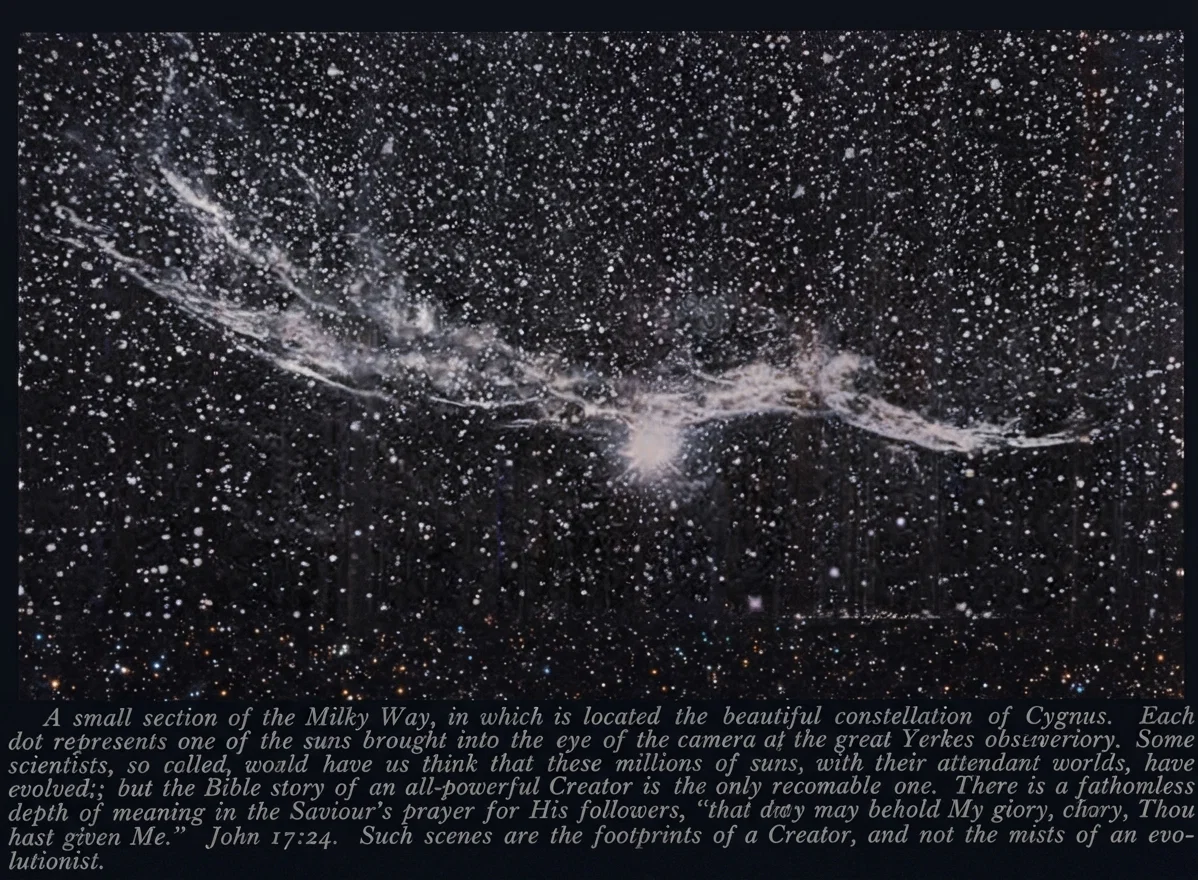
ONE OF THE MILKY WAY'S BEAUTY SPOTS
A small section of the Milky Way, in which is located the beautiful constellation of Cygnus. Each dot represents one of the suns brought into the eye of the camera at the great Yerkes observatory. Some scientists, so called, would have us think that these millions of suns, with their attendant worlds, have evolved; but the Bible story of an all-powerful Creator is the only reasonable one. There is a fathomless depth of meaning in the Saviour's prayer for His followers, "that they may behold My glory, which Thou hast given Me." John 17:24. Such scenes are the footprints of a Creator, and not the mists of an evolutionist.
Such reasoning is an effort to remove the basis of reasoning to such an infinitely small atom that what is assumed will be taken for granted, whereas regarding a larger form, reason would revolt at such an assumption, and demand proof.
Sir Henry Howorth is authority for the following truthful statement:
"It is a singular and notable fact that, while most other branches of science have emancipated themselves from the trammels of metaphysical reasoning, the science of geology still remains imprisoned in a priori theories."—"The Glacial Nightmare and the Flood," preface, 7.
LIFE ONLY FROM LIFE
Huxley asserts that "skepticism is the highest of duties, blind faith the one unpardonable sin." Yet according to his own statement, he believed in "the evolution of living protoplasm, from not living matter," without the slightest evidence. ("Methods and Results," pages 40, 41.)
Why has he given no proof? The reason is obvious. Science knows of no instance where life has been produced except from previously existing life. The evolutionist having failed to explain, in his theory of origin by "fire-mist," how the fire started without an ignitor of the fire, asserts that at one time the universe was in a state of solution in the form of primeval oceans; that these formed mud deposits, which hardened into salts, rocks, and earth; these formed the world, and without a seed, produced trees, grass, and vegetable life. One is asked to believe that the ocean formed itself, that from self-formed sea-mud the life germ developed itself contrary to all laws of natural history, and from that original germ, by "spontaneous generation," all other life has been produced.
And all this, evolution asks one to accept on "blind faith," without the slightest proof. Yet "blind faith" is the one "unpardonable sin" of this science.
Does the theory of "spontaneous generation" hold good when tested by natural history? No atom of the inorganic, or mineral world has ever been known to develop into life by "spontaneous generation." Science has produced no such demonstration.
"No biological generalization rests on a wider series of observations, or has been subjected to a more critical scrutiny, than that every living organism has come into existence from a living portion or portions of a preexisting organism."—P. C. Mitchell, in the "Encyclopædia Britannica," volume 3, page 952, Cambridge University edition.
For science to assume the origin of life without an Originator, and give no proof, is to admit defeat at the outset. Life from life is the universal law of natural history.
"SPONTANEOUS GENERATION"
To attribute "spontaneous generation" as a result of natural law is pure assumption. Natural law reveals no such process. Dana says:
"Thus the brute races of the middle quaternary on all the continents exceeded the moderns greatly in magnitude. Why, no one has explained."—"Geological Story Briefly Told," page 229.
Sir William Dawson says:
"Nothing is more evident in the history of fossil animals and plants of past geological ages than that persistence or degeneracy is the rule rather than the exception. . . . We may almost say that all things left to themselves tend to degenerate, and only a new breathing of the almighty Spirit can start them again on the path of advancement."—"Modern Ideas of Evolution," appendix.
Degeneration therefore is admitted by the most authoritative writers to be the tendency in the natural world. Where, then, is the evidence of "spontaneous generation"? A striking characteristic of the science of evolution is that whenever it reaches the point where evidence should be supplied to demonstrate its hypotheses, such is wanting. There are no scientific facts to support its claims.
"TRANSMUTATION OF SPECIES"
In the same category with all other evolutionary theories may be listed that of the "transmutation of species." That such a claim should be published under the name of science, in the absence of any facts in its support, is one of the most astounding surprises that confronts a real scientist. Every species of bird, beast, insect, and plant is a living protest against the theory. There are gradations of animal and vegetable life, but these do not come as the result of "transmutation of species."
EXPANDING MERE INFERENCES
Agassiz, well known as one of the greatest of scientists, is reported in the Presbyterian of December 7, 1872, as thus expressing his contempt for the unscientific theories of evolution, in a paper read before the Academy of Science:
"As I grow older in the ranks of science, I feel more and more the danger of stretching inferences from a few observations to a wide field. I see that the younger generation among naturalists are at this moment falling into the mistake of making assertions and presenting views as scientific principles which are not even based upon real observation. I think it is time that some positive remonstrance be made against that tendency. The manner in which the evolution theory in zoology is treated would lead those who are not special zoologists to suppose that observations have been made by which it can be inferred that there is in nature such a thing as change among organized beings actually taking place. There is no such thing on record. It is shifting the ground from one field of observation to another to make this statement, and when the assertions go so far as to exclude from the domain of science those who will not be dragged into this mire of mere assertion, then it is time to protest.
"He thought it was intolerant to say he was not on scientific grounds"