Will England's Established Religion Be Protestant or Catholic?—Leading Bishops Consider the Situation Grave—A Proposed Church Federation in East Africa Precipitates the Conflict
By W. T. BARTLETT
THE religious world in England finds itself to-day in the presence of a crisis of all-absorbing interest, in which crisis, strange to say, the name "Seventh-day Adventist" occupies a rather prominent place. Concerning the magnitude of this crisis the bishop of London says: "The church is face to face with a dispute which, unless it is properly and firmly and delicately handled, may split it into two pieces."
HOW THE TROUBLE STARTED
In June, 1913, some sixty missionaries in British East Africa gathered together in conference at Kikuyu. These missionaries, according to the published reports, represented the following Protestant missions at work in the protectorate: the London Missionary Society, the Church of England Mission, the African Inland Mission, Lutherans, Friends, Seventh-day Adventists, and United Methodists. At the close of the conference, the members took part in a united communion service. The only building favorable for the purpose was the Scottish church, and in this Bishop Peel, of Mombassa, celebrated the Lord's Supper, the bishop of Uganda being also present.
The object of the conference is said to have been to consider suggestions for the organization of a united native church, and a committee was appointed to prepare and submit a scheme. It is not to be supposed for a moment that the Seventh-day Adventists present were disposed to surrender principle and Bible truth for the sake of outward uniformity. They do, however, make it their aim, in their missionary operations in British East Africa as elsewhere, to cooperate just as far as possible with other missions. They have been able to do something along this line in the preparation and printing of literature for use in native schools.
It has been taken for granted, however, in the religious press, that the Kikuyu conference means a step toward the organization of a native church in which Seventh-day Adventism will have its share of representation; and the Church Times, the leading Anglican paper, speaks with scorn of "this amazing conference," sneering at the perplexity of a native Christian who should be addressed in turn from the pulpit of his church by a Presbyterian, a Lutheran, a Seventh-day Adventist, and a Quaker. The Roman Catholic press has also been amused by such a strange combination of preachers for one congregation as Seventh-day Adventist missionaries and Anglican clergymen.
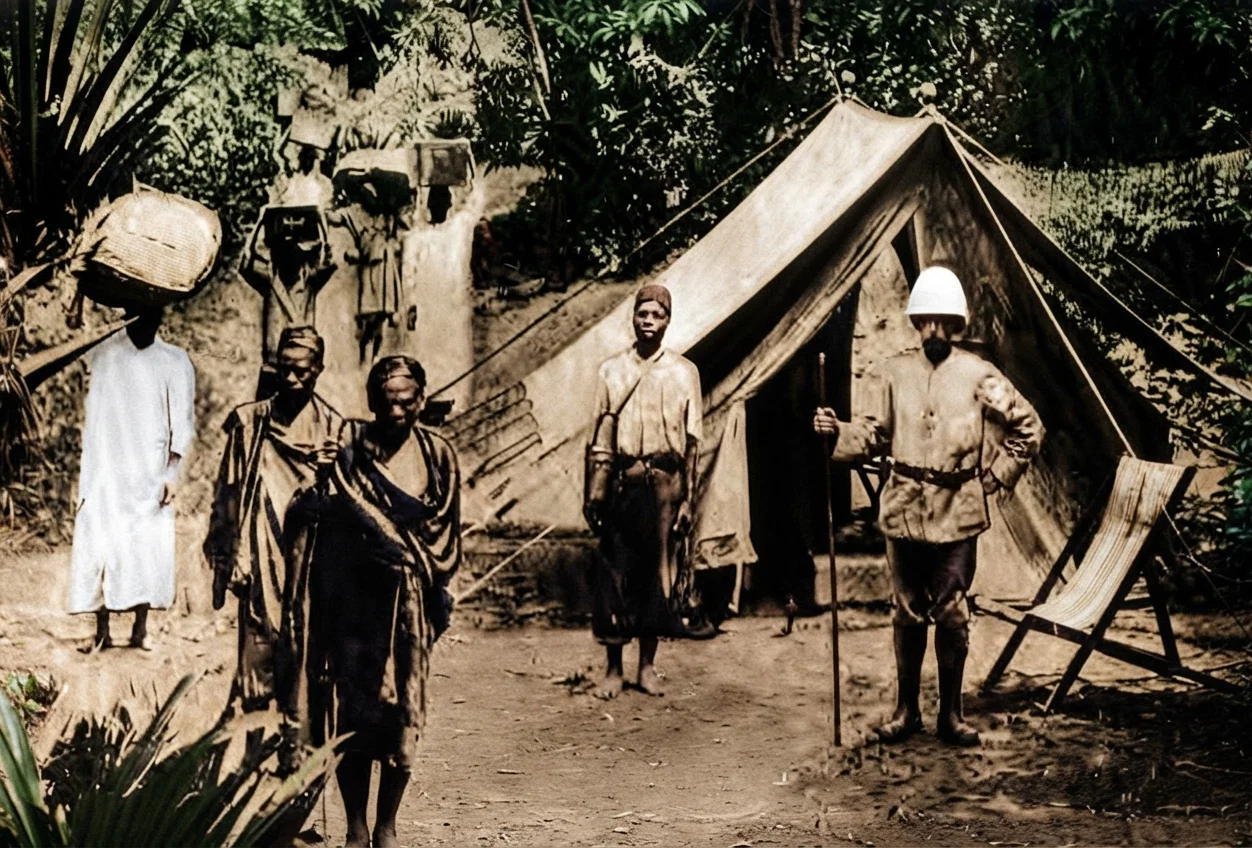
Photo by Paul Thompson The bishop of Mombassa, who was the instigator of the controversy, with some of his native followers, on a preaching tour through his diocese.
THE ISSUE CALLS FORTH NEW BOOKS
Already books are being published dealing with the issues raised by the conference; and in one of these, Mr. Norman Maclean writes concerning the puzzling mixture of sects that distracts the mind of the native of central Africa:
"The Baptists confront the universities' mission, saying, 'You must be immersed to be a Christian.' The Seventh-day Adventists confront the Baptists, saying, 'You must keep the seventh day holy and not the first, and so be a Christian.' The Brethren confront the Baptists, and the Friends the Brethren, and each raises his testimony to the truth; and the African, in his bewilderment, asks, 'What is the truth?'"
Thus the name "Seventh-day Adventist" is bandied about in not only the religious press, but the daily newspapers. These recognize the importance and interest of the situation, and are giving it plentiful space in their columns. The Times especially has printed a large number of letters from the most influential people in the religious world.
THE WARRING BISHOPS
But while the bishops of Uganda and Mombassa were showing themselves favorable to the idea of unity among the various denominations at work in the mission field, the bishop of Zanzibar was stirred with indignation at the sight of Anglican prelates planning to organize a native church to which non-episcopal Christians82could be admitted on terms of equality, and dispensing the holy communion to non-conformists in a Scottish church. He has definitely charged the two bishops with heresy in departing from the Anglican doctrine in respect to episcopacy, and demands that they be tried for their offense by the archbishop of Canterbury and a suitable ecclesiastical tribunal in England. He insists that the Church of England is not Protestant in character, but Catholic, and that —
"We who deliver the whole Catholic faith to our people [in Zanzibar] are directly challenged to our faces by the two bishops who are within easiest reach of us, and our cause is by them betrayed into the hands of our Protestant neighbors, our work is hindered, our witness is stultified; we are made to appear as pretenders, impostors."
SHALL IT BE CATHOLIC OR PROTESTANT?
Accordingly the bishop of Zanzibar demands some definite and authoritative pronouncement, that he may know where the Church of England stands. He affirms:
"If to Protestantize the world and modernize faith be the work that she officially undertakes, I for my part have no longer place or lot within her borders. Let the Ecclesia Anglicana declare herself."
The Evangelical party in the Church of England, with its Protestant sympathies, has not been slow to declare itself at this juncture. The bishop of Durham, the most prominent leader of this section of the Anglican church, has written:
"If the bishops of Uganda and Mombassa are arraigned for heresy for their share of responsibility for a program which I think to be true to the mind of our Master, and full of promise for His work, I, for one, would willingly, if it may be, take my place beside them."
So far the archbishop of Canterbury, who is nothing if not a diplomatist, has declined to commit himself on either side of the question. He will wait till all the particulars are before him, and meanwhile the matter is receiving his best attention. The bishop of Zanzibar is on his way home to lay his case before the archbishop and other authorities of the church.
THE MOST CRUCIAL CONFERENCE SINCE THE REFORMATION
The bishop of Zanzibar recognizes the gravity of the issue he has raised. He says himself:
"There has not been a conference of such importance to the life of the Ecclesia Anglicana since the Reformation. For it has brought us to the parting of the ways, that we have so long dreaded and sought to avoid."
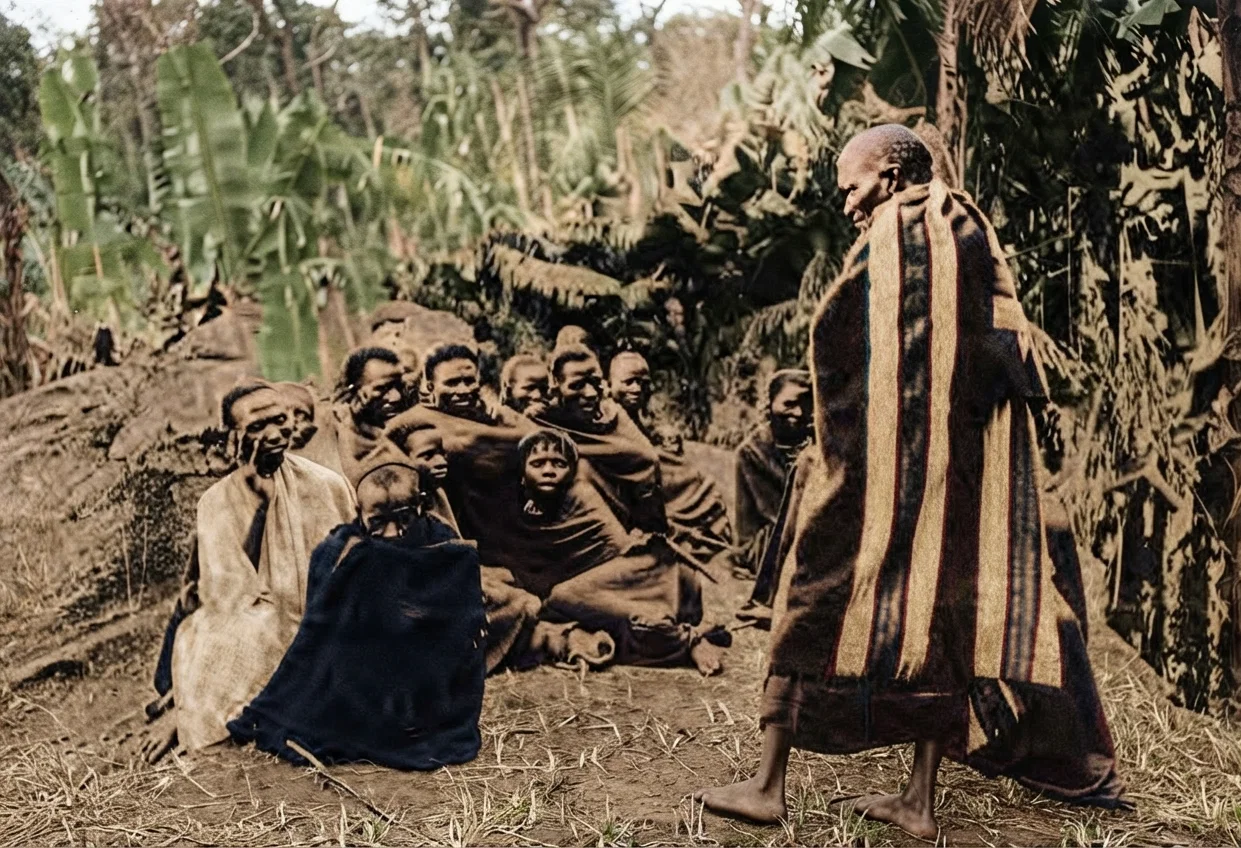
Photo by Paul Thompson. A medicine-man who was converted to the Christian faith by the bishop of Mombassa. He is preaching to his brother natives.
ENGLISH BISHOPS IN HOSTILE CAMPS
These charges of heresy, brought against one bishop by another, and the demands for a council that shall settle the question, together with the dividing up into hostile camps of the English episcopacy, and not least, the fact that the trouble arises in Africa, seem to carry the student of church history back into the atmosphere of the early centuries of the Christian era. The bishop of Zanzibar is not the only one who foresees a possible breaking up of the English church. If that prelate carries the day and secures the condemnation of the bishops of Mombassa and Uganda, grave consequences must inevitably follow. Says the dean of Canterbury:
"If the present conference should result in such repudiation of the Protestant character of the Church of England, not only would its bisection be inevitable, but the loss of its position as a national church would be unavoidable also. The religion of the nation of England is irrevocably Protestant, and the nation will never uphold with public authority, in every parish in the country, a church which repudiates the principles of the Protestant Reformation."
SET TOWARD ROMAN AND GREEK CHURCHES
For nothing else than this repudiation is really involved in the demand put forward by the bishop of Zanzibar. He is requiring that the church dissociate itself from the Protestant ideal, and identify itself with the Catholic, which in effect means that the Church of England shall shut the door against all recognition of English non-conformist bodies, and set its affections — albeit vainly — upon the Roman and Greek communions. The bishop of Zanzibar will be supported by the powerful High Church party, which for years past has been expressing the greatest detestation for the name and principles of Protestantism, and doing all in its power to restore in the Church of England the doctrines and practises of the Roman Catholic Church.
SEES THE ISSUE IN THE BATTLE
The bishop of Durham recognizes that this is the issue which must be fought out, and he declares his position boldly:
"If the English church comes to pronounce authoritatively such action heretical, a new epoch of vital or mortal import will enter her history. It will be officially avowed, for the first time, that we have no part nor lot with non-episcopal churches, to whom, by the way, in a sense unknown to history, the great word 'Protestant' is now being applied as a term exclusive of Anglicans. We shall be committed to the tenet, never before affirmed with authority by the Church of England, Catholic and reformed, that divine grace runs only for certain in the Episcopal channel; that all other ministries, as not irregular only, but invalid, are to be shunned in the name of spiritual truth."
BOTH PARTIES STRONG FOR CONFLICT
Both parties in the Church of England, the Catholic and the Protestant, are strong, and neither is disposed to give way, so that there is a possibility that the Church of England has before it one of the greatest crises in its history. The bishop of Oxford, Dr. Gore, says:
"I do seriously think, unless the great body of the Anglican church can again speedily arrive at some statement of its principles, such as will avail to pull it together again in a unity, comprehensive but intelligible, and compatible with the moral principle of sincerity of profession, it will go the certain way to disruption; with the appalling result that it will miss its great vocation in Christendom just when its characteristic witness appears to be most needed."
"WORLD CONFERENCE ON FAITH AND ORDER"
Another item that gives some added importance to the present crisis is the fact that a deputation is now on its way to these shores from America in the interests of the proposed "World Conference on Faith and Order." If the champions of an unyielding episcopacy carry the day in the Church of England, the World Conference might as well be abandoned. If, on the other hand, that principle is defeated in the struggle, and the Anglican church presents a kindlier aspect to the other religious bodies, the prospect before the World Conference will become distinctly more favorable.
WILL SEVENTH-DAY ADVENTISTS TAKE PART?
Possibly the present agitation is preparing the way for a definite submission of Seventh-day Adventist beliefs to the World Conference on Faith and Order. The bishops and others who have been ready to stand side by side with their brethren of Uganda and Mombassa, assailed for the offense of regarding Seventh-day Adventists in Africa as brethren in Christ, will hardly be able to deny a hearing to Seventh-day Adventists at home if a hearing should be asked when the World Conference on Faith and Order convenes.