EVERYWHERE men are realizing more and more the great barrier the liquor traffic presents to advancement.
In the several provinces of the Dominion of Canada there is evident a great consensus of opinion that the bar is a public menace, and that every man ought to help in the effort to abolish it. In the name of decent civil government, and for the sake of humanity, the manufacture and sale of this destroyer of the race should be banished.
As stated by the Hon. Lloyd-George:
"Wherever you find these poor creatures whose brains are shattered, wherever you find human beings huddled together in wretchedness, wherever you find men living in a condition of vice and crime, they all bear testimony that drink is the prime agency in the creation of all these unsightly masses of pain and degradation; and I say this,—that the government would fail abjectly in its duties if, through any base fear of any force or combination of forces, they would shrink from doing all in their power to cut from the social organism this most malignant growth that drains the vitality of the nation."
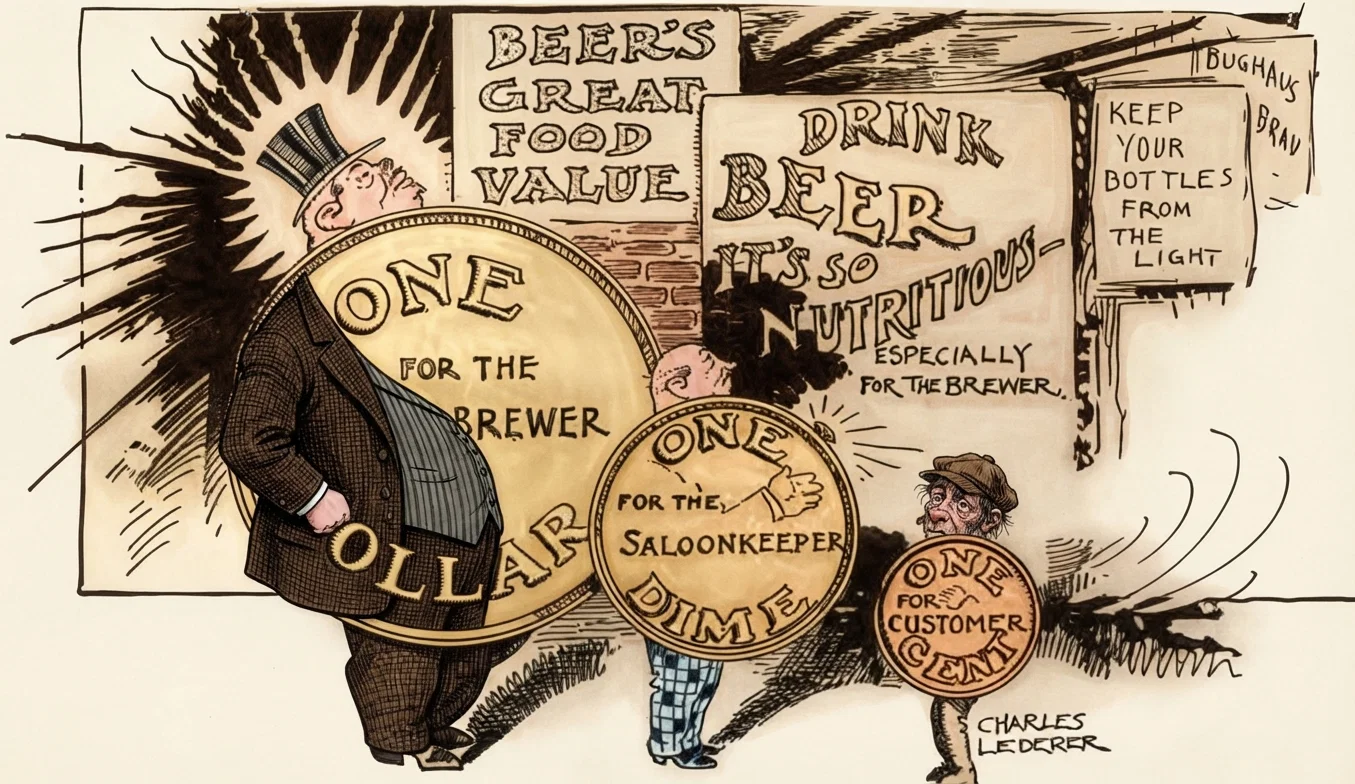
The consumer gets one cent of nutriment out of the $1.10 paid for beer, besides the poison. It was all in his pocket at first.
The latest statistics show that Canada has fourteen distilleries, twenty-eight malt-houses, sixty-four breweries, seventy-two tobacco manufactories, two hundred sixty-one cigar factories; and the numbers are still increasing. In a recent year there was in Canada an expenditure of $28,936,782 for liquor, $25,329,323 for tobacco, a total of $54,266,105.
It is said that this sum would cover the entire cost of operating our nine provincial governments for the same period. It would pay all the expenses in connection with the administration of justice; build our roads and bridges, wharves and ferries; provide bounties for hospitals; maintain asylums for the care of the insane; sustain the educational department; and pay all other expenses incurred in maintaining our nine provincial governments within the dominion; and would leave a surplus of more than $14,000,000, which would be sufficient to provide thirty-five thousand families with $400 each.
In view of this portrayal of facts, it must be self-evident that something should be done to arrest this condition of things and bring about a rapid and decided change.
Organized plans are being made for a strong campaign for temperance reform. Already the cause of temperance is gaining strength in Alberta, British Columbia, Manitoba, New Brunswick, Nova Scotia, Ontario, Quebec, and Saskatchewan. Many noble men and women have declared themselves determined to unite in a desperate effort to save the fair land of Canada from the curse of the liquor traffic.
In the Dominion Parliament the matter of temperance has been agitated by good men again this year. The papers say that the "Dominion Parliament was a few weeks ago given some figures of the liquor traffic in Canada that were of such serious proportions, that the minister of inland revenue was asked to furnish all the data at the disposal of his department in relation to the output of breweries and the consumption of liquor in general, so that if at all possible, Parliament might have an opportunity to consider seriously the whole question, not only in relation to excise, but also from the standpoint of the well-being of the Canadian citizen-hood."
Thank God for noble men and women whose natures revolt against the flood of intemperance that threatens the safety of their sons and daughters, and who are rising up in the name of the Lord to stand bravely in defense of the glorious cause of temperance.