Opening of Congress—Recognition by United States—The Quintuple Loan—General Conditions
The fourteen months which have passed since the abdication of the Manchu emperor and the setting up of the provisional government of the new Chinese republic, have been stirring times, marked by internal dissensions and outside criticisms, all of which, with few exceptions, have appeared to be more harmful than helpful.
That Yuan Shih Kai, the provisional president, has been able practically single-handed, with almost no funds from which to draw, to keep a strong hand on the helm and guide his almost sinking ship of state through the vortex of complex currents, steering her safely between the treacherous rocks which have appeared on every side and launching her fairly out upon the high seas of public praise and national confidence, has marked him at once to be a statesman of such ability that he is recognized by all as the "man of the hour," even his enemies bearing unspoken tribute to his virtue by the persistent and untiring way in which they have hunted his life during this period.
Opening of Congress
The first national congress of the republic of China was formally opened in the spacious hall of the Financial College at Peking on the morning of April 8, at eleven o'clock. When the opening hour arrived there were present 503 members of the house of representatives out of a possible 596, and 177 senators out of a total of 274, besides a large gathering of friends, including many foreigners.
These congressmen were elected by popular ballot at an election which was held in all the principal cities of China on Dec. 6, 1912, and the senators were chosen at the various provincial assemblies, the delegates of which were elected at the same time as the congressmen.
The hall where the opening ceremony was held is the chamber which in the future will be used for the sessions of the lower house. Accommodations have been provided for 600 members, each with his own desk and chair. Galleries surround three sides of the hall, and on this occasion all the visitors as they arrived were presented with a gilt commemorative medal.
At the ringing of a bell, the premier and the other members of the cabinet crossed the platform and took their seats on either side. The assembly was then called to order by Mr. Shih Yu, chief of the bureau of preparations. The senior senator, Mr. Yang Chun, then took the chair and called upon Mr. Lin, secretary of the late national council, to deliver an address. This he did in a shrill, sing-song voice, reading from a large scroll his speech, which was for the most part a collection of flowery phrases congratulating China upon her marvelous achievements. It was warmly received and heartily applauded by the members of the house.
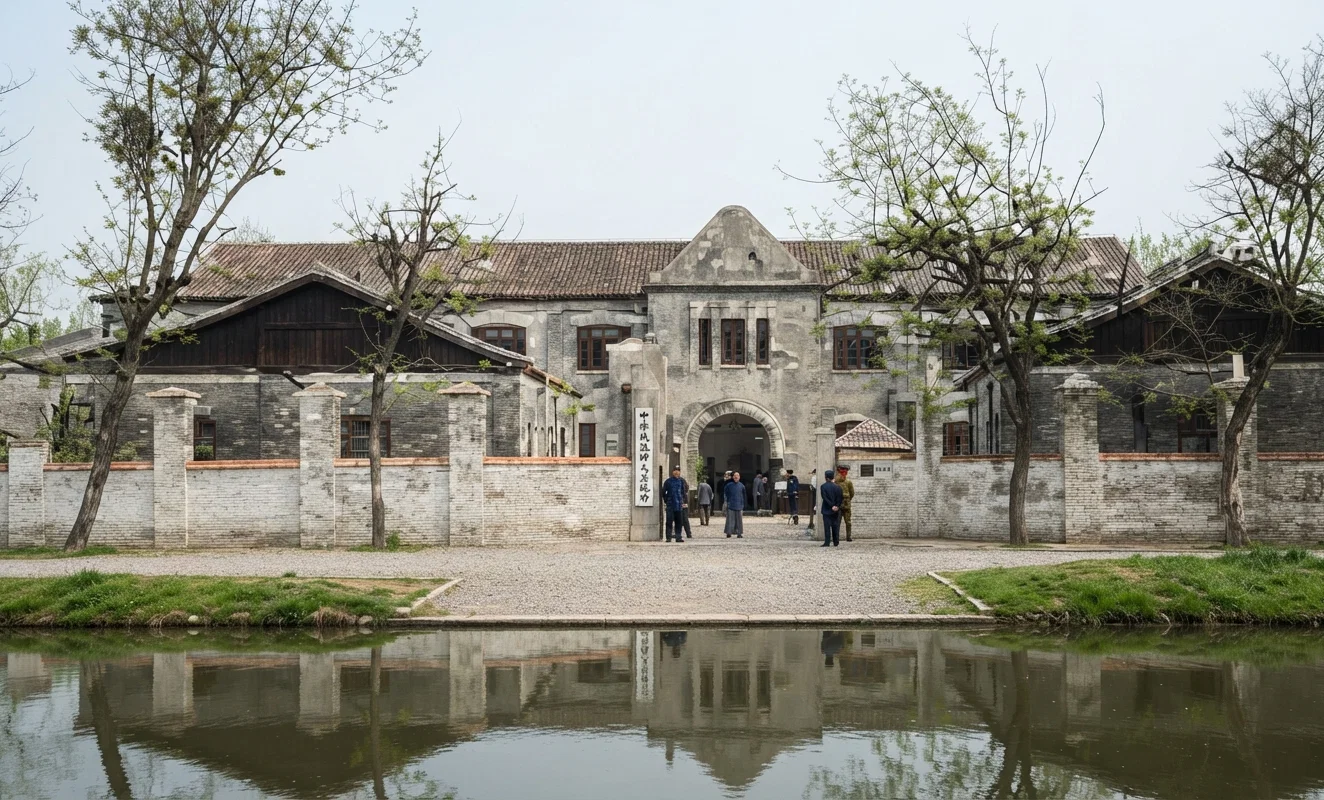
The building in Nanking where President Sun Yat Sen was first president of China
Mr. Liang Shih Yi, the president's secretary, then stepped forward and handed the chairman the president's message, which was placed upon the table unread. The ceremony of making three bows to the republican flag was then performed, all members standing and bowing in unison at a signal from the master of ceremonies. A band then played a few bars of music, after which the assembly was adjourned for four days.
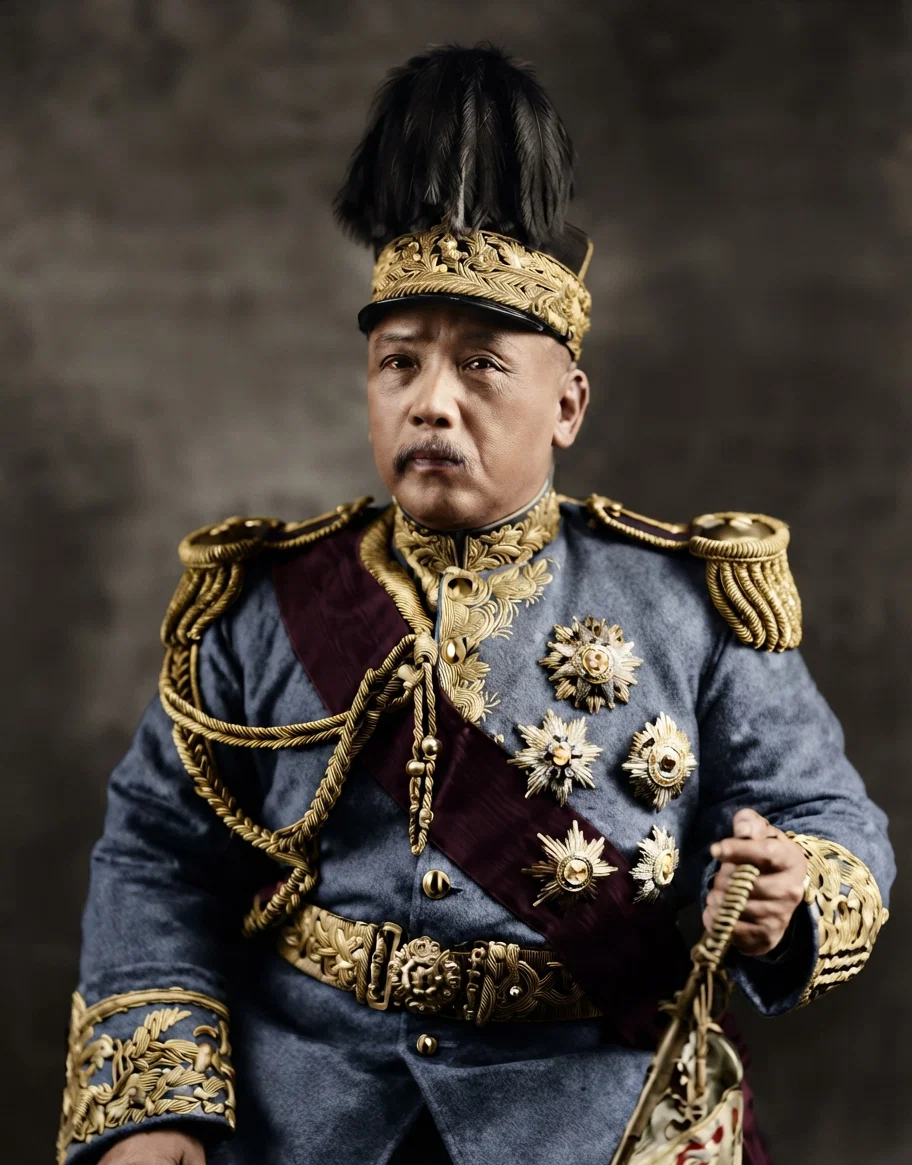
Yuan Shih Kai, president of China, in his official uniform
The President's Message
The president's message was very short and pointed, the text being given below:
"President Yuan Shih Kai's message to parliament.
'April 8, 1913.
"To-day, the eighth day of the fourth month of the second year of the republic, is the day fixed for the opening of the first national assembly, an event which is unparalleled in the 4,000 years of our history.
"We have adopted a republican form of government, and sovereignty must now be placed in the hands of the people. Since the inauguration of the new form of government, direct power of the people has been lacking. The two houses have now been elected by the people and will directly represent them. All the representatives of the people are patriotic and of great experience and vast learning. Therefore I believe they will establish a foundation upon which the republic will endure for ten thousand years and the prosperity of the four hundred millions of the people dating from to-day will originate in their parliament.
"I therefore take this opportunity to congratulate the people upon the opening of their parliament."
The congressmen displayed a decided preference for foreign style clothes, the great majority being attired in frock coats and silk hats. Some of the members affected a similar garb made entirely of Chinese silk. Not more than thirty were clad in the old style Chinese clothes, and the number of cues worn could easily be counted on the fingers of one hand.
Ostensibly the first and most important business of the parliament was to adopt a constitution and elect a president, and it was confidently hoped by the well-wishers of China that the new congress would set about these duties without delay, thus restoring the almost lost confidence in the ability of the Chinese people to govern themselves. Those who entertained such hopes have been sadly disappointed, however, and we are now face to face with the fact that altho the congress has been in session at the time of this writing for almost two months, yet practically nothing has been accomplished.
Both houses have been hopelessly divided on party lines since the opening day, and they have not been able to pass any measures of even the smallest importance. A deadlock appeared upon the first item of business which was brought up, that of electing a speaker of the house. A violent and heated discussion arose at once upon the method to be used in electing the speaker, the Kuo-ming-tang (people's) party insisting upon a secret vote, and the Kung-ho-tang (republican) party and the members of the other parties which are in the minority being equally insistent upon an open ballot. When the matter was put to a vote, the minority party, instead of accepting the vote of the majority, simply balked. They refused to vote, got up and left the house, and the session broke up in confusion.
This scene was repeated day after day; whenever a vote was suggested or any occasion came up for a test of strength, the minority party simply withdrew, the chairman announced that there was "no quorum," and the session broke up. After ten days of this kind of sessions the republican party held a council with the leaders of the minority parties, and they all united under the name of Chin-pu-tang, which means "progressive party." They adopted as their policy the support of Yuan Shih Kai and the present government, while the people's party are loud in their denunciation of Yuan Shih Kai and the present administration.
Bribery Charged
The new progressive party thus organized succeeded in electing a speaker of the lower11house, but the speaker of the senate was elected by the people's party. Both parties accuse each other of bad faith, however, and it seems quite certain that many of the congressmen are not adverse to receiving bribes for their services. The people's party openly publish the fact that their members are being bribed by the progressive party, backed by the government, according to the following scale: for remaining absent during the session, $2,000; for attending and not voting, $4,000; and for attending and voting for the government, $6,000. This, however, may only be a ruse to save their party "face" from the loss of many of its members who are now supporting the government party.
One of the chief reasons why this parliament has not been able to function as a legislative body lies in the fact that the members are tied hand and foot to their local "tang" or party which elected them, and every little question which comes up for decision must be referred back to hundreds of little secret councils in all parts of the country, discussed and considered there, and then instructions telegraphed back to Peking, before the congressman dares to commit himself. Not long ago, a member from Anhuei province received a telegram from his "tang" notifying him that if he did not conduct himself according to their mandates a death sentence would be passed upon him, and no one here in China questions a moment but that it would be carried out. The present political parties called "tangs" are merely an outgrowth of the medieval secret societies which have existed in China for centuries and which have been a terror to the peace-loving citizen. Those living near the large cities of America such as San Francisco or New York, will recall at once the character of the Chinese "tongs" which have carried on their "black hand" methods of assassination for many years past in those cities.
It was the carrying out of the death sentence of one of these "tangs" that precipitated the gravest crisis since the setting up of the republic, and brought the nation right to the verge of a counter revolution which would have hopelessly divided the country between the north and the south. It was the
Assassination of Sung Chiao Jen
On the night of the 20th of March, sometime between ten and eleven o'clock, the writer, returning from an evangelistic meeting held in our chapel on Haining Road, Shanghai, while passing the depot of the Shanghai-Nanking Railroad, heard a terrific commotion coming from inside the building. On going over to investigate we found that a few minutes before, Sung Chiao Jen, ex-minister of agriculture, just as he was about to board the Nanking train on the way to Peking, had been shot down by an unknown assassin, who afterward, waving his revolver threateningly at the crowd of officials, soldiers, and spectators, had dashed through the building and escaped in the darkness.
The ex-minister was immediately escorted to the Shanghai-Nanking Hospital, where he died in great agony the following day.
He was conscious to the end, and dictated a long letter to President Yuan Shih Kai, and received in his bedchamber a large number of his friends and prominent leaders of the Kuo-ming-tang, of which he was an influential member.
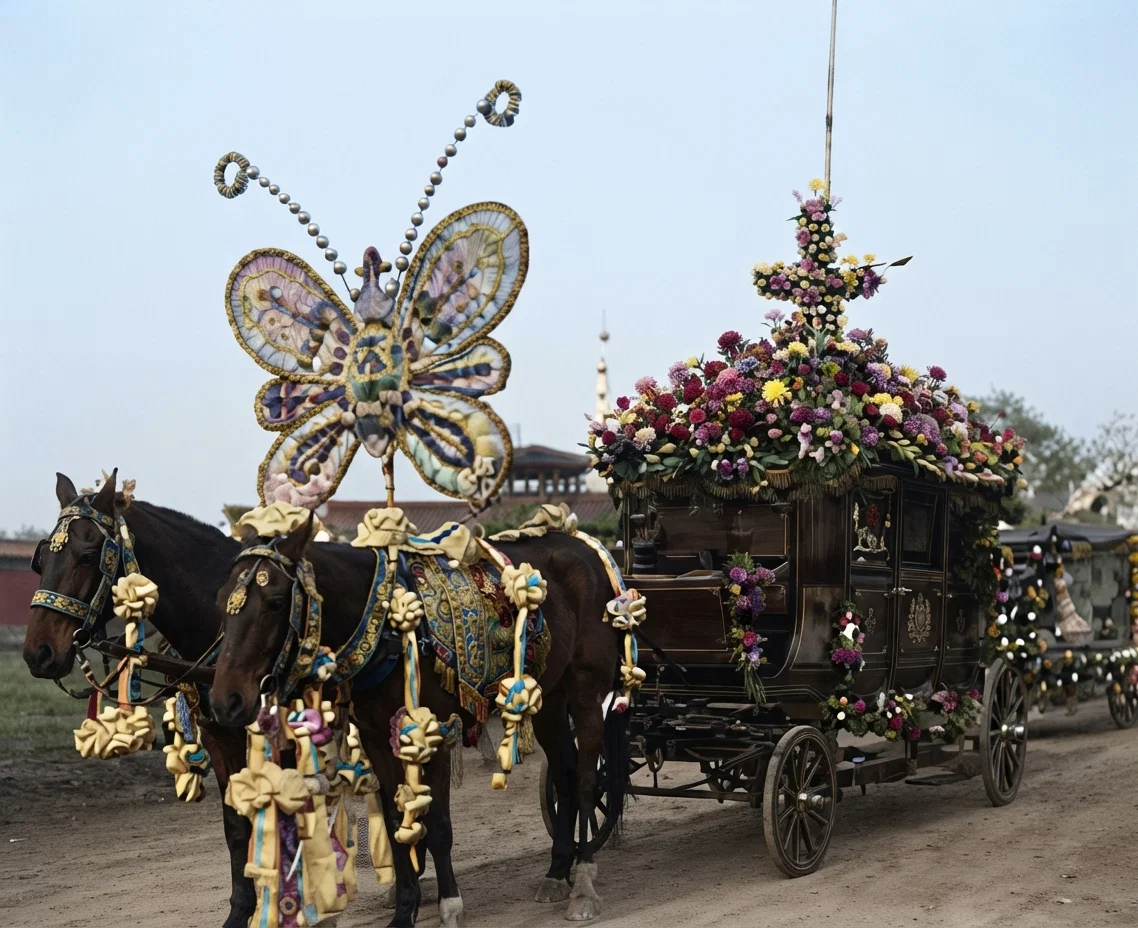
The following Sunday his coffin was carried through the streets of the city in a foreign style hearse loaded with flowers, and almost the whole city turned out to the demonstration. Great excitement prevailed. Mass-meetings were called. The Kuo-ming-tang leaders openly accused the government and Yuan Shih Kai of the responsibility of his murder. Resolutions were adopted calling on the national assembly to impeach the president, and calling upon all the provinces to stop remitting money to the central government.
One man got up on the platform, and after speaking until he was in a frenzy of excitement, whipped out a big knife and chopped off the end of his finger and with the blood wrote on the wall: "I solemnly swear to cut off the head of the nation's chief to vindicate the general hatred."
A foreign style hearse, showing the changing customs of the new republic; decorated with flowers; used by wealthy Chinese in Shanghai
The next few days witnessed scenes of the gravest disorder, which caused great apprehension to the foreign diplomats and others interested in the welfare of China. Inflammatory literature of a sanguinary character appeared on the streets, calling upon the people to arise and avenge themselves; troops were collected at various points, and to all appearances it seemed that the country was right on the verge of a counter revolution which would be more severe and bloody than the last one, the country hopelessly divided between the north and the south.
Just at this point Yuan Shih Kai took hold with a strong hand, and disregarding popular sentiment and private threats, made one bold diplomatic stroke which undoubtedly saved the country from disintegration and ruin and made him complete master of the situation. He closed the deal for the
Quintuple Loan
This loan, briefly speaking, is an agreement between the Quintuple Banking Group,
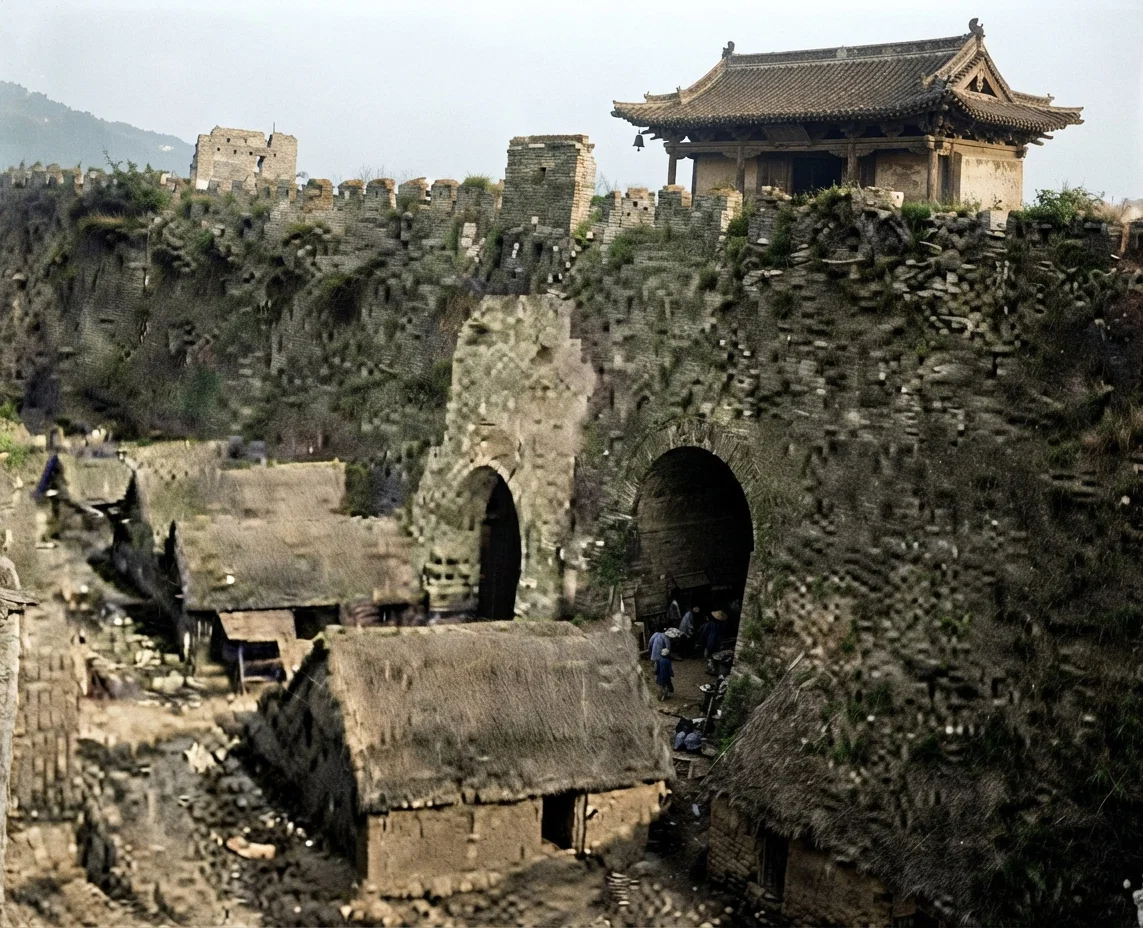
Nanking wall and Taiping Gate, where the Revolutionist soldiers entered the city
representing the five great powers of Great Britain, Germany, France, Russia, and Japan, to make a loan to the Chinese government of £21,000,000, to run for fifty years. The nominal price is 89, but the banking syndicate will receive a commission of five per cent, so that China will get but 84. The rate of interest is five per cent, and China has the option of converting or redeeming the loan at par after fifteen years by giving six months' notice.
With certain reservations the loan funds are to be used exclusively for seven purposes, as follows:
For the liabilities of the Chinese government.
For the redemption of outstanding provincial loans.
For the payment of losses arising during the revolution.
For the disbandment of troops.
For the redemption of other specified provincial liabilities.
For current administration expenses.
For the reorganization of the salt administration.
While wholly secured on the salt gabel, subject to the previous loans, etc., this loan constitutes a direct obligation on the Chinese government, and any surplus of the maritime customs — after paying all obligations upon the customs — will be utilized for the payment of this loan.
The loan was opened to subscribers upon the Bourse in Paris, and in London, Berlin, and other European financial centers, on the 20th of May, and closed three days later, being twelve times oversubscribed. This was the more remarkable considering the fact that the money market in Europe has been tight ever since the beginning of the Balkan war, and it is taken as a good omen of the confidence which is placed in the Chinese republic and the ability of the present administration to make good in the future.
The systematization of accounts under foreign supervision which is required under the loan agreement, while vigorously objected to by those who were privileged to disburse the funds and who have in the past enriched themselves with the "squeeze," is unquestionably a wholesome check upon avaricious officials, and will result in a great advantage to the nation generally.
The application of modern methods to the administration of the salt gabel, may be expected to produce, in due season, as happy results as have followed foreign supervision in the maritime customs.
The custom receipts for the year 1912 are most gratifying, the surplus, after meeting all obligations and loans secured on the custom revenues, amounting to £1,581,248. That trade has shown such vitality during an unsettled period, certainly augurs well for the future when orderly government is established.
The crops throughout the land have as a rule been exceptionally full ones, and to this as much as anything China owes her present stability, for after all is said and done, it is not the petty politician playing checkers in the gallery of fame, neither is it the tin soldier with his brass buttons and loaded rifle in hand, that marks the real rise and fall of nations. If you will seek for the true heart of the nation from which pulsate the life-giving streams of commerce and manufactures, you will find here in China as in other lands it can be traced "back to the land," to "the man with the hoe."
Withdrawal of the United States
The negotiations which led up to the signing of this loan have covered a period of nearly a year and a half. Several times a tentative agreement had been reached only to be broken up before the signatures could be affixed. When it started there were only four powers interested; namely, Great Britain, United States, Germany, and France. After some time Russia and Japan were admitted. The real reason, so far as China was concerned, was in the hope that these two powers would in that way be prohibited from independently operating upon their "spheres of influence" — Mongolia and Manchuria — in a way adverse to the interests of the new republic.12
The thus constituted six-power group all but completed the negotiation of the sextuple loan last February; the terms were published and all was ready for the final signatures, when the French minister announced that France was unwilling to go on with the loan unless a Frenchman was appointed as one of the advisers. This proved the last straw to the Chinese, who took from this incident a substantiation of their suspicions which they had entertained all along that the loan was not so much to help China as it was to help the other nations, and it would eventually end in the partition of the Chinese nation between the six great powers. They therefore immediately called it off, and the negotiations were at an end until early in April. In the meantime President Wilson came into office, and in accordance with former Secretary of State Hay's policy of the "open door," the American group withdrew from the loan, thus leaving the five great powers which succeeded in culminating the quintuple loan, the final signatures being affixed at three o'clock Sunday morning, April 27, 1913.
A Cause of Dissatisfaction
The final signing of the agreement was under circumstances dramatic in the extreme. The loan was initialed by the bankers and the Chinese minister of finance at three o'clock on Saturday afternoon, and it was arranged that it should be signed at ten o'clock the same night.
While the bankers, who had gathered at the office of the Hongkong-Shanghai Bank, were actually awaiting the arrival of the Chinese ministers to sign the contract, a deputation of Kuo-ming-tang members of the senate, headed by Mr. C. T. Wang, appeared and demanded an interview. They were admitted, and they formally protested against the signing of the loan before the contract had been submitted to and ratified by the national parliament. The bankers explained that matters had now gone too far for them to draw back; the members of the senate withdrew and loitered outside the premises waiting to see if the government would dare to sign the contract in defiance of their protest.
They had not long to wait, however, as the premier, the minister of finance, and the minister of foreign affairs soon arrived at the bank, and after a few minor details had been settled, affixed their signatures and the deed was done. Fearing an attack, permission was granted for 600 troops to enter the legation quarters, and they escorted the Chinese signatories to their homes, at three o'clock in the morning.
On Sunday morning, when it became known that the loan had actually been signed, a violent storm of protest arose from all sides, even Dr. Sun Yat Sen joining in the chorus of repudiation and sending a telegram to all European countries prophesying ruin to the Chinese nation if the loan was carried through. A Peking paper published the fact with the comment that "Yuan Shih Kai, after exhausting the sweat and blood of the nation, was now mortgaging its skin and bones."
The senate and house held a joint session and unanimously declared the loan to be unconstitutional. How this could be a fact when they had not yet adopted a constitution, they did not undertake to explain. If the congress had properly organized themselves and had been in shape to do legal business there is no doubt but the proposition would have been submitted to them for their approval or refusal; but altho they had then been in session twenty days, they had not yet succeeded in even electing their speakers, so Yuan Shih Kai, tired out with their bickering and quarreling, took the matter into his own hands, and on the authority of the provisional assembly, which will stand until the permanent parliament is fully organized, he went ahead and concluded the loan.
Position and Ambitions of President Yuan
His position is now regarded as unassailable. His troops command all strategic points in North China; his presidential orders are carried out as law by the larger part of the provincial tu-tuhs, or governors, who in the majority of cases are his own appointees. He now has the money to pay his troops and carry on a reorganization of the country, and it is safe to say that the majority of the people at large are with him; not, however, because they like to be, but because they realize that there is no other man who can take his place at this time. The only real opposition he has to face now is from the Kuo-ming-tang, or people's party, and their wild threats will never be carried into execution, for the reason that they can not raise enough money. The soldiers here will fight for the man who will pay them the most money, and that man now is Yuan Shih Kai. He is supreme—and he knows it.
Here are a few of President Yuan's pointed comments which he gave out a few days ago in an interview with a reporter from the "China Press," Shanghai:
"The chief need of China is peace, within and without."
"Our problem is to adapt republican institutions to the needs of the Chinese people."
"Trade can not thrive when the country is in disorder, and when law and property rights are not respected."
"There are really no serious differences between the north and the south. They are the inventions of designing politicians, and this government can not accept the lurid fulminations of politicians as the will of the people."
When told that some people said that he wished to be another Napoleon, he laughed and said:
"Yes, I know they say that, but they are wrong. I have taken Washington, not Napoleon, as my model. Who is the most admired figure in history? Is it Napoleon, or any king or emperor?—No, it is Washington. What did Napoleon leave?—A torn and wasted country. What did Washington create?—A great and free nation. Why should I want to be a Napoleon, when I might become another Washington?"
"In regard to reforms, it is necessary to reorganize the revenue system and the methods of taxation; also the currency. These reforms are necessary to make others feasible. Productive enterprises should be encouraged, and the resources of the country developed, so that the people may become prosperous. Prosperity of the people is the true foundation of true government."
When asked if he thought that recognition by the United States would be of any practical help to China, he replied: "I believe it will be; sentiment plays a great part in the affairs of humanity and of nations. This act of America can not fail to stimulate our people to make effort to deserve the trust."