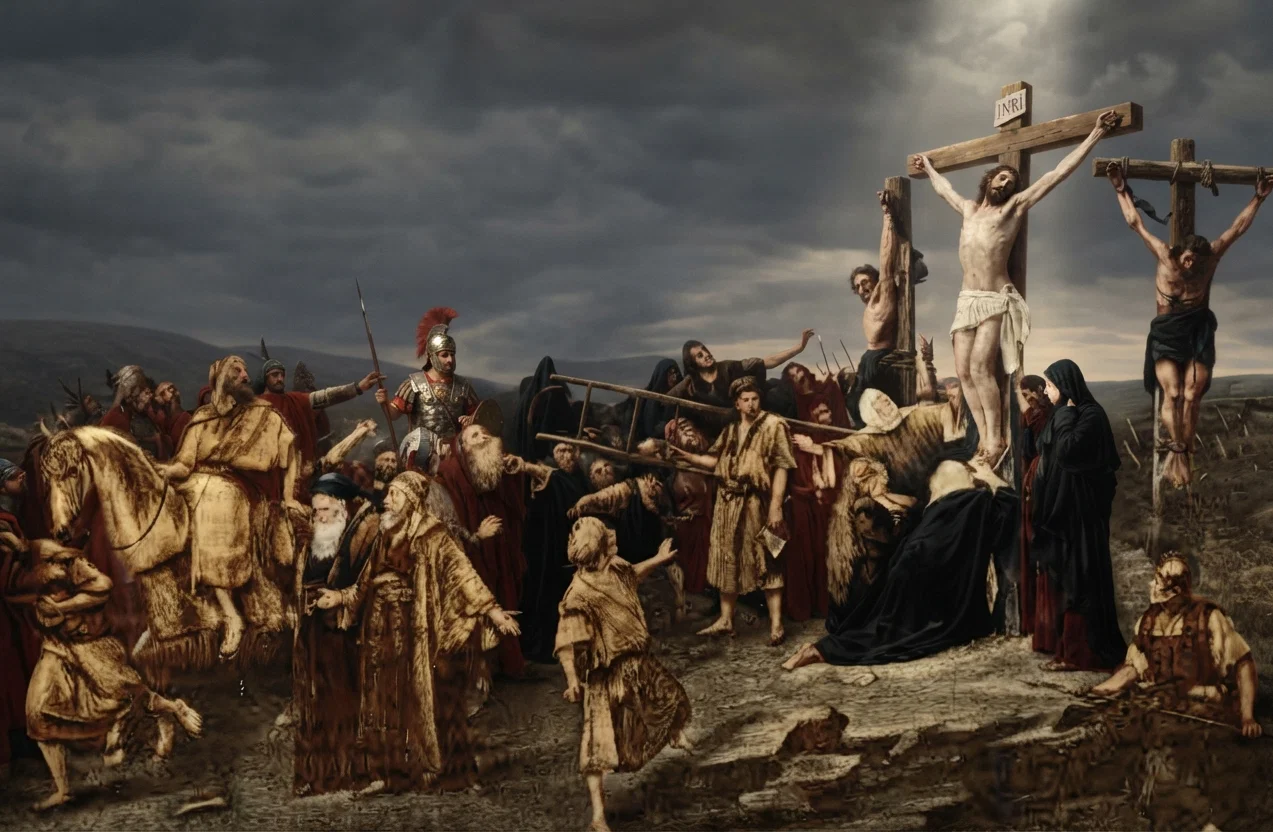
Unfallen Worlds Join with Angels in Rejoicings of Victory — Evil Men and Fallen Angels in Human Form Hurl Their Furies Against the Man of Calvary, but to No Effect — The Sublime Climax Proclaimed, "It Is Finished"
By MRS. E. G. WHITE
THAT He might sanctify the people with His own blood," Christ "suffered without the gate." "And when they were come to the place, which is called Calvary, there they crucified Him." For transgression of the law of God, Adam and Eve were banished from Eden. Christ, our Substitute, was to suffer without the boundaries of Jerusalem. He died outside the gate, where felons and murderers were executed. Full of significance are the words, "Christ hath redeemed us from the curse of the law, being made a curse for us."
In Agonies of Suffering He Prays for His Tormentors
At the place of execution, the prisoners were bound to the instruments of torture. The two thieves wrestled in the hands of those who placed them on the cross; but Jesus made no resistance. His face remained calm and serene, but great drops of sweat stood upon His brow. There was no pitying hand to wipe the death-dew from His face, nor words of sympathy and unchanging fidelity to stay His human heart. While the soldiers were doing their fearful work, Jesus prayed for His enemies. "Father, forgive them; for they know not what they do." His mind passed from His own suffering to the sin of His persecutors, and the terrible retribution that would be theirs. No curses were called down upon the soldiers who were handling Him so roughly. No vengeance was invoked upon the priests and rulers, who were gloating over the accomplishment of their purpose. Christ pitied them in their ignorance and guilt. He breathed only a plea for their forgiveness,—"for they know not what they do."
Had they known that they were putting to torture One who had come to save the sinful race from eternal ruin, they would have been seized with remorse and horror. But their ignorance did not remove their guilt; for it was their privilege to know and accept Jesus as their Saviour. Some of them would yet see their sins, and repent and be converted. Some by their impenitence would make it an impossibility for the prayer of Christ to be answered for them. Yet, just the same, God's purpose was reaching its fulfilment. Jesus was earning the right to become the Advocate of men in the Father's presence.
The Raging of Men, and of Demons in Human Form
The enemies of Jesus vented their rage upon Him as He hung upon the cross. Priests, rulers, and scribes joined with the mob in mocking the dying Saviour. "If Thou be the Son of God," they said, "come down from the cross." "Let Him save Himself, if He be Christ, the chosen of God." In the wilderness of temptation Satan had declared, "If Thou be the Son of God, command that these stones be made bread." "If Thou be the Son of God, cast Thyself down" from the pinnacle of the temple. And Satan with his angels, in human form, was present at the cross. The arch-fiend and his hosts were cooperating with the priests and rulers. The teachers of the people had stimulated the ignorant mob to pronounce judgment against One upon whom many of them had never looked, until urged to bear testimony against Him. Priests, rulers, Pharisees, and the hardened rabble were confederated together in a satanic frenzy. Religious rulers united with Satan and his angels. They were doing his bidding.
Jesus, suffering and dying, heard every word as the priests declared, "He saved others; Himself He can not save. Let Christ the King of Israel descend now from the cross, that we may see and believe." Christ could have come down from the cross. But it is because He would not save Himself that the sinner has hope of pardon and favor with God.36
The Prince of Sufferers and His Abhorrence of Sin
The Lord of glory was dying, a ransom for the race. In yielding up His precious life, Christ was not upheld by triumphant joy. All was oppressive gloom. It was not the dread of death that weighed upon Him. It was not the pain and ignominy of the cross that caused His inexpressible agony. Christ was the Prince of sufferers; but His suffering was from a sense of the malignity of sin, a knowledge that through familiarity with evil, man had become blinded to its enormity. Christ saw how deep is the hold of sin upon the human heart, how few would be willing to break from its power. He knew that without help from God, humanity must perish, and He saw multitudes perishing within reach of abundant help.
Upon Christ as our substitute and surety was laid the iniquity of us all. He was counted a transgressor, that He might redeem us from the condemnation of the law. The guilt of every descendant of Adam was pressing upon His heart. The wrath of God against sin, the terrible manifestation of His displeasure because of iniquity, filled the soul of His Son with consternation. All His life Christ had been publishing to a fallen world the good news of the Father's mercy and pardoning love. Salvation for the chief of sinners was His theme. But now with the terrible weight of guilt He bears, He can not see the Father's reconciling face. The withdrawal of the divine countenance from the Saviour in this hour of supreme anguish pierced His heart with a sorrow that can never be fully understood by man. So great was the agony that His physical pain was hardly felt.
His Sense of Sin Was the Bitterness in the Cup
Satan with his fierce temptations wrung the heart of Jesus. The Saviour could not see through the portals of the tomb. Hope did not present to Him His coming forth from the grave a Conqueror, or tell Him of the Father's acceptance of His sacrifice. He feared that sin was so offensive to God that their separation was to be eternal. Christ felt the anguish which the sinner will feel when mercy shall no longer plead for the guilty race. It was the sense of sin, bringing the Father's wrath upon Him as man's substitute, that made the cup He drank so bitter, and broke the heart of the Son of God.
Inanimate Nature and Unfallen Beings Aghast
With amazement angels witnessed the Saviour's despairing agony. The hosts of heaven veiled their faces from the fearful sight. Inanimate nature expressed sympathy with its insulted and dying Author. The sun refused to look upon the scene. Its full, bright rays were illuminating the earth at midday, when suddenly it seemed to be blotted out. Complete darkness, like a funeral pall, enveloped the cross. "There was darkness over all the land unto the ninth hour." There was no eclipse or natural cause for this darkness, which was as deep as midnight, without moon or stars. It was a miraculous testimony given by God that the faith of after generations might be confirmed.
In that thick darkness God's presence was hidden. He makes darkness His pavilion, and conceals His glory from human eyes. God and His holy angels were beside the cross. The Father was with His Son. yet His presence was not revealed. Had His glory flashed forth from the cloud, every human beholder would have been destroyed. And in that dreadful hour Christ was not to be comforted with the Father's presence, therefore He trod the wine-press alone, and of the people there was none with Him.
Struck with Awe and Terror
The silence of the grave seemed to have fallen upon Calvary. A nameless terror held the throng that was gathered about the cross. The cursing and reviling ceased in the midst of half-uttered sentences. Men, women, and children fell prostrate upon the earth. Vivid lightnings occasionally flashed forth from the cloud, and revealed the cross and the crucified Redeemer. Priests, rulers, scribes, executioners, and the mob, all thought that their time of retribution had come. After a while some whispered that Jesus would now come down from the cross. Some attempted to grope their way back to the city, beating their breasts and wailing in fear.
At the ninth hour the darkness lifted from the people, but still enveloped the Saviour. It was a symbol of the agony and horror that weighed upon His heart. No eye could pierce the gloom that surrounded the cross, and none could penetrate the deeper gloom that enshrouded the suffering soul of Christ. The angry lightnings seemed to be hurled at Him as He hung upon the cross. Then "Jesus cried with a loud voice, saying, Eloi, Eloi, lama sabachthani?" "My God, My God, why hast Thou forsaken Me?" As the outer gloom settled about the Saviour, many voices exclaimed, "The vengeance of Heaven is upon Him. The bolts of God's wrath are hurled at Him, because He claimed to be the Son of God." Many who believed on Him heard His despairing cry. Hope left them. If God had forsaken Jesus, in what could His followers trust?
Mocking Priests Refuse Him Water
When the darkness lifted from the oppressed spirit of Christ, He revived to a sense of physical suffering and said, "I thirst." One of the Roman soldiers, touched with pity as he looked at the parched lips, took a sponge on a stalk of hyssop, and dipping it in a vessel of vinegar, offered it to Jesus. But the priests mocked at His agony. When darkness covered the earth, they had been filled with fear; as their terror abated, the dread returned that Jesus could escape them. His words, "Eloi, Eloi, lama sabachthani," they had misinterpreted. With bitter contempt and scorn they said, "This man calleth for Elias." The last opportunity to relieve His sufferings they refused. "Let be," they said, "let us see whether Elias will come to save Him."
In the silence the beholders watched for the end of the fearful scene. The sun shone forth; but the cross was still enveloped in darkness. Priests and rulers looked toward Jerusalem; and lo, the dense cloud had settled over the city and the plains of Judea. The Sun of righteousness, the Light of the world, was withdrawing His beams from the once favored city of Jerusalem. The fierce lightnings of God's wrath were directed against the fated city.
The Triumphant Proclamation, "It Is Finished"
Suddenly the gloom lifted from the cross, and in clear, trumpet-like tones that seemed to resound throughout creation, Jesus cried, "It is finished." "Father, into Thy hands I commend My spirit." A light encircled the cross, and the face of the Saviour shone with a glory like the sun. He then bowed His head upon His breast and died.
Amid the awful darkness, apparently forsaken of God, Christ had drained the last dregs in the cup of human wo. In those dreadful hours He had relied upon the evidence of His Father's acceptance heretofore given Him. He was acquainted with the character of His Father; He understood His justice, His mercy, and His great love. By faith He rested in Him whom it had ever been His joy to obey. And as in submission He committed Himself to God, the sense of the loss of His Father's favor was withdrawn. By faith Christ was victor.
The Conqueror Plants His Banner on the Heights of Eternity
Christ did not yield up His life till He had accomplished the work which He came to do, and with His parting breath He exclaimed, "It is finished." The battle had been won. His right hand and His holy arm had gotten the victory. As a conqueror He planted His banner on the eternal heights. Was not there joy among the angels? All heaven triumphed in the Saviour's victory. Satan was defeated, and knew that his kingdom was lost.
To the angels and the unfallen worlds the cry, "It is finished," had a deep significance. It was for them as well as for us that the great work of redemption had been accomplished. They with us share the fruits of Christ's victory.
Satan's Character Now Fully Revealed
Not until the death of Christ was the character of Satan clearly revealed to the angels or to the unfallen worlds. The arch-apostate had so clothed himself with deception that even holy beings had not understood his principles. They had not clearly seen the nature of his rebellion. Had Satan and his host been left to reap the full result of their sin, they would have perished, but it would not have been apparent to heavenly beings that this was the inevitable result of sin. A doubt of God's goodness would have remained in their minds as evil seed, to produce its deadly fruit of sin and wo.
But not so when the great controversy shall be ended. Then, the plan of redemption having been completed, the character of God is revealed to all created intelligences. The precepts of His law are seen to be perfect and immutable. Then sin has made manifest its nature, Satan his character. Then the extermination of sin will vindicate God's love and establish His honor before a universe of beings who delight to do His will, and in whose heart is His law.
Well, then, might the angels rejoice as they looked upon the Saviour's cross; for though they did not then understand all, they knew that the destruction of sin and Satan was forever made certain, that the redemption of man was assured, and that the universe was made eternally secure. Christ Himself fully comprehended the results of the sacrifice made upon Calvary. To all these He looked forward when upon the cross He cried out, "It is finished."