The “Western Watchman” (Roman Catholic), which has a very able correspondent in Rome, declares: “For the past two years the Holy See has taken pains on several occasions to reaffirm its claims in favor of independence in the fullest sense of the word, and of the temporal power as the indisputable right of the sovereign pontiff. With excellent reason, Pius the Tenth has stated the position of Christ’s vicar as it is and as it ought to be, for Italian monarchists have feigned to believe the Roman question to be a thing of the past, the status quo to be accepted by all concerned, and the present abnormal condition of the pope to be almost the only one possible under the circumstances. And now many of them would go a step further, and hint the claim to temporal power is being relaxed at the Vatican, and that for independence is substituted, as if one does not include the other in this case.”
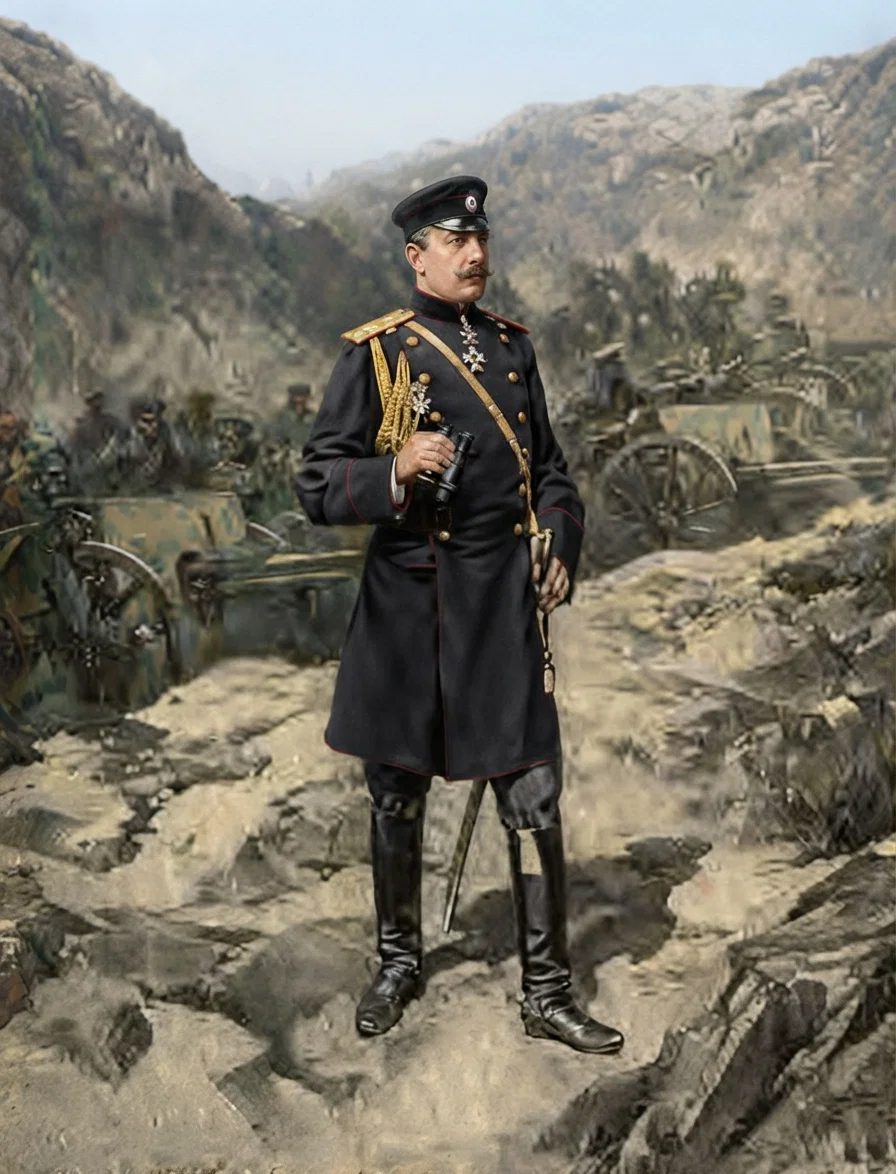
General Savoff, the commander-in-chief of the Bulgarian army, under the general direction of King Ferdinand. He has received a part of his training in the Russian Military School. He is fifty years of age. (From "Illustrated London News")
Because of more or less misunderstanding regarding this, even in Roman Catholic circles, it has been thought that all claims to temporal power are to rest, and a new formula on the necessity of independence was to be devised. But the correspondent declares:
“We at once state that no order of the kind has come to us. Besides, this question has remained, and does remain, unchanged by years and events.”
And then he quotes a paragraph from Leo XIII, directed to Cardinal Rampolla, secretary of state, on June 15, 1887, as follows:
“Up to this, the only means used by Providence to guard as was necessary the liberty of the popes, was their temporal sovereignty. When this means failed, the pontiffs were always persecuted, or prisoners, or exiles, or certainly in a condition of dependence, and in continual peril of seeing themselves driven out on one or other of these ways. The whole history of the church attests this.”
And the correspondent declares:
“This is the mind of Leo XIII, and this has been followed in all his whole policy by the reigning pontiff, Pius X. As one can plainly see, it is impossible to divide at present the two questions, since one identifies itself with the other.”
To this agrees the editor of the “Western Watchman” in the same issue.
The “Watchman’s” correspondent from London, in the same issue, also discusses the same question. There have been certain Englishmen who have been making a pilgrimage to the “holy father,” and among these are the duke of Norfolk, who stands at the head of the Catholic Union of Great Britain, and who —
“never fails, on any public occasion suitable, to reiterate the just demand for papal independence. The duke himself has often voiced such sentiments before, in the time of Pope Leo as well as the present pontiff, and if he confidently asserted this on this occasion, that the day of restoration would yet dawn, at which 500 pilgrims cheered lustily, is it any more extravagant than the rumored intention of the present king of Italy to revive in his own favor the title of Roman emperor?”
All of which is working toward the solution of the temporal sovereignty, which must lie, it would seem, outside of Italy, in view of Italy’s antagonism to an empire within her empire. Yet Italy is Roman Catholic, and would do all in her power to place the pope on vantage-ground outside of Italy.