THE hand of sin has written death around the circle of the world. The owl and bittern are droning the epitaph of human greatness on the sites of ancient cities. Where once the cohorts of kings clanked through marble halls, the shifting sands are deepening now under the feet of desert winds. "Passing Away" is graven with the finger of Time on all that man's hands have reared since the flowers of Eden faded and fell under the blistering touch of sin.
The winding-sheet has covered Nineveh, and her sun-baked bricks have crumbled back to the dust from whence they came. The marble temple of Karnak—most magnificent monumental structure ever reared by man—is humbled in the dust, and her pillars rise out of a sea of sand like the masts of sunken ships. The pyramids of Ghizeh, built to defy time and tempest, are yielding reluctant witness to the transitory existence of man and all that man has made.
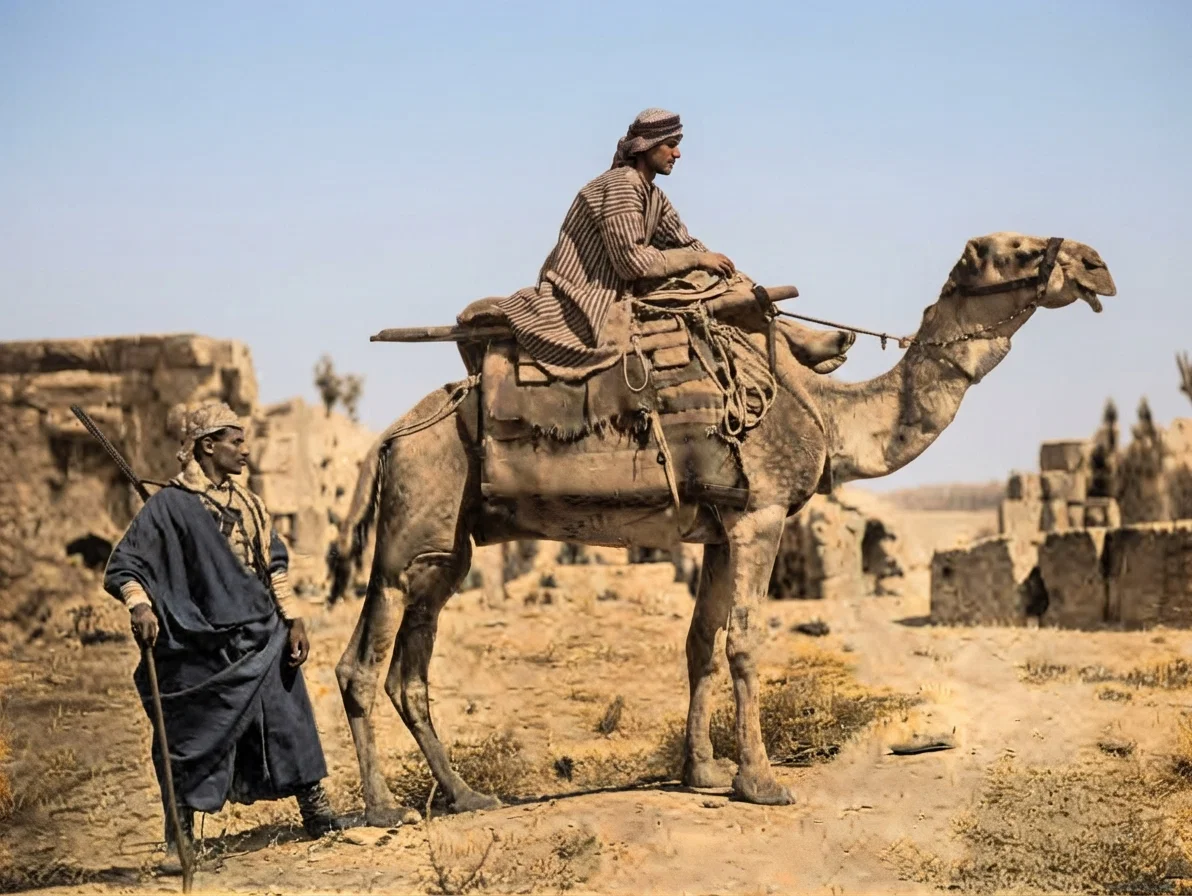
ARABS ROAMING AMONG EGYPTIAN RUINS.
But these are not all. Every country in the world has its prehistoric records, in crumbling ruins, or chisel tracings in time-worn stone, translated or still unread. The architecture of Egypt is contemporaneous with the bramble-covered and tree-capped ruins of Central America. The mound-builders and the cliff-dwellers were busy with their pottery and their idols when the Cymri were roaming over ancient Europe; when Gog and Togarmah were powers in the earth, and when the Incas and the Aztecs were reveling in riches and idolatry, sacrificing human beings to the Molechs of the western world. While the American Indian was creating poetic legends for his posterity, the people of ancient Memphis and Babylon were reading their horoscopes and studying the secrets of the stars from pyramid and Babel tower.
Now the Turk, the Arab, the Egyptian, the Maya, the Navajo, and the white man, roam over the ruined temples of their ancestors, and learn, if they will, the lesson which the ruins teach. It is the lesson of the thorn and the bramble, the thistle and the tare. Disobedience to the Architect of the universe has strewn the ruins of human architecture over the surface of the earth. As Adam read the result of the fall in the weariness of the flesh through his combat with the thorn and thistle, so do his posterity read it in the wrecks of human handiwork from Mexico to Nineveh, in Tyre and Memphis, in Thebes and Carthage.2
The curse of sin hangs heavy on the world. All that art and wealth could bring were lavished on the idol temples of Thebes and Memphis, of Carthage, Tyre, and Babylon, wherein immorality deified lust, and the human worshiped the human through Baal, Molech, and Ashtaroth. The beautiful mosaics in the temples of ancient Carthage (older than Tyre and Rome) were executed to the honor of heathen gods; the beautiful sculpture exhibited in the marble ruins of Karnak ascribe worshipful praise to the sun-god, the crocodile, and the sacred beetle.
But God declared: "I am against Pharaoh king of Egypt, and will break his arms;" "The sword shall come upon Egypt, and great pain shall be in Ethiopia;" "They also that uphold Egypt shall fall;" "They shall be desolate in the midst of the countries." "I will also destroy the idols, and I will cause their images to cease out of Noph [Memphis]; . . . and will execute judgments in No [Thebes]. . . . I will pour My fury upon Sin, the strength of Egypt." Ezekiel 30. "I will punish the multitude of No, and Pharaoh, and Egypt, with their gods, and their kings." Jer. 46:25. "I will make the land of Egypt utterly waste and desolate, from the tower of Syene even unto the border of Ethiopia." Eze. 29:10.
And her punishments came in fire and sword from the delta to Ethiopia, as God had declared. God had set Himself against her idols and her idol temples, and she has become the "basest of kingdoms;" and now the cry of her people for bakshish is heard wherever a stranger sets foot upon her soil. From glory to dishonor, from wealth to beggary, she has fallen through devotion to her idols.
Babylon, her sister in sin, the patron of Baal, the envy of the nations,—Babylon, the "glory of the Chaldees' excellency," has sunk into forgotten mounds, crushed beneath the ponderous idols Jehovah has overthrown. Babylon would build to heaven a gateway of her own; but God smote her tower and confounded the tongue of her people. Babylon would trust in gods of her own creation; and Jehovah buried her among their shattered ruins. In pronouncing woe upon Babylon for her wickedness, the Lord had said, "I will also make it a possession for the bittern, and pools of water; and I will sweep it with the besom of destruction." Isaiah 14:23.
The besom of destruction has swept the site of that ancient city; for God has punished Babylon, as He said He would do. Jehovah said, "Thou shalt have no other gods before Me;" but Babylon was filled with idols and wickedness. Jehovah said, "Thou shalt not bow down thyself to them nor serve them;" but Babylon's service was wholly in her idol temples—she had forgotten God, or "glorified Him not as God;" but changed His glory "into an image made like to corruptible man, and to birds, and four-footed beasts, and creeping things." Rom. 1:21, 23. Thus suffered the idolatrous nations for forsaking God and turning from His commandments to the commandments of men.
The lesson of the ruins is this: God will not permit the breaking of His law. The nations who have thus trespassed have fallen among the ruins of their temples. God is the same yesterday, to-day, and forever. The law of His kingdom is as immutable as the kingdom itself is eternal. The nations and peoples who forget Him now and turn from His law will perish as did the nations of old. The Lord tells us plainly that all His "commandments are righteousness;" that that "righteousness is an everlasting righteousness;" "and every one of Thy righteous judgments endureth forever." Ps. 119:172, 142, 160. "All His commandments are sure. They stand fast forever and ever." Ps. 111:7, 8.
If "every one" of those judgments, or commandments, endure forever, then "every one" of those "ten words" are as binding upon the people of this age as they were upon the condemned and executed ancients. If God "visited" them for their transgressions, He will not pass over the breaking of His law by their remote descendants of the present day. The ancients are telling us this through the ruins of their overturned temples. God's declaration of their punishment and their mute witness to its execution, leave us without excuse in tampering with His law, or breaking even one of its precepts.
Destruction is still decreed for "the nations that forget God," the destruction of the last day. Ps. 9:17. It is the destruction of the "day of the Lord," "in the which the heavens shall pass away with a great noise," and "the earth also and the works that are therein shall be burned up." 2 Peter 3. Then will the earth in its entirety lie as desolate as Carthage and Nineveh now are (Isaiah 34), until the New Jerusalem descends "from God out of heaven, prepared as a bride adorned for her husband," to become the capital of a renewed, re-created earth. Then will the curse be wiped away. The ruins of the temples of sin will be seen no more. The deserts will blossom as the rose (Isaiah 35); and those who have yielded to God, and have obeyed His Word, will dwell in that land forever.
Let us learn the lesson which God has for us in the destruction He has brought upon the nations that trampled on His law.