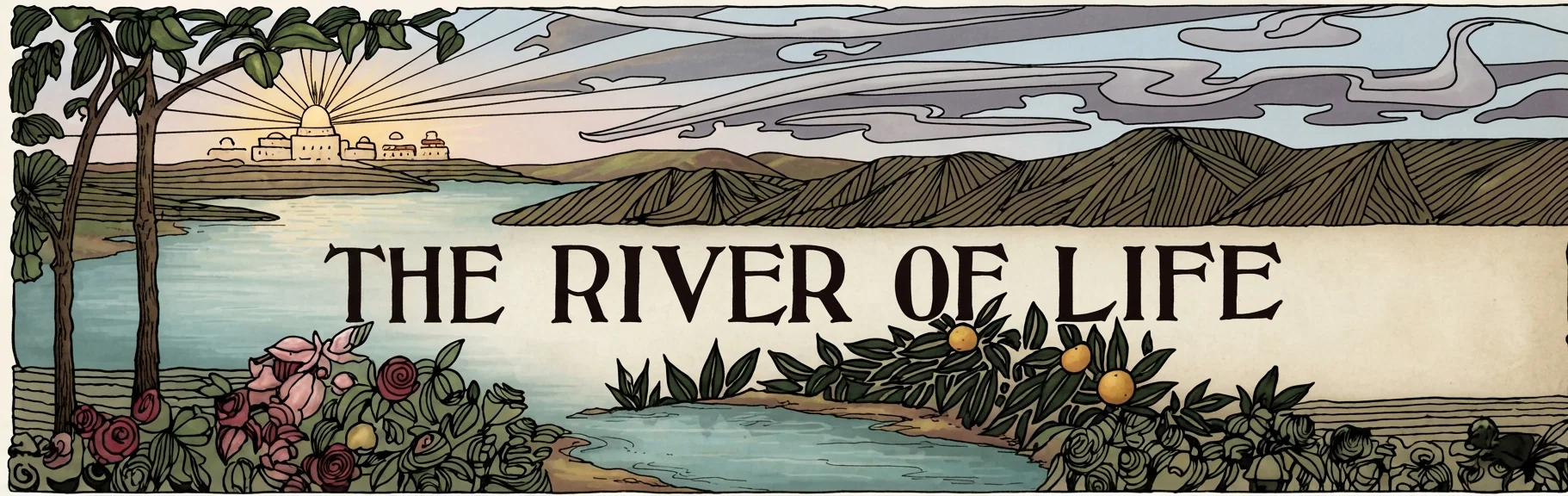
THE RIVER OF LIFE

6%

Pacific Press Publishing Company · Oakland, California · Aug 1, 1900

FromSigns of the Times, Vol. 26, No. 31.

Read the full edition

THE RIVER OF LIFE

THE TREE BY THE RIVER.

“IN the midst of the street of it, and on either side of the river, was there the tree of life, which bare twelve manner of fruits, and yielded her fruit every month; and the leaves of the tree were for the healing of the nations.” Rev. 22:2.
It has been made plain, we trust, that, in a spiritual sense, the river of life is in the earth to-day, flowing constantly from the throne, and that all are invited to partake of its waters. If the river is here, it is reasonable to believe that in the same sense the tree of life is here also, for the tree grows by the river. What, then, is the present significance of the tree of life? This is the theme for this paper.
Already we have seen that Christians who know God for themselves, having had a personal experience in divine things, are called “trees of righteousness, the planting of the Lord.” Of such a Christian, David speaks thus, “He shall be like a tree planted by the rivers of water, that bringeth forth his fruit in his season; his leaf also shall not wither; and whatsoever he doeth shall prosper.” And the prophet Jeremiah is still more explicit: “Cursed be the man that trusteth in man, and maketh flesh his arm, and whose heart departeth from the Lord. For he shall be like the heath in the desert.” This describes all who depend upon human mediation, all who do not come into the primary circuit of blessing, all who seek their supply of living water from others. Then he describes those who come to God for themselves: “Blessed is the man that trusteth in the Lord, and whose hope the Lord is. For he shall be as a tree planted by the waters, and that spreadeth out her roots by the river, and shall not see when heat cometh, but her leaf shall be green; and shall not be careful in the year of drought, neither shall cease from yielding fruit.” Every thoughtful mind must recognize a very striking likeness between this picture of a living, growing Christian, and John’s description of the tree of life growing by the river of life.
But some one may object, and say that the Bible does not call the Christian a tree of life, but only a tree planted by the river. The reply is, that it is clear, from all that has been said, that this river by which the tree is planted, is the river of life. And if so, this tree living by its living waters, and sending them forth through the leaves to bless others, must be a tree of life. In the Bible, righteousness and life are interchangeable terms. Spiritual life is righteousness, and righteousness is spiritual life. So, when the Christian is called a tree of righteousness, he is called a tree of life. Again, God made everything bear fruit “after its kind.” The final fruit of anything is another thing like itself. But, says the Scripture, “The fruit of the righteous is a tree of life.” Prov. 11:30. If the fruit of the righteous is a tree of life, the righteous man himself must be a tree of life in order to yield such fruit.
But, it may be said, there are many righteous men, and the tree of life is one. Here is the deepest, sweetest mystery of all. May the dear Lord give us the spirit of wisdom and revelation in the knowledge of Him, that our hearts may behold its glory.
Ezekiel saw a vision of this same river of life flowing from the sanctuary, and he saw the trees of life growing by the banks of the river. He did not see, as did John, that these trees are one. Ezekiel said, “Behold, at the bank of the river were very many trees on the one side, and on the other.” And once more: “By the river upon the bank thereof, on this side and on that side, shall grow all trees for meat, whose leaf shall not fade, neither shall the fruit thereof be consumed; it shall bring forth new fruit according to his months, because their waters they issued out of the sanctuary; and the fruit thereof shall be for meat, and the leaf thereof for medicine.”
This is a beautiful figure. Christ the crucified, is the smitten Rock from which the living waters gush out. From the throne in the sanctuary, the river of spiritual life flows out into the whole universe, down even into this sinful world, which else were a moral desert. Every real Christian is a tree growing by the banks of this river, and rooted into its waters; a tree thus enabled to bear fruit constantly, not being “careful in the year of drought;” a tree, every rootlet of which is taking up the living water, hurrying it up through root and body and branch, to the leaves that send it out into the air, to come down again in showers to heal the barrenness of life’s desert; a tree whose fruit is so sweet that men, feeding upon it, may find God, and so become themselves trees of righteousness rooted into life’s river.
Ah, this is splendid! but there is something better even than this. After Ezekiel wrote, and before John wrote, Christ lived His matchless life of love incarnate. He identified Himself with all humanity, making it one in Him. He was “not ashamed to call them brethren,” saying, “Inasmuch as ye have done it unto one of the least of these My brethren, ye have done it unto Me.” He said: “I and My Father are one.” “Believest thou not that I am in the Father, and the Father in Me?” “I will pray the Father, and He shall give you another Comforter, that He may abide with you forever; even the Spirit of truth.” “When He, the Spirit of truth, is come, He will guide you into all truth.” “At that day ye shall know that I am in My Father, and ye in Me, and I in you.” “I am the vine, ye are the branches.” “Sanctify them through Thy truth; Thy Word is truth; . . . that they all may be one; as Thou, Father, art in Me, and I in Thee, that they also may be one in us; that the world may believe that Thou hast sent Me, . . . and hast loved them, as Thou hast loved Me.” Paul also pictured the church as the body of Christ,—one body, with Christ its head.
After all this glorious teaching of the wonderful unity there is for us in the Spirit, is it a wonder that when that Spirit spoke again of the tree of life, it was presented to John as one tree, growing on either side of the river? It would seem, however, that this was a conception so grand that even Inspiration could lift humanity to it only by degrees,—perhaps never fully, had not Christ lived and taught this unity in the flesh.
Now let us study the figure as John saw it. He saw a river flowing from the throne, and “on either side of the river, was there the tree of life, which bare twelve manner of fruits, and yielded her fruit every month; and the leaves of the tree were for the healing of the nations.” Nature presents an image of this tree as it was here revealed by the Spirit. The original trunk of the banyan tree puts out branches, which, drooping to the earth, take root, and become new trunks putting out in like manner more branches to again take root. Thus the tree sometimes covers acres, and spanning rivers, becomes a forest in itself. It is one tree, and yet there are many trees. All are united to the same original trunk; all are rooted into the same living water which courses through every root and trunk and branch and leaf of it all. What a glorious figure of the church of Christ, as it stands revealed by the Spirit in this age! Christ incarnate is the original trunk. When He was here in the flesh, He was as dependent upon the living water as are we. He said, “I can of Mine own self do nothing.” He is the original trunk, and every true Christian becomes a new tree, united through this trunk with every other Christian, and all rooted alike into the same unfailing supply of spiritual power. So the tree is one, one life coursing through it all.
The fruit of such a tree will be the fruits of the Spirit, for the water of this river by which the tree lives, is the Spirit. These fruits will be borne constantly, and will ripen continually, unhindered by any drought. These fruits are love, joy, peace, long-suffering, gentleness, goodness, faith, meekness, temperance, patience, courage, and hope,—twelve manner of fruits. He who sows this fruit as seed, will surely, as his reward, see growing other Christians, other life-trees, rooted into the same water, and united to the same trunk. The leaves of such a tree will all exhale the living water to come down in showers of blessings, thus healing the sin-sick nations, making earth’s moral desert blossom as the rose. What Christian does not look forward with longing unspeakable for the realization of this ideal? Jesus longed for it, and prayed for it when He prayed, “Sanctify them through Thy truth; . . . that they all may be one.” It will be realized, for that prayer will be answered, and He will have a church “not having spot, or wrinkle, or any such thing.”
Why do we fall so far short of realizing this ideal now?—It is because we are not all rooted into the living water, and are not all united fully to the original trunk. We are too far from Christ, and therefore too far from each other. For these reasons we are not one. The branches of the banyan tree not only root into the ground, but when two branches approach and touch, especially if they be bruised so that the sap oozes out, they will unite and grow together. Perhaps, therefore, when we are bruised by the persecution that is before us, the living water will flow out and we shall unite, and become one. How greatly our intuitions need quickening by the Spirit, ere this can fully be! Brothers in the same church now pass by, day after day and week after week, each unconscious of the other’s burden, and yet each is heart-full, and each is hungry for a word of cheer and courage. This would not be so if we could really know each other, and meet heart to heart, instead of only face to face.In every face is written a life’s history, with its comedy and tragedy, its power and its pathos. Almost any face would cause us to pause and grow tender rather than critical, could we only truly read it. But, alas! this writing is in the hieroglyphics of the heart, and in this age of hot competition and business strife, it has become an unknown tongue. But fellowship of suffering under persecution, and mutual communion of the Spirit, will translate into living language these hieroglyphics. Our intuitions will be so quickened, and our hearts so tendered, that we shall be one with Christ, and one with each other. There will be a community of joy, and a community of sorrow. Then they that fear the Lord shall speak often one to the other, and the Lord will harken and hear it, and pronounce them His. Thus the tree shall be one, with fruit-bearing branches and healing leaves.
But because the river of life, and the tree of life, in a spiritual sense, are in the world to-day, we must not disbelieve in the literal river and the literal tree in the Paradise of God. Who does not recall some river of his childhood, a stream, perhaps, flowing through the woodland, on whose banks he sported in early years, dear to him now by the memory of the past? So when Paradise is restored, with the literal river and the literal tree, and the ransomed of the Lord, from every nation and every tongue, are gathered home, that river and that tree will speak to them of all their triumphs in Christ during this child-life down here. When we reach that place, and see that river and that tree, it will not be new and strange there, but the heart will know its home. And Christ will be all, and in all.