PROF. JOHN FRYER, of the University of California, who is now in China, contributes an interesting article to Ainslee's Magazine for August, from which we take the following:—
"A serious difficulty the missionary in China has to contend with is the complicated form of the religion of the Chinese. Instead of one system of doctrines and teachings, there are three great and separate religions, dwelling side by side, and with little, if any, friction or want of harmony. Altho radically different in their origin, characteristics, and general aims, each seems to be a complement of the other. A Chinaman may select and follow as much of all three as he pleases, without being inconsistent. The missionary has, therefore, to study all three religions in their history, doctrines, and practical influence upon the heart and every-day life of the people, before he can hope to meet them on their own ground and answer all their objections to Christianity. He has three separate citadels to attack instead of one.
"The writings of Confucius are the source whence the officials and literati derive their theories of government and social duties. The ethics of Confucius pervade and influence every phase of Chinese life. The doctrines taught by their 'most holy sage' are cited as the infallible criterion of uprightness and integrity in public and private life, and were disseminated several centuries before the coming of Christ. They were not original with Confucius, but rather the teachings of the ancient kings and sages, who flourished in the far-off Golden Age of China, when the evils of bad government were unknown, and when the Chinese seem to have recognized and worshiped the true God. Confucius confessed to be only a reformer, a transmitter, and not the author of a new religion. But it is almost impossible to estimate the enormous hold this system, with its time-honored classics, now has upon the educated and thinking men of China. Its teachings are of a high moral order, yet they are as much disregarded in every-day affairs as Christ's teachings are disregarded among ourselves. The Chinese know what is right, but fail utterly to practise it.
"Then there is Taoism, the second form of religious faith and practise, originating with the philosopher Lao-tze, in the century when the Jews returned from Babylon. Its ancient classic, the Tao-teh-king, comes nearer to the philosophy of our Old Testament teachings than any other book in the world. Had this system remained in its original purity, it would have served as an excellent basis for Christianity. Unfortunately, the Taoists went astray, hunting for the philosopher's stone, the elixir of immortality, with other vague conceptions, and then fell into the grossest superstitions and demonolatry. The evil influences of modern Taoism upon Chinese society are tremendous, and it is a greater foe to the Christian missionary than Confucianism.
"These two great religions, Confucianism and Taoism, did not satisfy the longings of the soul of the Chinaman, nor did they afford comfort or solace in the many troubles and sorrows of life. To supply this want, Buddhism came from India some time before the birth of Christ, but it was not till shortly after that event that the Emperor Ming-ti had his wonderful dream, and, as a result, sent messengers to India to invite Buddhist teachers. After experiencing many vicissitudes, Buddhism became firmly established. The worship of Amida Buddha with the Goddess of Mercy became prevalent, while temples and monasteries, priests and nuns, were soon to be found everywhere. The western paradise, the Buddhist hells, the transmigration of souls, the vegetarian diet, the doctrines of Karma and Nirvana, and the worship of the goddess Kwan-yin, who has power to save and to bestow sons upon her votaries, are all so firmly engrafted on the ordinary Chinese mind that it seems impossible that they should be modified, much less effaced by the teachings of Christianity. Yet the missionary is expected to go forward boldly to attack this giant also, in the name of the Lord, and armed only with his sling and his stone.
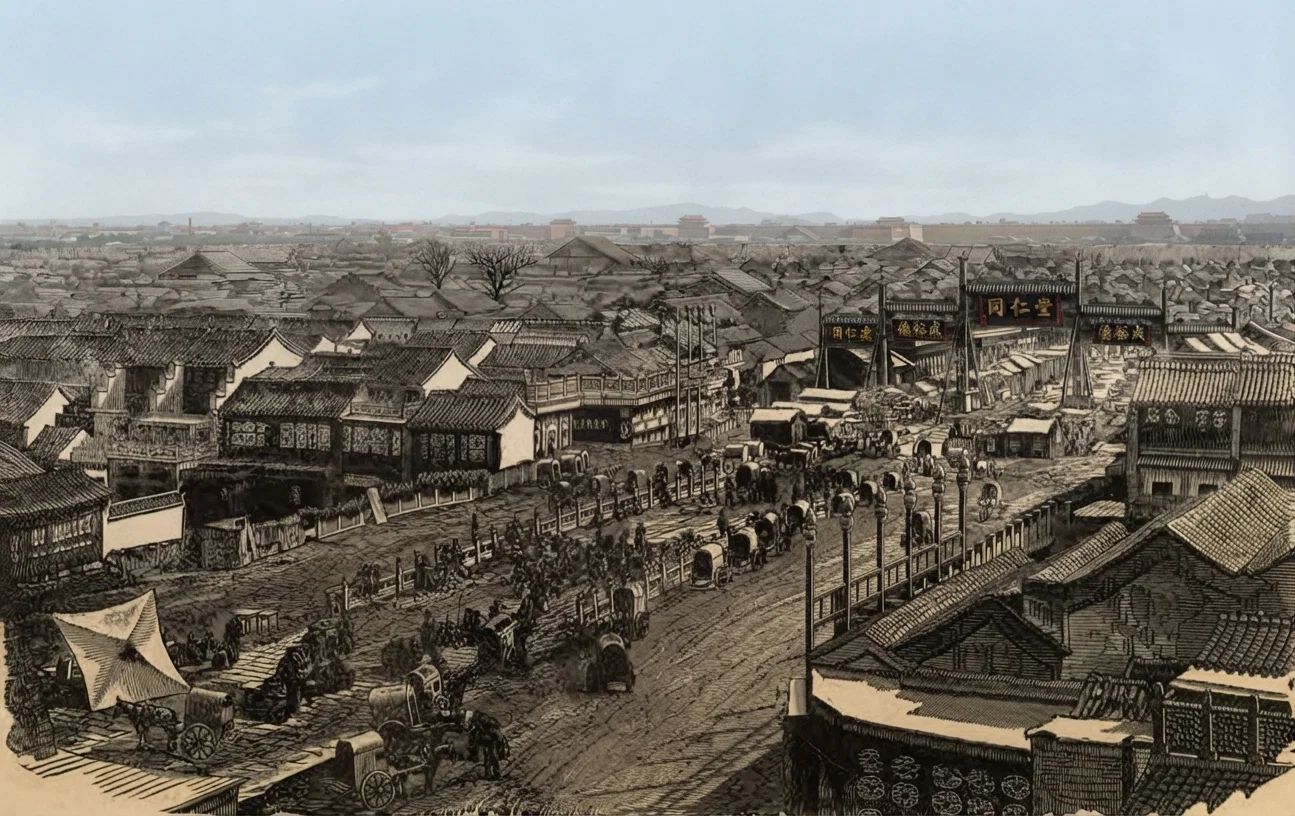
Scene in Peking, China.
"As if all these difficulties were not sufficient, Buddhism had hardly settled down harmoniously with its two sister religions when Mohammedanism entered the empire, pushing its way into imperial notice with great effect, and contesting with its monotheistic doctrines against the corrupt religious practises that had grown up in the other three divisions. It came to stay, in spite of numberless persecutions and rebellions, in which millions of Mohammedans have been put to death. Most of the Moslem Chinese now occupy a very strong position in the whole of Northwest China. Others are scattered over the face of the empire, many of them being rich and enjoying official positions. Altho opposed to the main features of Christianity, the Mohammedan faith is not entirely without its advantages to the work of the Christian missionary. The denunciation of all idolatry, the worship of the true God, the observance of the Mohammedan sabbath, and the teaching of certain theological terms, are all aids to Christian preaching. On the whole, however, most missionaries who have come in contact with Mohammedans would much rather work in places where they are not to be found."