THE PAPAL OUTLOOK

2%

Pacific Press Publishing Company · OAKLAND, CAL., KANSAS CITY, NEW YORK · Nov 28, 1900

FromSigns of the Times, Vol. 26, No. 48.

Read the full edition
THE PAPAL OUTLOOK
By Prof. Percy T. Magan Of Battle Creek College.
THE Papal Church, during the latter days of the eighteenth century, still calling herself the body of the Lord, sat in solitary sadness. Her form was wrapped in the weeds of widowhood, and her soul enshrouded in the deepest gloom.
Rome had warred as a principal in tremendous issues. She had done battle to the sword with blood to the hilt. Everywhere the day had gone against her even more decisively than when the ruddy hand of the Reformation had shaken the pillars of her power.
That Rome toward the end of the eighteenth century would come to such a state, had been predicted long time before on the pages of the Scriptures. Subsequent history had faithfully proved the divinity of the wonderful Word. That Rome should sit as a widow and see sorrow, had been foretold by the pencil of the Holy Ghost; and the seer had also said that she should be wounded as to death.
The closing years of the eighteenth century appear to our perspective now like one great day of carnage and of strife. The red spark of revolution once kindled in France had ignited combustible material all over Europe, and every nation was involved in hideous war.
Blood flowed in torrents. Crowned heads, dynasties, and nations had gone down in the fray. It is all over now. The gentle moon of time has risen, and shed the pallid light of her beams over the sickening, ghastly scene. And there one sees that wondrous “woman,” who was once arrayed in purple and scarlet color, and decked with gold, and precious stones, and pearls, but now lying desperately wounded, amidst the corpses of her royal lovers, so thickly strewn upon that bloody battle land. Yes, and she was one of the only ones to arise from her fallen posture. The Scripture had said that her “deadly wound” should be healed. In the nineteenth century, now closing, she has arisen; she has, in a measure at least, recuperated her shattered fortunes, and regained her lost influence. Well did the great Lord Macaulay say:—
When we reflect on the tremendous assaults which she has survived, we find it difficult to conceive in what way she is to perish.

A Cause of the Struggle.

The terrific struggles which mantled the autumnal years of the last century in the russet habiliments of blood were all fought over a proposition which was succinctly stated by one of the greatest of these governmental reformers, in the following words:—
We hold these truths to be self-evident, that all men are created equal; that they are endowed by their Creator with certain unalienable rights; that among these are life, liberty, and the pursuit of happiness; that to secure these rights, governments are instituted among men, deriving their just powers from the consent of the governed.
The principles embodied in this proposition were the all-absorbing theme of controversy in the days whereof I speak, not simply in America, but in all the civilized world. On the one side stood the plain people demanding the right to rule themselves. On the other stood prince, potentate, pope, and Papacy, tenaciously clinging to the doctrine of the divine right of kings, and maintaining that it was their prerogative to rule the people without their consent.
This epidemic of government by the consent of the governed may be said to have first broken out in England. The people demanded a redistribution of seats in Parliament. The aristocrats had things so arranged that they could return themselves at every election. Under the old law, defunct towns, such as Old Sarum, which did not have a single inhabitant, were entitled to representation. The lord of the neighboring manor had easy work to send himself to the Parliament, there to represent his own interests. Great manufacturing towns, like Birmingham and Manchester, were at the same time unable to exercise the imperial franchise. Hence they demanded a change. The king and his nobles were unwilling to grant it.
A crisis was imminent. To avert it the royal party transferred the struggle to England’s colonies in America. This was a shrewd move. It was wisely thought that it would be easier to turn the people of England against the colonies than against themselves. If they fought the principle of representation in the case of the colonists, their hands would be tied and their mouths stopped should they attempt to further contend for it for themselves.

A Successful Issue.

The American colonists, however, carried the consent-of-the-governed principle to a successful issue. As a result of this in due process of time the principle triumphed in England.
The movement in America was distasteful to the Papacy; but as it tended to cripple the power of England, and as England was a heretical nation, she did not say very much.
In 1798 the new government of the United States under the present Constitution was launched. On April 30, in the city of New York, George Washington was inaugurated as the first President of the republic. Five days later the States-General was opened in France, and the French Revolution was begun. On the 4th of July the Americans celebrated their liberty, and on the 14th the French people, in afrenzy of passion, tore down the hated Bastile. To this day the 14th of July is the day celebrated as the birthday of liberty in France.
From the beginning the Papacy was opposed to the French Revolution. Pius VI., being pope, took the side of Louis XVI. against the people of France. He denounced the Legislative Assembly, and issued an encyclical proclamation, in which he condemned the efforts of the French people to establish a republic. Here are his words: “That assembly, after abolishing monarchy, which is the most natural form of government, had attributed almost all power to the populace, who follow no wisdom and no counsel, and have no understanding of things.” He further instructed the bishops that all “poisoned books” should be removed “from the hands of the faithful by force and stratagem.” He denounced the liberty after which France was striving, in imitation of the American example. He declared it had a tendency to “corrupt minds, pervert morals, and overthrow all order in affairs and laws.” He asserted in bold terms that the doctrine of the equality of man leads to “anarchy” and the “speedy dissolution” of society.
Thus did the Church of Rome pit herself against the movement for popular government. But the French Revolution was not confined to France. It advanced all over Europe like a great tidal wave. Wherever the arms of the republic were victorious, monarchical forms of government fell, and government of the people was instituted in its stead. Italy was no exception to the general rule. When Napoleon led his troops across the Alps, kingdoms and duchies were overthrown, and the Cisalpine and Transpadane republics appeared in their stead.
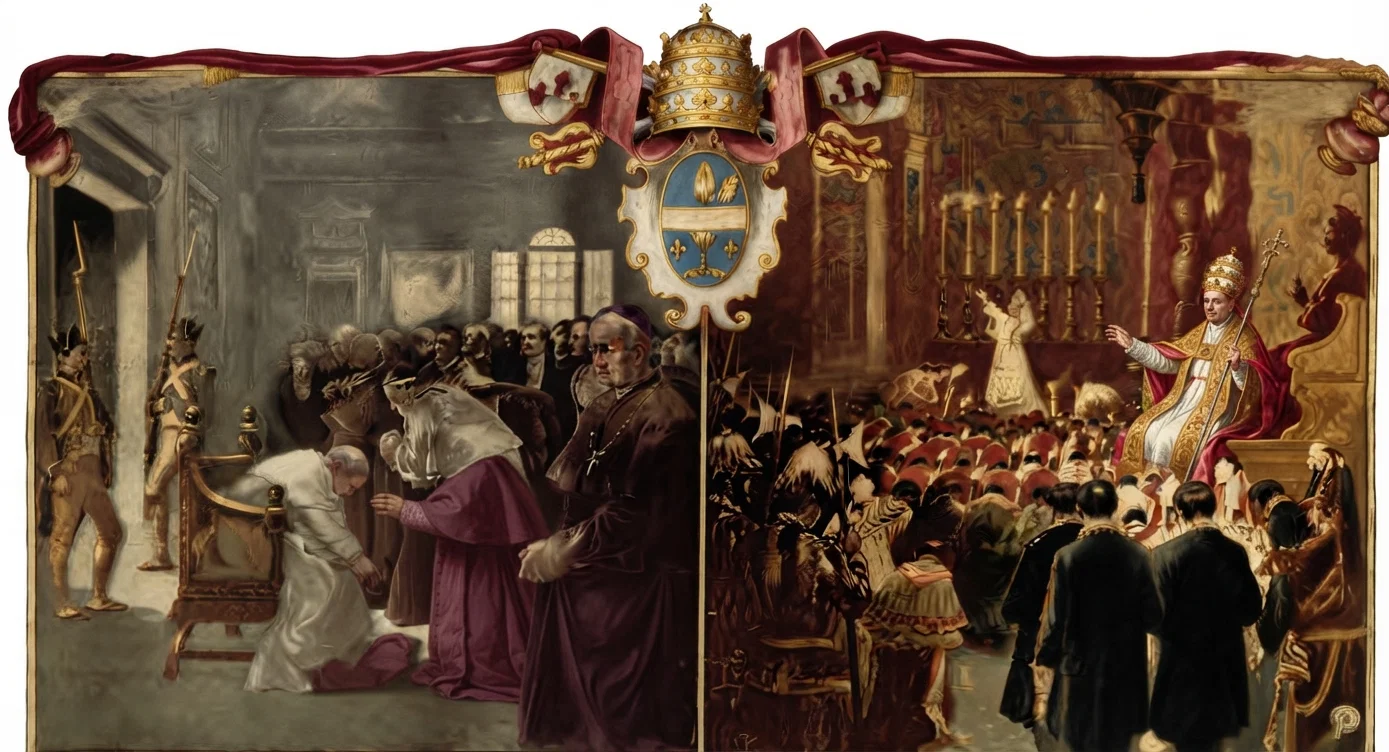
The pope thundered anathemas against the advancing French. His own temporal power shook like an aspen leaf. At last, in 1798, on the tenth day of February, Berthier, the French general, came in sight of the ancient capital of the world. The democrats, at the summit of their wishes, assembled in the Campo Vaccino, in sight of the remains of the ancient forum, and proclaimed the Roman Republic. The pope was stripped of his power, conveyed into Tuscany, and thence to Valence, France, where he died attended by a solitary ecclesiastic, and for two years there was no pope.
Ultimately, however, temporal power was restored to the pope, and he ruled as a king over the papal States. With almost the very beginning of the present century, the people of Italy began to plead for constitutional government. This the pope was determined not to grant. True, he offered to reform some abuses; “but,” says his own biographer, these had only “an irritating effect on the public, especially when the leaders of public opinion had determined beforehand that nothing short of a constitutional and parliamentary government, administered by laymen, should satisfy them, or be accepted by the people of the Roman States.”
Once, in 1848, in the month of November, the pope weakened. This was when a deputation from the people bore an ultimatum to the pontiff. In it they stated that they would “allow his holiness one hour to consider; after which, if not adopted, they announced their firm purpose to break into the Quirinal, and put to death every inmate thereof, with the sole and single exception of his holiness himself.” Then Pius IX. gave way, and announced his submission. “The sovereign has given us a REPUBLIC!” spread from rank to rank, and shouts of joy rent the air.

The Overthrow of the Temporal Power.

But the joy of the people was short-lived. Things did not improve as they had hoped; the promised reforms were not granted. The end came in 1870. In that year the plebiscite in the papal territories voted to throw off the yoke of the temporal sovereignty of the pope, and unite with the kingdom of Italy. There were 167,548 voters. Of these 133,681 voted in favor of the union, only 1,507 voting against it. On Sept. 20, 1870, the army of Italy entered Rome. The temporal power of the pope was at an end. His persistent refusals to grant popular government were the cause. The Papacy stood opposed to republics on principle, and held to the divine right of kings. It was the movement in favor of popular government which dethroned the pope.
Republican government drew its first full breath on American soil. From the United States the precious light had gone forth to all the world, and almost every government on earth had been influenced by it. In resisting this light, the Papacy had fallen.
The Declaration of Independence has done much to secure the liberty and happiness of mankind. It was not a local document, intended only for the benefit of the American colonists. Indeed, it is an interesting fact that its original title was not “The Declaration of Independence.” This title does not appear in the original. It was then called “The Unanimous Declaration of the Thirteen United States of America.” It was not thought that it would assist the colonists in gaining their independence. It was an enunciation of grand principles of true government, good for all mankind. These were the principles which the Papacy fought, and before which she fell.
God gave freedom to the people of the United States. He gave it to them because of the principles of civil and religious liberty which they cherished and nourished as a sacred trust from Him. The fathers were sensible of the importance of their work. This is wonderfully told in Washington’s first inaugural:—
The preservation of the sacred fire of liberty and the DESTINY OF THE REPUBLICAN MODEL OF GOVERNMENT are justly considered, perhaps, as deeply, as finally, STAKED ON THE EXPERIMENT INTRUSTED TO THE HANDS OF THE AMERICAN PEOPLE.
In other words, the fathers realized that what they had done would have an influence on all the world. They also knew that if they ever apostatized from the principles of republican government, that model of government would come to an end in the world as it now is. They believed this “as deeply as finally.” These words are italicized in the original draft made by Washington himself.

What Is the Outlook?

And now I am ready to answer the question as to what is the outlook for the Papacy in the coming century. It is in its immediate aspects very flattering. The principle against which she struggled, and before which she fell, is now being repudiated by the government which gave it birth. Government by the consent of the governed is now being declared by the United States as not good for all mankind. In other words, it is being pronounced a failure. The “destiny of the republican model of government, . . . staked on the experiment intrusted to the American people,” is now being sealed. “The republican model” is being abandoned and declared of no account.
This move on the part of the United States means much to the Papacy. It means everything to her. With great éclat the champion of the principles against which she stood is now surrendering these principles. There can be but one ending to this,—the restoration of the old order of things the world over, and the triumph in this earth as it now is of the old Roman Catholic doctrine of the divine right of kings. This is what the events of the last two years spell for the Church of Rome. A writer of many religious works has truthfully said:
The Roman Church is far-reaching in her plans and modes of operation. She is employing every device to extend her influence and increase her power in preparation for a fierce and determined conflict to REGAIN CONTROL OF THE WORLD. . . . Marvelous in her shrewdness and cunning is the Romish Church. She can read what is to be. She bides her time.
Added to this, other things have been working in her favor. The Church of England has been steadily falling into her hands. In 1844 began the so-called Tractarian, or Oxford, movement. Its real animus was to bring the Church of England back to Rome. Dr. John Henry Newman was its most remarkable man. He ultimately became a Roman Catholic, and was made cardinal. His friend, Dr. Pusey, “began to incorporate the mysticism and the symbols of Rome with the ritual of the English Protestant Church.” In 1851 a great stir was occasioned in England by the pope’s issuing a papal bull, “given at St. Peters, Rome, under the seal of the fisherman,” and directing the establishment in England “of a hierarchy of bishops deriving their titles from their own sees.” This called out Lord John Russell’s famous Durham letter, and a new “no popery” agitation. Nevertheless, the Ecclesiastical Titles Bill, designed to make void the pope’s bull, wrecked the government which endeavored to pass it. It ultimately, after a most painful journey through the House of Commons, was passed by the Lords and received the royal assent. But it never was anything but a dead letter. It was never enforced. Protestants had enjoyed a barren and very nominal victory. The pope had gained his point and got a lot of free advertising. The Catholic prelates made a point of using their territorial titles in letters addressed to the ministers of state themselves. Many years afterwards, in 1871, the bill was quietly repealed. “It died in such obscurity that the outer public hardly knew whether it was above ground or below.”
Meantime the forward movement in the Church of England toward Rome grew in volume and strength.
Clergymen and congregations loved to have their churches adorned like those of the Catholics; they delighted in the sweet and noble music, the incense, the painted windows, the devotional effigies and symbols, the impressive and gorgeous ritual. . . . There was the High Church priest setting up his altar, swinging his censor, making his genuflexions, and even establishing his confessional. . . . The law, which was invoked, proved impotent to deal with the difficulty.
In the United States also things have gone well for Rome. A spirit of persecution for religious views has been rising. Protestants have sought to enforce Sunday-keeping by civil statute. Keepers of another day—the seventh-day Sabbath—have been cast into prison, and put to work in chain-gangs. In this, Protestant America has been abandoning principles of religious freedom, which were the cornerstone of her structure, and advancing along the road to Rome.
Catholic schools among the Indians have received large gifts of money from the United States Government. Papal delegates have been harkened to in the White House. In the treaty with Spain the rights of Rome in church properties were guaranteed. As these rights in the Philippines had long formed a bone of contention between the natives and the Spanish Government, a substantial gain was made by the church on this count. That the Vatican recognizes this is made clear in an audience granted Archbishop Ireland by the pope. He said: “We are well pleased with the relations of the American Government to the church in Cuba and the Philippines. The American Government gives proof of good-will, and exhibits a spirit of justice and respect for the rights and liberties of the church. You will thank in my name the President of the republic for what he has done.” Of course the pope feels to thank the President of the United States for what he has done. The President, jointly with the pope, it is asserted, appointed Monsignor Chapelle “to restore the friars to their parishes and to the power from which they had been driven by the Catholics themselves. Charges of immorality and extortion against the friars were said to be one chief cause of the insurrection of 1896. . . . Apparently the root of the difficulty in the Philippines is a claim of the monastic orders to certain properties and revenues. The eighth article of the Treaty of Paris provides that the relinquishment of power by Spain “can not in any respect impair the property or rights which by law belong to the peaceful possession of property of all kinds of . . . ecclesiastical or civil bodies.”
Again, President Schurman, head of the Philippine Commission, sent out by the United States Government, has said that missionaries “are needed in the islands, and I hope they will be sent there in large numbers. . . . It would be highly impolitic to send missionaries of different denominations to confuse the minds of the people. I do hope that when we send the missionaries, we will decide beforehand on one form of Protestant Christianity. Send only one type of missionaries. . . . I do hope that before sending missionaries to the Philippines, the different denominations will unite on some common platform.”
All of this must be exceedingly gratifying to Rome. To have Protestants make a creed, and unite on one common platform, is her idea precisely, because such a course can only lead the Protestant sects back to the arms of Rome.
In closing I can only say that the fruit of the latter years of this century is distinctly favorable to the Roman Church; that the principles for which she fought, and before which she fell toward the close of the last century, are now being conceded to her by her former antagonists, who, in doing this, are practically marching to her fold again. PERCY T. MAGAN.