THE Catholic religion prevails throughout the civilized portion of the archipelago, with the exception of the Mohammedans in the Sulu group and the island of Mindanao, comprising a population of about two hundred and fifty thousand. Polygamy is also practised in this Mohammedan territory, and it is a part of the Mohammedan religion. They are a race of powerful and fearless men, and are religious fanatics. It is part of their belief that the road to heaven can be attained by killing Christians. This portion of the archipelago is governed by the Moro chiefs, they having set up an independent government of their own, having at no time been under Spanish or Catholic sovereignty.
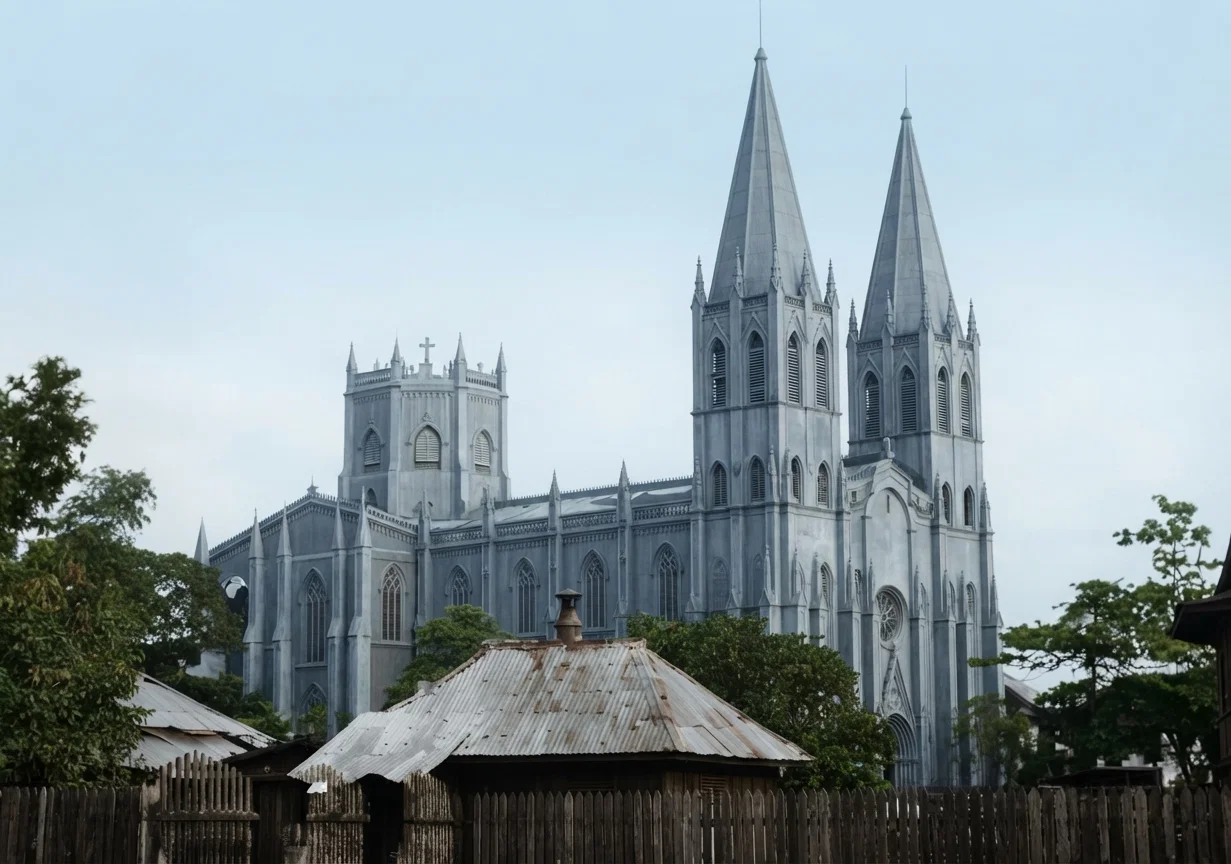
San Sebastian Church, Manila, Philippine Islands.
The archbishop of Manila presides over the spiritual welfare of the Ladrones and the Caroline group as well as the Philippines. The Philippines are divided into five dioceses, and are presided over by five bishops. They are also divided into one hundred and eight parishes and missions, which are in charge of the Jesuits. Each province or district is presided over by at least one or more Spanish priests.
The archbishop of Manila has his seat in the Walled City, and is assisted by an ecclesiastical chapter consisting of a dean and four dignitaries, the archdeacon, the precentor, the superintendent of schools, and the treasurer.
The Church and State under Spanish rule were inseparable. The monks had such a grasp upon those in authority that all they had to do was to speak the word, and their wishes were carried out to the letter, the Spanish Government being a mere puppet in their hands. The monks imposed exorbitant church taxes on the Filipinos, and many times they succeeded in getting the land of the natives confiscated and made over to them, compelling the original owners to till the land for them and continue to pay their church tax. If their crops should fail, their tax was not reduced, but increased. Failing to contribute to them, their carabou and cattle were seized, and in many instances the families were driven from their old homesteads. The monks, not being content with this, interfered with their family relations, many of them living in their quarters like despotic pashas. Many instances are on record where women have taken their own lives to rid themselves of these clerical traitors.
With such a state of affairs existing, what can be expected of a people who have seen nothing but corruption and vice existing under the cloak of religion?
The non-recognition of the Filipino priests by the Spanish also had a tendency to irritate the people at large. Instead of treating their priests as colleagues and co-workers, they were treated as inferior beings and underlings. Were they given a parish, it would be in some of the poorer districts where their income would hardly sustain them.
The cause leading to the Filipino rebellions of 1872 and 1896 was the despotic and tyrannical treatment of the native Filipino by the monastic orders. Freemasonry was a great bane to the monks. It was largely through this and other kindred orders, and the instigation of their leaders, Andres, Bonafacio, Dr. Jose Rizal, Emilio Aguinaldo, and many others, that the Filipinos have been kept in a state of rebellion.
It was through the pen of Dr. Rizal, in his novels, that the Filipinos and the world at large were made acquainted with the misdeeds of the monks. All complaints of the natives about the wrongdoings of the clergy remained without response, for the monks had colleagues in Madrid and Manila, and all complaints were intercepted or the complainants intimidated before reaching the higher Spanish authorities. One after another of these opposers of the ecclesiastical rulers were put out of the way, or driven into exile. Dr. Rizal was executed on the Luneta, in Manila, in 1897, and a reward of $25,000 was offered for the head of Aguinaldo. His countrymen being loyal to him, he lived to see the overthrow of Spanish rule, and, it is wished, religious oppression in the Philippines.
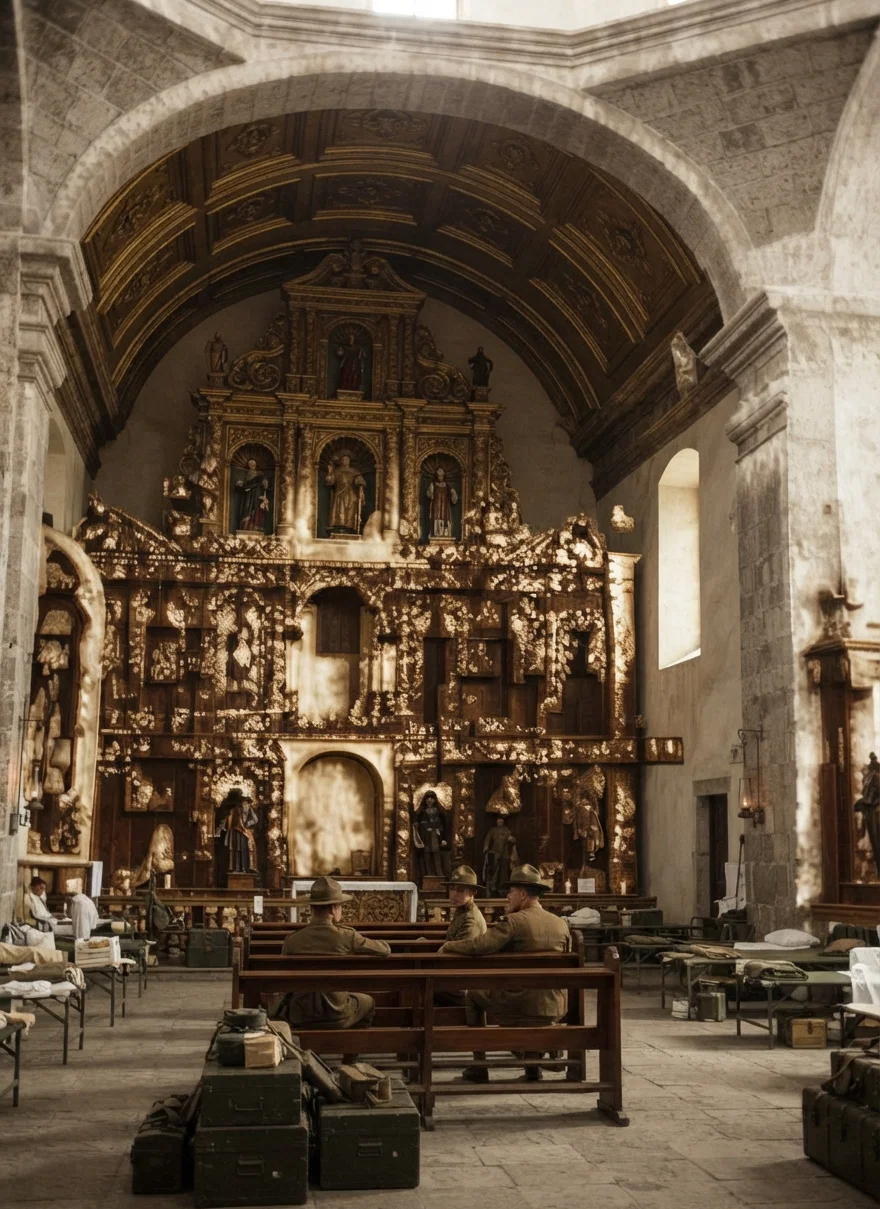
Nave of Church in Manila, Used as a Hospital by American Troops.
The native Filipino is naturally of a religious turn of mind, but seems to seek that form of worship which has outward show, and appeals to his imagination. A form of worship without images, incense, pomp, ornamentation, and bright colors will not appeal to his sympathies. This explains why the Catholic faith has such a strong hold in the Philippines. Anything imaginable or bordering on the supernatural makes a strong impression upon the Filipino. They wear charms and armlets with Latin prayers engraved on them, which they believe will protect them from all harm. Most of the Filipino families have a crucifix or shrine at which they worship since the priests have left the small villages. It is not uncommon to see the natives congregate in houses and have their worship at early morn and at the close of day. The women are the most religiously inclined. They seem very devoted to their religion, and nothing can prevent them from attending their regular masses.
There are but a few Protestants among the English and Germans around Manila, and so the native Filipino has comparatively little knowledge of the Protestant religion, and but few have heard the Gospel of Jesus Christ. They ask vague questions concerning our God, and whether it is the same One they have in the Philippines. I have put in many hours trying to tell them of our religion, and have always found them ready and willing listeners. They all seem anxious to learn what they can "of the religion of the Americano."
The church property, like the clergy, was under the control of the Spanish Government.11In Manila, like other Catholic cities, the churches form interesting studies of architecture. They were built by the sweat and blood of an oppressed people, and are now relics of a dead tho not forgotten past. Manila has many massive cathedrals. They, with their towering spires and many-chimed bells, present an imposing spectacle. The church of San Sebastian without doubt is by far the grandest. It, from outward appearance, looks to be made of granite; but it is constructed of steel throughout. Its walls are of plates of steel bolted to a frame of the same material. The interior is very imposing. There are two rows of pillars which branch out and form the arches of the ceiling. The furnishings of the altar are very elaborate, and many vessels and ornaments are of silver and gold. In the vestry is a hard wood table made of one piece of timber nine feet across, and twenty-seven feet in circumference. The windows of stained glass are most wonderfully designed. Great pipe-organs may be seen, and at early mass they fill the spacious cathedrals with, mellow music. Many of these churches are not ceiled, but are most elaborately finished to the very top of the domes, from which hang beautifully ornamented chandeliers.
The most peculiar feature connected with these cathedrals is the fact that they contain no seats; the congregation remains standing during services.
To attend these churches, to see the gold and silver ornaments, the priests with their almost priceless robes, and then to note the half-clad, half-starved beggars forming part of the congregation, one would decide that the time has come for the introduction of a different religion. It tells a story of tyranny and oppression more eloquently than words. Is it not time that the shackles of such a religion be shaken from the necks of this people? Is it not time that we should stir ourselves to the utmost to spread the Gospel to these sin-sick souls?
It is a strange fact, but nevertheless a true one, the grander the church and more demonstrative the religion, the more plentiful and destitute the beggars. This is said to be true all over the world, and I know it to be true in the Philippines. The people are anxious and waiting to hear the Gospel of Jesus Christ. It has been the one object of their lives to be rid of Spanish rule and the tyranny and oppression of the leaders of the Catholic Church.
It is beyond the comprehension of one living in our country of religious liberty to imagine the degree of persecution that has been perpetrated upon this people in the Philippines. It goes to show what the Church and State will do when combined under one rule.
May they soon be liberated from this religion, and have an opportunity to hear the simple Gospel of Jesus Christ.