THE OUTLOOK TEMPORAL

4%

Pacific Press Publishing Company · Oakland, Cal., Kansas City, and New York · Nov 29, 1899

FromSigns of the Times, Vol. 25, Nos. 48, 49.

Read the full edition

THE OUTLOOK TEMPORAL

By A. O. Tait, of the "Signs" editorial staff.
A SIDE from all divine prophecies of the future of this world, what is the real outlook from the purely human standpoint?
There is no end to the material progress that is being made. Every day adds some new discovery in science, or some new invention in mechanics, that tends to make the burdens of life easier and its joys fuller and richer. There never was an age when life was more interesting. The progress of each succeeding year leads one to feel that he would like to live on, and on, and on, so that he might behold and enjoy all the new developments as they arise.
But amid all this flowering of genius that is giving so much of seeming worth to the material world, there are vexing problems that threaten the very foundation of the social and political order.
The God-given genius of man that has enabled him to seize upon the forces of steam and electricity, and thread the continents with railroads and telegraphs, and connect the two hemispheres with steamships and ocean cables, has placed the power of commercial centralization within the grasp of a favored few. And these few have not been slow in laying hold of the wealth of nations and gathering it to themselves. This gives us the question of capital and labor, which, as Mr. Chauncey M. Depew says, is the "century-vexing problem."
The mechanical genius that has given us the great machine-shops, with all of their labor-saving products, has also invented the most awfully destructive implements of war; and unprecedented armies and navies are being built up and equipped with these engines of terrific slaughtering capacity. Particularly in the Old World has the military burden become so heavy that it can not be endured much longer without a collapse. And even in the United States there are strong indications that this nation, too, is about to take upon itself a very greatly increased load in the way of navy and army expansion.
The possibilities of present-day war The heart stands still in silent dread before the possibilities of present-day war. For, while there is much talk about a universal peace, yet the facts in the case are that there is a general quarrel among the nations of the whole world, and no one can safely say how long hostilities can be averted. Everything shows that a universal war is drawing on; there is absolutely nothing pointing in the contrary direction. Even the Peace Congress so recently convened at The Hague shows that the spirit of the age is the spirit of war and not of peace; for if the blessed influences of peace were ruling in the minds of men to-day, there would have been no necessity for calling a Peace Congress. It is only in times of actual or threatened war that councils of peace are thought of. And the utter lack of any real, tangible thing accomplished by The Hague Peace Congress shows that the representatives of the nations are actually afraid to commit themselves to an agreement that will in the least impede their progress in organizing armies and building navies.
In the first half of the present decade the murders in this country increased more than one hundred per cent., at least, so says Judge Parker, of the United States District Bench, in the North American Review. And testimony almost without limit could be produced from recognized authorities to show that crimes and vices of every sort are tremendously on the increase. But such authorities are not needed. Common observation convinces one that the whole political fabric is one vast school of evil. It is commonly remarked nowadays that politics is a great immoral cesspool, and through jobbery and bribes it contributes to every form of vice and corruption.
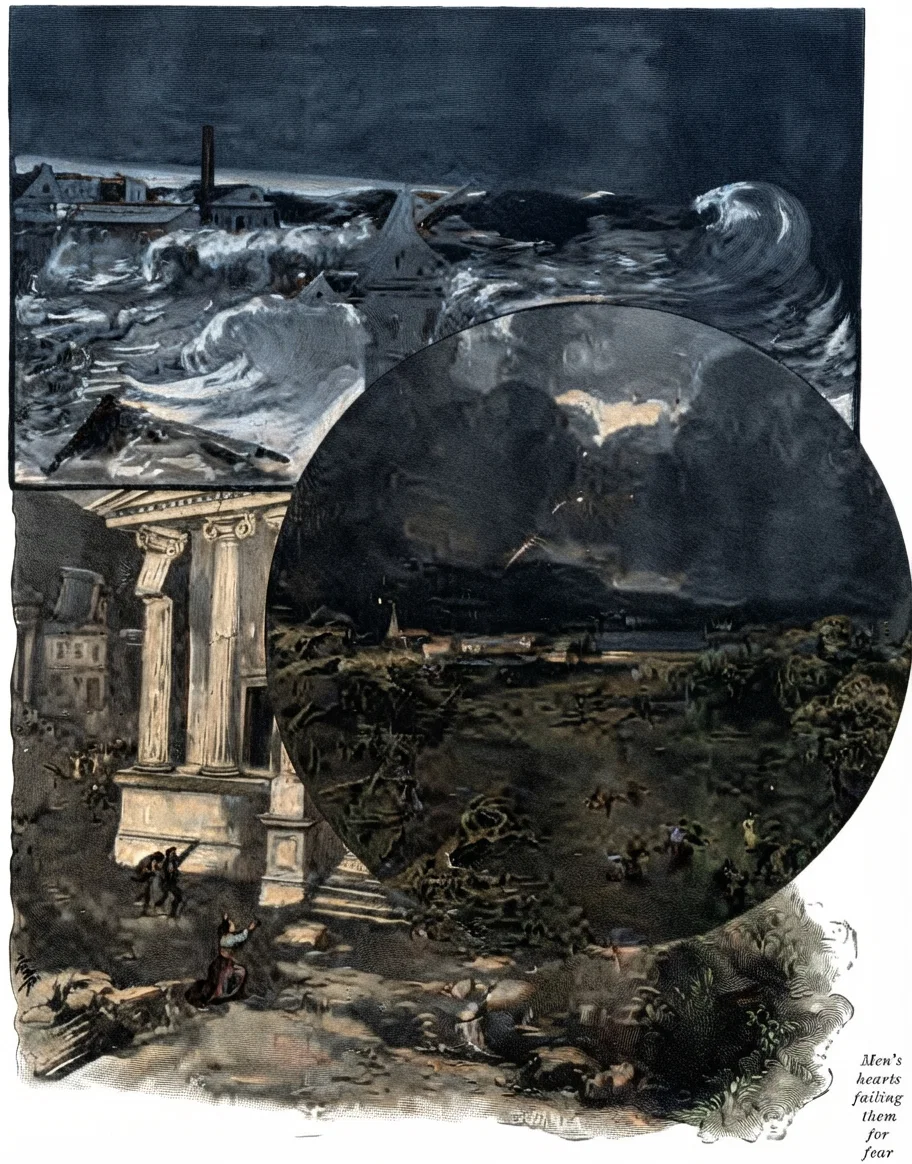
Men's hearts failing them for fear
The much-praised genius that has established the great factories has drawn men from the farm to fill up villages and colossal cities. These men can not at all times find work in the shops, and so this factory age has given us the great army of vagrants that we commonly call "tramps." And the same conditions have also augmented in our great cities that other twin evil that we call the "slum problem."
The distressed conditions of labor Intelligent and true-hearted men are seeking to relieve the distressed conditions of labor, and whether it is wise and right or not, yet they nevertheless order strikes. At the times of these strikes the "tramps" from all over the country flock to the centers of disturbance, and the "slums" turn out their vast hordes of half-starved and desperate wrecks of humanity. These irresponsible persons are only too willing for any violent deed, and stand ready for riotous action whenever the opportunity is offered.
The chemist's laboratory has discovered one agent after another that have been combined into most powerful explosives. These things are very useful in the development of the mine and in other industrial fields; but they only serve to give another illustration of how discoveries that might be helpful to man are used to serve as agents in his destruction; for not only is the high explosive made to do terrible execution in killing men in war, but violent and bloodthirsty anarchy has allied itself to the bomb, and in the scenes of strife that lie just before us, not only whole houses, but whole blocks, and even whole cities, may be speedily wrecked. The possibilities, yea, even the probabilities, in this direction strike men with terror.
The dangerous conditions of these times are seen by all serious observers. Men are free to affirm that the world is threatened with social and political calamities with which all the darkest records of all past time do not furnish a parallel.
Speaking of military matters, Lord Salisbury, England's prime minister, says: "The burden has become so serious to many nations that many have thought that the day will come when nations will rather rush into war and provoke a decision once for all than to continue to groan under the suffering which modern necessity forces upon them."
Again Mr. Salisbury says: "But what has been pressed upon us is that the subject matter of war is terribly prevalent on all sides. . . . Still more serious is the consideration which recent events have forced upon us that these wars come upon us absolutely unannounced and with terrible rapidity. The war cloud rises in the horizon with a rapidity that obviates all calculation, and, it may be, a month or two months after the first warning you receive you find you are engaged in or in prospect of a war on which your very existence is staked."
A little more than a year ago, Gen. Nelson A. Miles said: "I have seen all the great armies of Europe except the Spanish army. What I have seen does not indicate that the millennium is at hand, when swords shall be beaten into plowshares."
The late Bishop Newman's version of the situation is that "this is the most unsettled condition of the world since the crucifixion of Christ. The stability of government is no longer a fact. Change is in the atmosphere. It is just as true now as a thousand years ago, 'Thou knowest not what a day will bring forth.' . . . Statesmen are at their wits' end. Philosophers speculate in vain."
Archbishop Ireland says: "The bonds of society are relaxed; traditional principles are losing their sacredness, and perils hitherto unknown are menacing the life of the social organism."
Leo XIII., in his encyclical on the condition of labor, says: "The momentous seriousness of the present state of things just now fills every mind with painful apprehensions; wise men discuss it; practical men propose schemes; popular meetings, legislatures, and sovereign princes, all are occupied with it; and there is nothing which has a deeper hold on public attention."
Mr. Benjamin Kidd, in his book "Social Evolution," writes: "The problems which loom across the threshold of the new century surpass in magnitude any that civilization has hitherto had to encounter."Prof. E. Benjamin Andrews, formerly president of Brown University, and now superintendent of the public schools of Chicago, remarks: "No well-informed person in Europe seems to believe that peace is destined to endure there very long. On all hands people are preparing for war. Armies and navies are strengthened; fortifications multiplied; immense war treasures of gold piled up; all possible hypothetical plans of campaign, offensive and defensive studied and discussed; firearms, great and small, ceaselessly experimented upon and improved; civil measures subordinate to military, and statesmen to great army men and navy men."
On all hands people are preparing for war Signor Crispi, Italy's greatest statesman, says: "Europe resembles Spain from a certain point of view. Anarchy is dominant everywhere. To speak frankly, there is no Europe. The European Concert is only a sinister joke. Nothing can be expected from the Concert of the Powers. WE ARE MARCHING TOWARD THE UNKNOWN. Who knows what to-morrow has in store for us?"
A quotation from Jesus of Nazareth is a fitting conclusion to these present-day sayings of men: "And there shall be signs in the sun, and in the moon, and in the stars; and upon the earth distress of nations, with perplexity; the sea and the waves roaring; men's hearts failing them for fear, and for looking after those things which are coming on the earth; for the powers of heaven shall be shaken. And then shall they see the Son of man coming in a cloud with power and great glory." Luke 21:25-27.
If we are not standing in the very midst of the fulfilments of this great prophecy, given by the Christ of God, then, pray tell, where are we?