DEPARTED GLORY

6%

Pacific Press Publishing Company · OAKLAND, CALIFORNIA · Nov 14, 1900

FromSigns of the Times, Vol. 26, No. 46.

Read the full edition

DEPARTED GLORY.

CARMEL, "the Fruitful," is one of the most noted mountains of the "Holy Land." It is not a single peak, but a range or ridge, twelve miles in extent, directly west of the Sea of Galilee, on the Mediterranean coast. One end of the ridge juts out into the sea, ending in a bold bluff 500 feet high. From thence it extends southeasterly, ending in an inland bluff about 500 feet above the sea. Its highest elevation is about eight miles from the Mediterranean, where it rises to a height of 1,740 feet.
THE mountain still proves its title to the "excellency of Carmel." Its steep and rugged sides, sometimes precipitous, are covered with shrubs of pistachio, sponge-laurel, hawthorn, and arbutus. Such flowers as rock-roses, striped asphodel, hollyhocks, the daisy, and the red and purple anemone, abound. From the thyme and mint the feet of the traveler's horse, Schaff tells us, press sweet fragrance. Herds of goats browse its steep sides; occasionally gazelles are seen, while foxes, jackals, wolves, wild boars, panthers, woodcock, and partridges add to its animal life. "Huge valleys upward of 1,000 feet deep wind tortuously from the main ridge to the sea, requiring hours to cross to the opposite summits."
THE section in which it is located was given to the tribe of Asher. Along its northerly base flowed the swift river Kishon. Twenty miles to the southeast was the town of Jezreel, where lived King Ahab in his marble palace, and where also was a temple of Astarte, with its 400 priests, supported by Queen Jezebel. It was on Carmel that it is supposed that those sent to take Elijah were destroyed. 2 Kings 1:9-15. It seems also to have been a stopping-place for Elisha (2 Kings 2:25; 4:25), whence the Shunamite sent to call him when her child died.
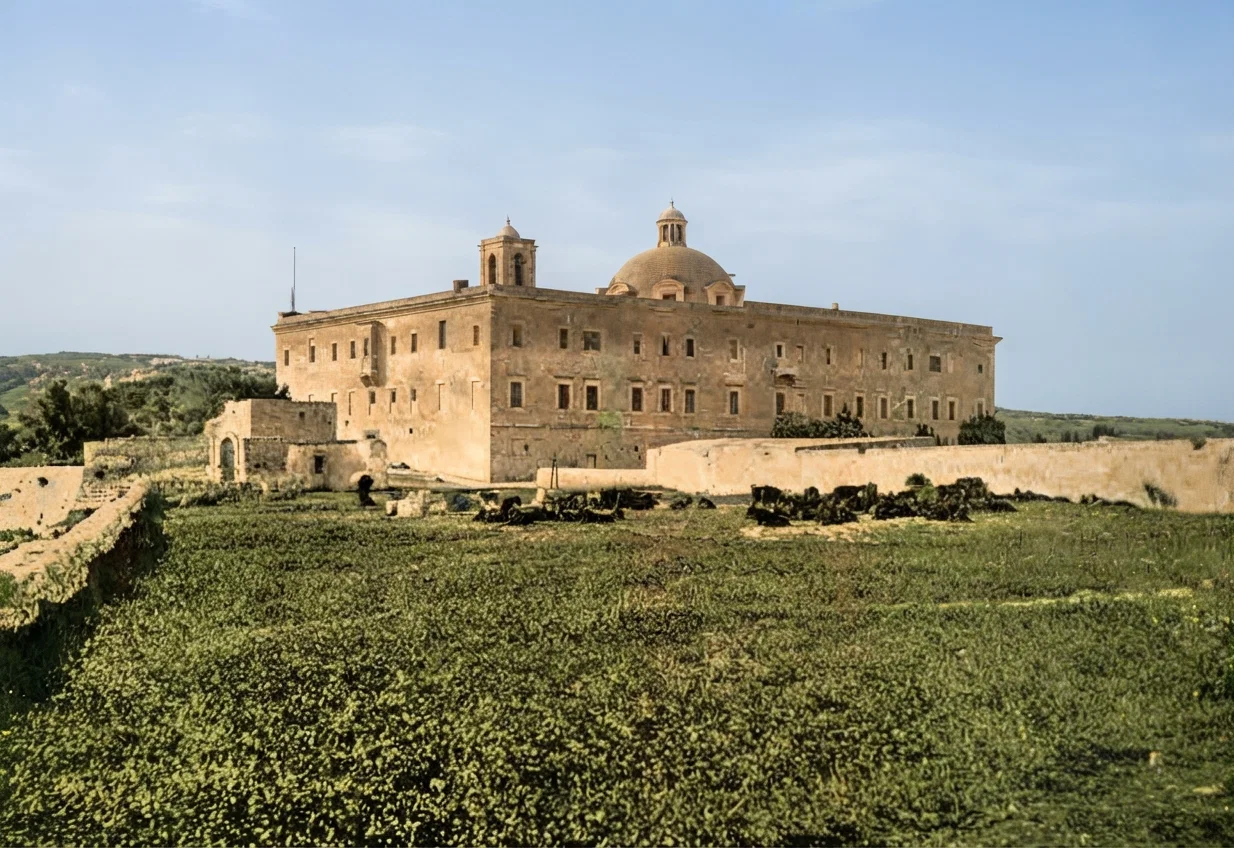
Mt. Carmel and the Carmelite Monastery.
BUT the chief event for which the mountain is noted was the conflict between Elijah, the servant of Jehovah, alone, and the united priests of Baal and Astarte, 850 in number. The record is found in 1 Kings 18. The place was near the top of Carmel, where could be seen the great sea on the one side, and the beautiful Valley of Esdraelon on the other; in the distance, the royal city of Jezreel.
THE famine was sore in the land. Heaven had stayed its rain for three years by the word of Elijah because of the backslidings of Israel. Ahab had married Jezebel, the daughter of Ethbaal, the sun-worshipping king of the Zidonians. She had brought with her all the abominable nature-worship of both Baal and Astarte, the licentiousness ever connected with the ancient sun-worshipping cult. Four hundred and fifty prophets of Baal and four hundred of Astarte ("the groves") were fed from the queen's table. Under the royal leadership the people were utterly losing sight of God, and He in His goodness left them to themselves. He withheld the rain till the brooks were dried, the cattle perished, and the people in their anguish began to long for God.
JEZEBEL, and Ahab weakly influenced by her, thought if the prophet were slain the famine would cease, just as tho the slaying of His messenger would destroy God! Here andthere throughout his own realm and into adjacent kingdoms, Ahab had sought the bold prophet, but in vain. At last Elijah meets the king, and tells him that it is he and his father's house that are the cause of Israel's trouble, in that they had "forsaken the commandments of Jehovah," and had "followed the Baalim." One of God's commandments, that which points out the Giver of the law as the Creator, is the Sabbath precept. It is God's sign between Himself and His people forever, that they might know that He is God. Eze. 20:20. Connected with sun-worship was the observance of the "wild solar holiday of all pagan times," the Sunday. The two customs, one based on God's authority and the other on pagan traditions, were antagonistic, and so must be their followers.
ELIJAH proposes a test on one of the upper broad shelves of the mountain, where a perennial spring pours forth its waters. He tells Ahab to gather there the prophets and the people. They come, and the prophet of God, going near to the people, thus addresses them: "How long halt ye between two opinions? if the Lord be God, follow Him; but if Baal, then follow him. And the people answered him not a word." Verse 21. The poor, blinded, carnal people could not decide.
THEN, filled with the divine Spirit, Elijah lays before them his test: "Then said Elijah unto the people, I, even I only, remain a prophet of the Lord; but Baal's prophets are four hundred and fifty men. Let them therefore give us two bullocks; and let them choose one bullock for themselves, and cut it in pieces, and lay it on wood, and put no fire under; and I will dress the other bullock, and lay it on wood, and put no fire under; and call ye on the name of your gods, and I will call on the name of the Lord; and the God that answereth by fire, let Him be God." And the blinded people could see this; and they "answered and said, It is well spoken."
THE prophets of Baal chose their bullock, dressed it, built their altar, placed the bullock upon it, and cried and leaped and cried from morning till noon, but there was no voice nor sign. As the sun reached the meridian and was about to decline, urged on by Elijah's justifiable mockery, the pagan prophets grew more violent. They leaped, they danced, they cut themselves with knives and lances, till blood flowed freely, until the sun declined, and hope was dead.
THEN the prophet of God calls the people to him that they may see all that he does. According to God's instructions, he takes twelve unhewn stones, according to the numbers of the tribes, and builds the simple altar. Then he digs a trench about it, places the wood upon the altar, slays the bullock, places the parts upon the altar, and twice calls for four barrels of water, both times pouring the water on the sacrifice and the wood, and filling the trench, that all might know that the answer was not from man's device, but that it came direct from God.
ALL this work had brought the prophet to the time of the evening oblation; for he was abiding by God's direction in all this. Then he offers his simple prayer of faith from a heart burdened for a sinful people: "O Lord, the God of Abraham, of Isaac, and of Israel, let it be known this day that Thou art God in Israel, and that I am Thy servant, and that I have done all these things at Thy word. Hear me, O Lord, hear me, that this people may know that Thou, Lord, art God, and that Thou hast turned their heart back again." It was not a long prayer, but it was a prayer of faith, asked according to God's will, and it went directly to the Heart of Heaven. "Then the fire of the Lord fell, and consumed the burnt sacrifice, and the wood, and the stones, and the dust, and liked up the water that was in the trench. And when all the people saw it, they fell on their faces; and they said, The Lord, He is God; the Lord, He is God."
IT would seem as tho all this had been sufficient to convert both Ahab and all the priests. But no, their profession was too lucrative, their hearts too gross and hardened. Yet they must not be left to turn back a misguided people, and God's judgment followed upon them swift and sure.
GOD gives the weak king another assurance. He was told to eat and drink, for rain was coming. Seven times the prophet bows before God; seven times he sends his servant to look out over the sea for the appearance of rain. But not until the seventh time do the brazen heavens answer, and then only by a little cloud. It is enough to the prophet; he warns Ahab, and then he himself, girding up his loins, runs the twenty miles to Jezreel before Ahab's chariot.
O, THERE are lessons for to-day in this story! Ahab represents the State, weak and vacillating. Jezebel is God's own symbol for apostasy in religion. As of old, the conflict centers around the Sabbath of the Lord and "the wild solar holiday of all pagan times." As of old, God is calling to His people, "How long halt ye between two opinions?" He appeals to them by all the Word of truth, by all the record of the past; by the life of Christ, to serve Him. But the test does not lie in ocular signs; it lies in the Word of God. The agents of the devil will work false miracles, will imitate Elijah of old in bringing down fire from heaven; and this miracle will be used to deceive people into the worship of the beast and the reception of his mark. Rev. 13:13-17. Christ declares, "Not every one that saith unto Me, Lord, Lord, shall enter into the kingdom of heaven; but he that doeth the will of My Father which is in heaven." Matt. 7:21. In the great final conflict only he whose feet are upon the Rock of eternal truth will stand. God's message will again go in "the Spirit and power of Elijah;" so would He have all receive it; and only so will we be saved from Satan's delusions.
THERE is another lesson worthy of our notice. Carmel was once holy ground, because God there met His prophets. It was "the Fruitful" in the lessons it taught to the back-sliding Israel. Its only merit, as of that of any spot or thing of earth, lies in the continued presence of God; for His presence only makes glorious. So was the temple made glorious; so was Jerusalem; so is still the Sabbath. So was Carmel. But its glory is departed. Yet poor, ignorant, spiritually-blinded man will endeavor to go back to the old places and gather up some rays of departed glory to bolster up an unworthy cause. Thus an order of monks, the Carmelites, about the year 1200, or a little later, settled on Mt. Carmel. They invented the scapular, and pretended to great exaltation, were acknowledged by the popes, till the Jesuits exposed some of their hollow pretensions and wretched frauds. For centuries the order has languished. They have both monks and nuns belonging to the order, and an institution is still maintained on Mt. Carmel. But the glory is departed. The presence of God is not there; and the former "excellency of Carmel" will never be known till God shall "make all things new."