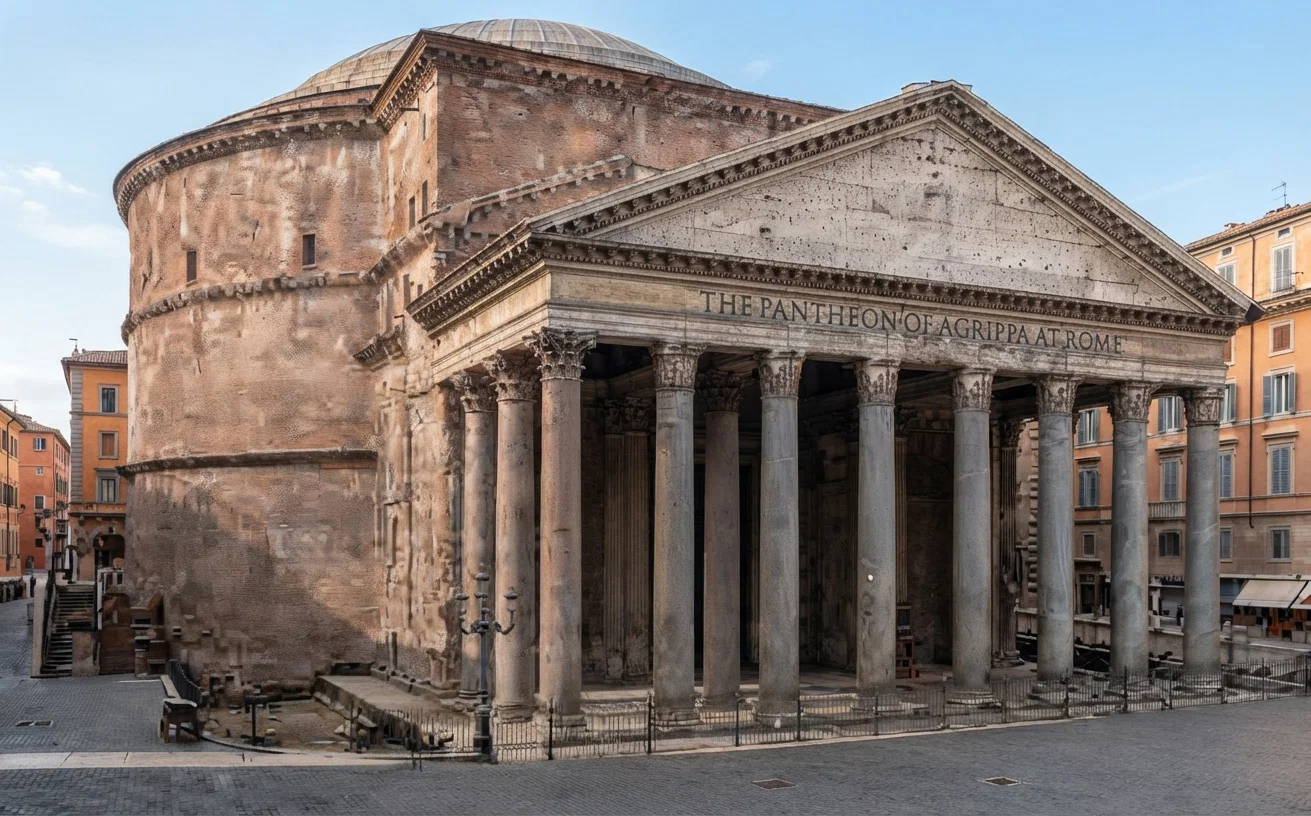
NOTHING of earth more pitifully brings to our mind the powerlessness of man, his unrealized ambitions, his hopeless struggles, and the sad end of all earth's hopes, than does the gazing upon some magnificent monument of the past, perhaps in ruin, devised by his brain and erected by his hand.
THE PANTHEON OF AGRIPPA AT ROME.
SUCH a monument is the one pictured on this page, the Pantheon at Rome, erected by M. Agrippa, son-in-law of Augustus Caesar, in the third year of his consulship, A.D. 27, the very year that Jesus Christ began His ministry. The name of the architect—Valerius of Ostia—is preserved to us. It is noted in history that the emperors Septimius Severus and Caracalla repaired the wonderful structure. This historic edifice is remarkable not only for its size, but for its magnificence and beauty. The external diameter is one hundred and eighty-eight feet; its height to the summit of its cornice, one hundred and two feet; and to the top of the dome, one hundred and forty-eight feet. Its portico, one hundred and three feet wide, its sixteen columns, forty-seven feet high, of polished granite with white marble bases and capitals, its gilded bronze roof, its marvelous decorations and ornamentations in stone and silver and bronze, gave the great pile "an extraordinary air of majesty." The walls were twenty-three feet thick, and the huge rotunda was lighted by an opening in the dome—like a great eye—twenty-six feet in diameter. It was a structure so beautiful that it has been said, "There is nothing wanted to desire, nothing committed to rectify."
IT was named the Pantheon, not signifying, as is generally supposed, Anthon tells us, devoted to the worship of all the gods, but from pan, "all," and theion, "divine," "all divine." It was dedicated to Jupiter Ultor, with niches for six more great deities, such as Mars, Venus, and others.
THE builders of the tower of Babel called it Bab-il, "the gate of God." God called it what all history has demonstrated it to be,—Babel, Babylon, confusion. Agrippa built his glorious monument and named it All-divine, but the subsequent history has demonstrated it all human. Pagan Christianity tried to preserve it. The emperor Phocas gave it to Pope Boniface IV. in 609, who dedicated it as a church to the Virgin and holy martyrs, "a quantity of whose relics were placed under its great altar." In 830 Gregory IV. dedicated it to "all the saints." But future emperors and popes despoiled it of its beauty. Some of its precious metals were carried to Egypt, whence Agrippa brought the plunder with which he built it. Urban VIII. robbed the structure of its bronze beams, amounting to over twenty-two thousand tons.
Now THE "all-divine" temple of humanity is stripped of its glory. Says a historian: "During the eighteen centuries it has suffered from the dilapidations of time and the cupidity of barbarians. The seven steps which elevated it above the level of ancient Rome are buried beneath the modern pavement. Its rotunda of brick is blackened and decayed; its leaden dome [formerly of gilded bronze], overlooked by the cupolas of every neighboring church, boasts no imposing loftiness of elevation; the marble statues, the bassi relievi, the brazen columns have disappeared; its ornaments have vanished; its granite columns have lost their luster, and its marble capitals their purity; all looks dark and neglected, and its splendor is gone forever."—Anthon. It was not worthy of preservation.
MAN can make nothing divine. Himself sinful, he can make nothing holy. He may carve beautiful forms from the dead marble, but they are cold, pulseless, irresponsive, lifeless images. He may polish huge granite shafts; the hand of time will mar and ruin his work. He is human, and his work is "all human," not "all divine." He is of the earth, earthy. He builds for self; it perishes. This is the negative side of the lesson.
THE positive side of the lesson is this: There is but one building of earth worthy of eternal preservation; and in that building every person has been, is, or will sometime be interested. That is the building of character. But one character shines out above all others, of which all others with any degree of worthiness are but reflections, and that is the character of Jesus Christ. Tho wrought out in this world at the very time when the Pantheon (the "All-divine") was building, tho condemned by the sinful of earth whom Christ came to save, that character is truly all divine, and will exist forever in never-dimming glory and luster. "Too low they build who build beneath the stars." And it is the privilege of every soul to be built up in Jesus Christ, to become "partakers of the divine nature," and finally to be "all divine" for all eternity, the sons of the living God. This is the ideal, the real, the glorious possibility of every soul who will build in Jesus Christ. "For in Him dwelleth all the fulness of the Godhead bodily. And ye are complete in Him." This is the lesson the Pantheon should teach every believer in Christ.