NOTWITHSTANDING the South African war, which is engrossing the attention of the British people largely to the exclusion of other matters, some here and there are making a determined stand against the encroachments of the Ritualists. The recent successful effort to hinder the instalment of Canon Gore as bishop because of his ritualistic sympathies, is evidence that this anti-Rome movement has some following among the people. But it must be admitted that the vast majority are totally indifferent regarding these matters, while a very influential and powerful minority are openly in favor of ritualism.
The writer attended, on the fourth inst. a huge Protestant demonstration in the Royal Albert Hall. The Right Hon. Viscount Midleton presided, and made a vigorous introductory speech. He was supported by Prebendary Webb-Peploe, Pastor William Cuff, Rev. W. R. Mowle, the Right Hon. Lord Kinnaird, and other speakers of some prominence, both churchmen and dissenters.
Three resolutions were presented, and adopted with a great show of enthusiasm, and without opposition. This will be understood when it is explained that the enormous audience was a select one, each person being admitted by ticket. The resolutions read as follows:—
1. That the steady growth of the mass and the confessional within the Church of England, is mainly due to the abuse of patronage by the government and by the episcopate, and especially to the action of certain of the bishops who seek to substitute their own personal rulings for the ascertained and well-known law of the land, as laid down by the King's judges.
2. That loyalty to the free constitution of Great Britain renders it needful that the Sovereign should give a personal pledge of his rejection of the destructive errors of the Church of Rome. This meeting therefore pledges itself to resist any attempt to tamper with or in any way weaken the plain meaning of the Royal Declaration, recognizing, as it does, that the revolution of 1688, to which we owe the existing Declaration, was the natural sequel to the Reformation of the 16th century, and forms at once its complement and its safeguard.
3. That the inaction of successive governments in allowing the open violation of the law which expressly provides for the exclusion of monks and Jesuits from residing in this country, and in refusing to provide for the impartial inspection of nunneries, is unstatesmanlike, seeing that the experience of all civilized countries has shown that the existence in any country of such communities is pernicious to society and a danger to all good government.
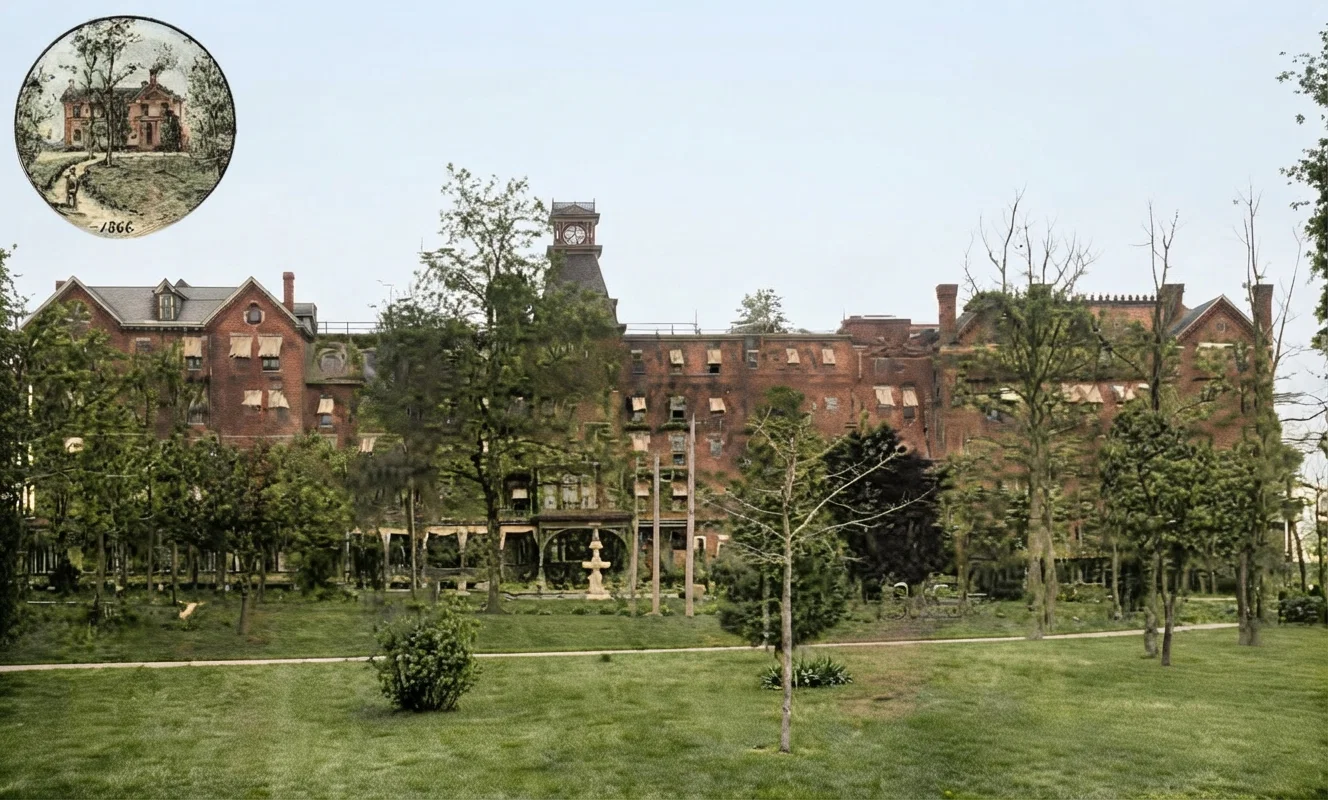
The main Sanitarium Building (Battle Creek, Mich.,) as it was before the fire. In the upper left-hand corner is a picture of the first Sanitarium building erected. It too was burned February 18; the hospital also, which stood on the opposite side of a narrow street at the left of the main building, was burned.
The general bearing of the first resolution will be understood in view of the fact that a considerable number of Church of England clergy are not only advocating the mass and auricular confession, but actually practising them in their churches in defiance of the general laws of the church.
Number two is aimed at any efforts to change the form of the king's oath, which, as it stands at present, makes him declare that he regards the mass and worship of Mary as idolatrous. This matter was discussed in last year's Parliament, and many prominent members expressed themselves in favor of altering the tone of the language, to make it less offensive to Catholics.
The flocking to England of the religious orders leaving France because of the restrictive legislation, is the immediate reason for the third resolution. It can not be denied that such orders are increasing very rapidly in this kingdom, and wielding a powerful influence in behalf of Romanist principles and doctrines.
Albert Hall was well filled with attentive listeners, and tho the meeting lasted some three hours, very few left before it closed. As a general rule, the speakers were moderate in their statements, but did not hesitate to express abhorrence for the doctrines of Rome and real concern over the ominous growth of papistical ideas in Britain. They rightly emphasized the importance of the Bible as the best weapon with which to fight error. "Urge your minister to preach the simple Gospel," they said. The condition of women in the convents, the general character and aims of the Jesuits, the fact that Rome has never changed, that she is still at heart a persecuting power—all these matters were fully set forth, and the audience cheered so loudly at times that the speaker's voice was entirely drowned.
Beholding the great sea of upturned faces and the general enthusiasm of both speakers and audience, one might be inclined to think that Ritualism was receiving its death-blow. But London, with its more than 6,000,000 human souls, has all sorts and conditions of people, and almost any party can make a pretty large showing. If Ritualists chose to do so, they might have just as imposing a demonstration, but they prefer to work underneath, and they will get what they seek all the sooner.
Such public gatherings as have just been described are being held in different parts of the country. But for the most part they are not very popular. The newspapers barely mentioned the demonstration in Albert Hall. And tho the program contained the names of over thirty members of Parliament said to be in sympathy with the objects of the meeting, it is significant that not one of these was present.
The general tendency in Britain, without a shadow of a doubt, is Romeward. The wind may play on the surface of the waters, making them move first one way and then another, but the stream flows on, slowly but steadily in one direction only.