ALCOHOL; ITS HISTORY, AND ITS EFFECTS UPON SOCIETY.
By W. H. Riley, M.D., Superintendent of Colorado Sanitarium, Boulder, Colo.
[All rights reserved.]
History of the Use of Alcohol.
INTOXICATING drinks, the basal principle of which is alcohol, have been known and used by almost every nation mentioned in history. From the remotest periods, in the most ancient records, we find allusions to its use, and it has a history exceedingly interesting. “There is nothing new under the sun,” and we accordingly find the spirituous beverage of to-day not among the inventions and discoveries of this great century of increased knowledge. Early discovered, the human family have tenaciously clung to it, seemingly finding in it the great antidote for dull care, sorrow, and the multitude of human woes. Generally considered a blessing, it has nevertheless been a viper nourished in the bosom.
We find reference made to intoxicants in the earliest historical records—the sacred classics—of the most ancient nations. The Rig-Veda, the sacred books of the ancient Brahmans of India, have references to two drinks of this character. A variety of beer, called sura, was made from rice, barley, and honey, with but little expense, and was popular among the common people. This was very intoxicating, and was in disrepute among the priesthood, by whom, however, the sacred wine, soma, was highly praised. This soma was offered as a libation to Indra, Vishnu, and other favorite gods, by whom it was also drunk. In order to make an acceptable offering, it was not necessary that the libation be entirely poured out, but the larger portion might be drunk, the pleasant after effects being a token of divine favor, and in nowise due to any ingredient common to the vulgar sura. The Chinese have for ages used these beverages, the early records mentioning wine made from grapes, and beer from rice.
The Bible gives an instance of intoxication from wine as far back as twenty-three centuries before the Christian era, and in the history of Judea the use of wine, both temperately and intemperately, was always known. Many allusions are made in the Scriptures to both the good and evil effects of wine. It is thought that two different kinds of wine are alluded to, the good results coming from the pure juice of the grape, the ill effects arising from that which had undergone fermentation. The effects of “strong drink” are portrayed to be the same as to-day. Drunkards are described as reeling “to and fro.” Besides mistakes in walk, stumbling, and losing their way, their sight was imperfect, and the judgment impaired as a result of the use of intoxicants. “They also have erred through wine, and through strong drink are out of the way; the priest and the prophet have erred through strong drink, they are swallowed up of wine, they are out of the way through strong drink; they err in vision, they stumble in judgment.”
The effect upon the stomach is also mentioned: “For all tables are full of vomit and filthiness, so that there is no place clean.” The question is asked, Who hath woe, sorrow, contentions, babbling, redness of eyes, and wounds without cause? The answer is, “They that tarry long at the wine; they that go to seek mixed wine.” And the wine at first enticing and attractive, at the last “biteth like a serpent, and stingeth like an adder.” The drunkard was assured that he would “come to poverty,” the same wretched condition witnessed to-day.
In the early history of Israel, drunkenness was severely punished. If a youth was addicted to gluttony and drunkenness, rebelling against the admonitions of his parents, he was to be stoned. Two priests, whose minds had become confused with liquor, burned common fire in their service instead of sacred, and for this were smitten with death. A woe was pronounced upon him who gave his neighbor intoxicating drink, and in later times all drunkards were declared to have no part in the kingdom of God.
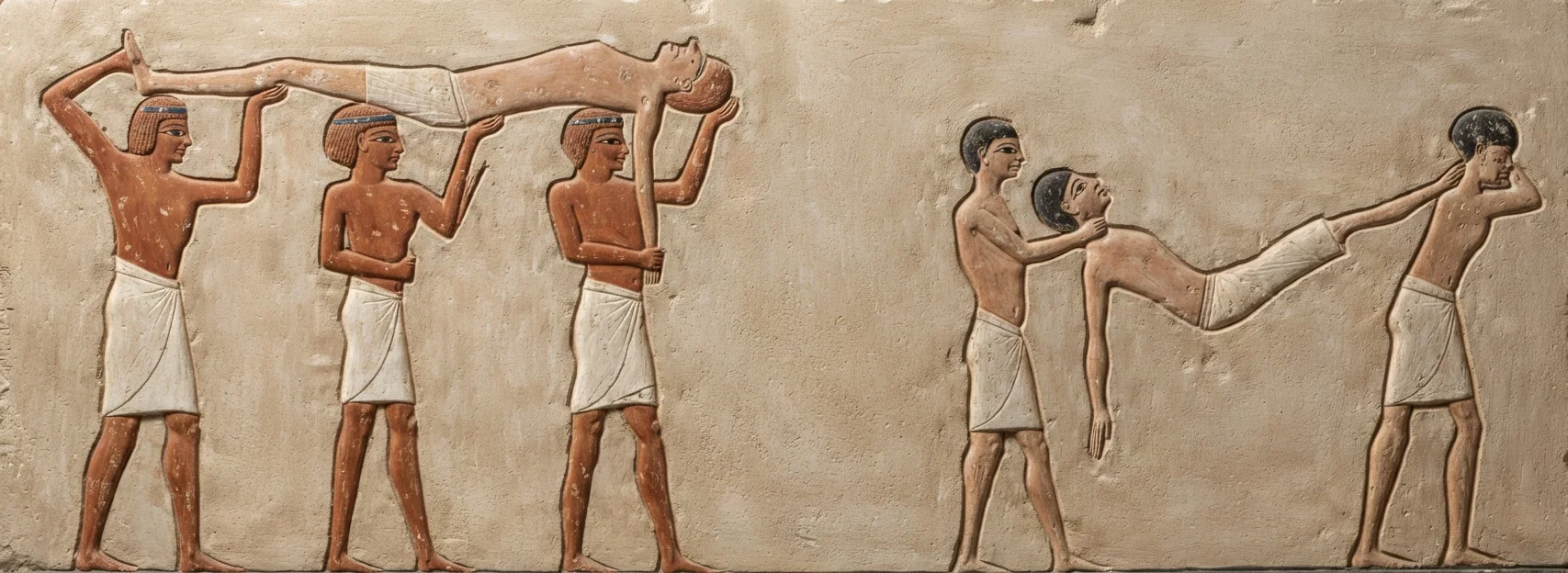
The Egyptians early discovered the art of making intoxicating drinks from barley and grapes. We have the testimony of Herodotus and other historians, and find similar records in the mural paintings on the ancient monuments. On the tombs of Beni-Hassan, by some thought to be 5,000 years old, is still to be seen the work of the artists of that day, who seem to have delighted in portraying the scenes of their every-day life. Among these pictures are to be seen vineyards, and a system of irrigation. We get an idea of their processes of making wine, which was either trodden out or squeezed in a bag by twisting. The storage and fermentation are also represented. There are seen genteel people drinking in their houses, and also those drinking immoderately, who act like beasts under its influence. The accompanying cut shows one of their portrayals of a man carried home drunk by his slaves. Women also are represented as indecently intoxicated.