THE gifts of God can not inure to any individual imbued with a spirit of selfishness. Neither can any gift of God be purchased with money. If it could be purchased, it would not be a gift. The richest man in the world must come to God just as the poorest must come,—as one owing an enormous debt, and having nothing wherewith to pay. How can one buy anything of God with money, when all the gold and silver are His already? Wherewith can sinful man pay the Almighty for aught, when "the earth is the Lord's, and the fulness thereof; the world, and they that dwell therein" (Ps. 24:1)?
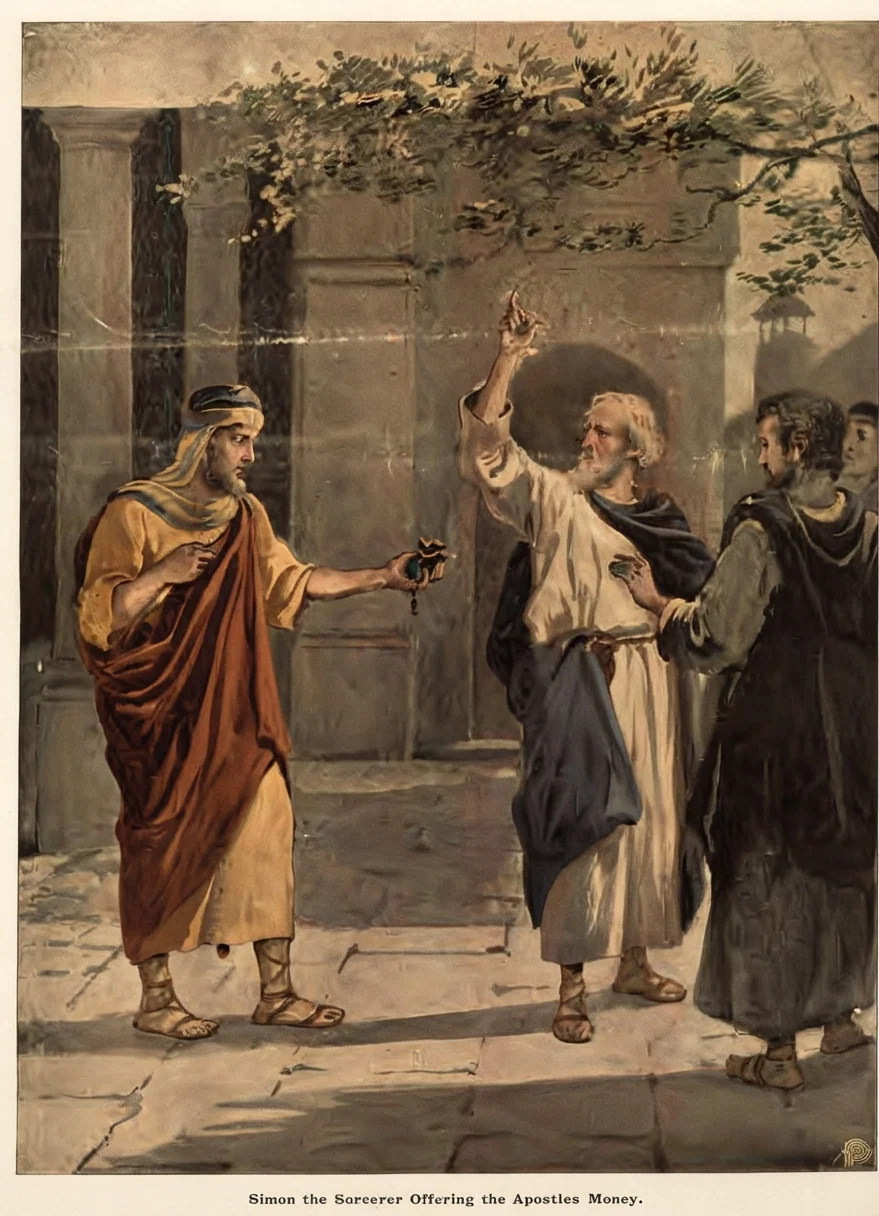
Simon the Sorcerer Offering the Apostles Money.
"THE gift of God is eternal life through Jesus Christ our Lord." Rom. 6:23. A rich man once came to Jesus and asked, "Good Master, what good thing shall I do, that I may have eternal life?" Jesus replied, "If thou wilt enter into life, keep the commandments." The young man claimed that he had done so from his youth up, and on this point the Master tested him. "Jesus said unto him, If thou wilt be perfect, go and sell that thou hast, and give to the poor, and thou shalt have treasure in heaven; and come and follow Me." The Lord did not want the man's money; but He wanted him to have the gift of eternal life, and selfishness stood in the way. His desire to hold onto his wealth, when there were so many poor around him, was proof that he was not keeping the commandment to love his neighbor as himself. So his money could not buy the gift of God, and his selfish spirit precluded his receiving eternal life even as a gift. Jesus loved the man, but this would not avail as long as he loved his earthly riches more than he loved the riches of God—eternal life. "A rich man shall hardly enter into the kingdom of heaven," because his riches have no purchasing power at the throne of grace. The best thing to which Jesus could point this rich man was to "keep the commandments." So He counsels all, "If ye love Me, keep My commandments; and I will pray the Father, and He shall give you another Comforter, that He may abide with you forever." John 14:15, 16.
WE have one instance of a man directly offering money to purchase a gift of God. No doubt many others have given money with the thought of buying such favor who did not so plainly express their minds. The man who was bold enough to make a direct offer of this kind was named Simon, and he lived in Samaria. He had gained a great influence over the people by the use of sorcery, or spiritism. In this way he "bewitched the people of Samaria, giving out that himself was some great one." So great was his influence that to him all the people "gave heed, from the least to the greatest, saying, This man is the great power of God. And to him they had regard, because that of long time he had bewitched them with sorceries." Acts 8:9-11. If Simon had really possessed the power he claimed, and with which he was accredited by the people, he would not have needed to buy any further power. If he were2"the great power of God," there was no more power to be had.
BUT there came a time when the power for evil by which Simon had been actuated must acknowledge a superior. Upon the dispersion of the disciples from Jerusalem after the martyrdom of Steven, "Philip went down to the city of Samaria, and preached Christ unto them. And the people with one accord gave heed unto those things which Philip spake, hearing and seeing the miracles which he did. For unclean spirits, crying with loud voice, came out of many that were possessed with them; and many taken with palsies, and that were lame, were healed. And there was great joy in that city."
THE fact that so many people were possessed of unclean spirits in a city where Simon, who claimed collusion with the spirits of the dead, was held in such high regard, showed the character and the result of his work. Seeing the greater power manifested in the preaching and miracles of Philip, Simon, in common with others, could not well refrain from acknowledging the truth thus portrayed. And to save as far as possible his prestige, he would naturally wish to identify himself with the new power. So when multitudes of the people believed Philip's preaching, and were baptized, "Simon himself believed also; and when he was baptized, he continued with Philip, and wondered, beholding the miracles and signs which were done." Simon's was just the kind of mind that would be "converted" by wonderful manifestations, when the plain truth would not have made any decided impression upon him. In this respect he has many counterparts in our own time. As a rule, such "converts" lose interest when the manifestations cease. To such apply the words of Jesus, "Except ye see signs and wonders, ye will not believe."
"Now WHEN the apostles which were at Jerusalem heard that Samaria had received the Word of God, they sent unto them Peter and John; who, when they were come down, prayed for them, that they might receive the Holy Ghost (for as yet He was fallen upon none of them; only they were baptized in the name of the Lord Jesus). Then laid they their hands on them, and they received the Holy Ghost. And when Simon saw that through laying on of the apostles' hands the Holy Ghost was given, he offered them money, saying, Give me also this power, that on whomsoever I lay hands, he may receive the Holy Ghost." Acts 8:14-19.
SIMON'S purpose to make merchandise of the religion of Jesus Christ, and to use it for selfish ends, revealed to the true Christian apostle the real condition of the mere professor's heart. The "discerning of spirits" is a gift of the Holy Spirit (1 Cor. 12:10), and on this occasion it enabled the apostle to detect the sordid principle of Simon's heart. In reply to Simon's offer, Peter said: "Thy money perish with thee, because thou hast thought that the gift of God may be purchased with money. Thou hast neither part nor lot in this matter; for thy heart is not right in the sight of God. Repent therefore of this thy wickedness, and pray God, if perhaps the thought of thine heart may be forgiven thee."
NOT only did Peter show to Simon of Samaria that the gift of God could not be purchased with money, but he has laid down the true principle in his writings: "Forasmuch as ye know that ye were not redeemed with corruptible things, as silver and gold, from your vain conversation received by tradition from your fathers; but with the precious blood of Christ, as of a lamb without blemish and without spot; who verily was foreordained before the foundation of the world, but was manifest in these last times for you, who by Him do believe in God, that raised Him up from the dead, and gave Him glory; that your faith and hope might be in God." 1 Peter 1:18-21.
ALL the gifts of God are comprised in the one gift of His Son. "He that spared not His own Son, but delivered Him up for us all, how shall He not with Him also freely give us all things?" Rom. 8:32. As redemption itself can not be purchased with money, neither can the gifts which inhere in the Redeemer.
G.