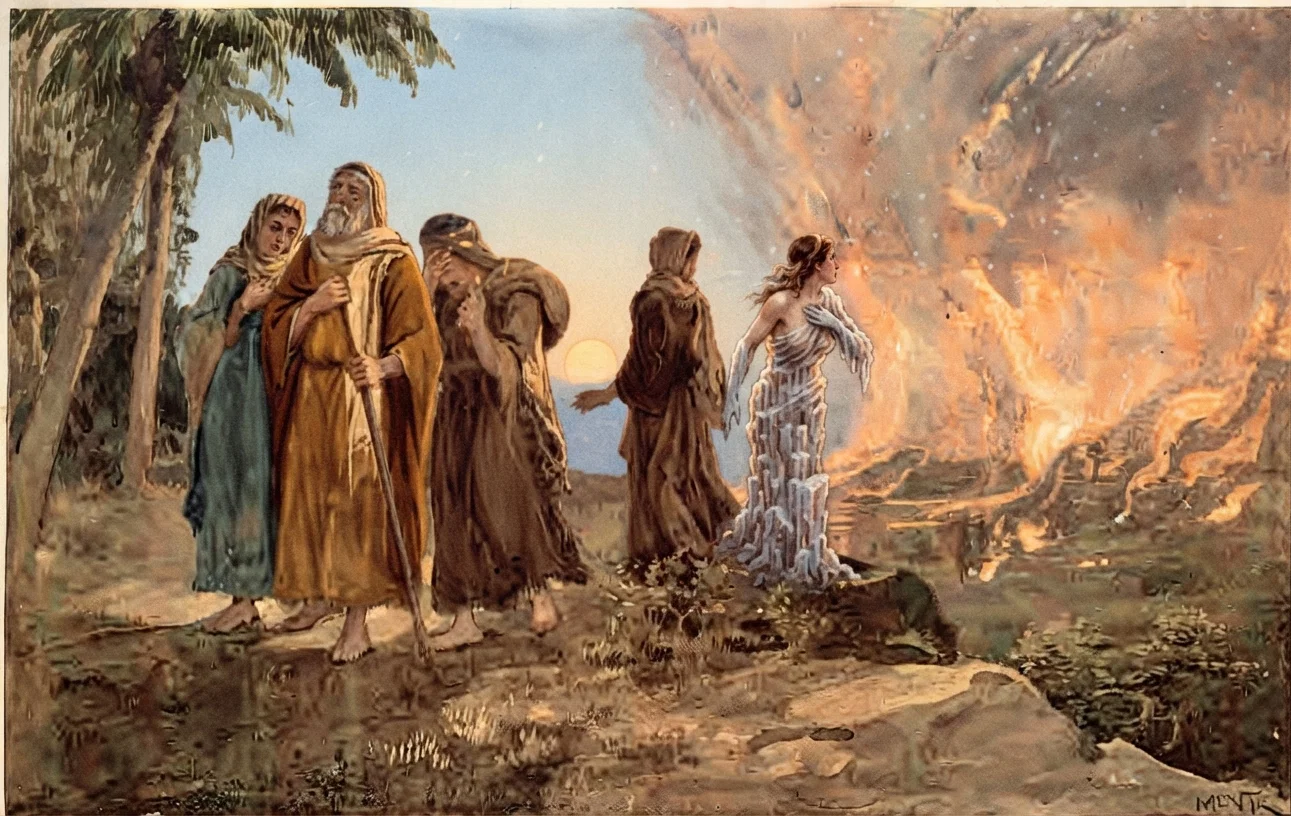
AT Bethel, in the land where dwelt the Canaanite and the Perizzite, Abram and Lot pitched their tents. And heaven smiled upon them, and their possessions of flocks and herds increased and multiplied and covered the land, even until "the land was not able to bear them, that they might dwell together."
A SEPARATION and migration became necessary. To the right or to the left one must go. To Lot was given first choice, and he "lifted up his eyes, and beheld all the plain of Jordan, that it was well watered everywhere, before the Lord destroyed Sodom and Gomorrah, even as the garden of the Lord. . . . Then Lot chose him all the plain of Jordan; and Lot journeyed east." And in the course of time he made his home in the city of Sodom.
FROM a worldly and business standpoint, it would seem that Lot had made a wise choice. Here flourished in lavish abundance the olive and the pomegranate, the palm and the luscious orange. Waving fields of grain mantled the pleasant hills, and beautiful vineyards lent of their fatness to delight the soul of man. And beyond stretched the great, green pasture lands. As the garden of the Lord it was, indeed. Hardly can we wonder that the sight pleased his eye, and that Lot pitched his tent toward the cities of this inviting domain.
"The sun was risen upon the earth when Lot entered into Zoar. Then the Lord rained upon Sodom and upon Gomorrah brimstone and fire from the Lord out of heaven; and He overthrew those cities, and all the plain, and all the inhabitants of the cities, and that which grew upon the ground. But his wife looked back from behind him, and she became a pillar of salt." Gen. 19:23-26.
IT was the golden era of the cities of the plain. And in the midst of this unrivaled scene of tropical beauty and overflowing plenty, like a gem in richest setting shone the fair city of Sodom, queen of the goodliest vale of all Palestine. Through her crowded marts flowed the wealth of the East and of the South, and at her summons the denizen of the great desert brought of his peculiar treasures to enrich her palaces and enhance the splendor of her temples, while art and philosophy and the science of the age flourished in her courts. But the multitudes ate and drank, and made merry with heaven's choicest blessings, and honored not the munificent Giver.
To us of a later age the name Sodom stands for corruption and every evil thing, and with it is associated the thought of terrible punishment. Not so when Lot looked with longing eyes on her dazzling magnificence. We say now that he should have looked beyond the temporal prospects and delights to the probable moral effect upon himself and his family, for he knew that the inhabitants of the cities of the plain were idolaters. But he knew not how ugly and black was the wickedness that was lightly concealed beneath the glittering exterior. He had to learn by the bitterest experience that there is awful danger in association and affiliation with a godless generation. In the end he was bereft of wealth and home, of wife and married daughters, and hardly escaped with his own life. Of Lot the record tells us that he maintained his integrity toward God amid the corruptions of Sodom. But in the records of that city's last hours and Lot's later history, we clearly discern the benumbing effects of its corrupt practises and teachings upon him and his family.2
WEALTH and plenty, without God, are the highways to ease and idleness and the luxuries and pleasures of sin. Sodom the beautiful lay at the conjunction of all such highways. "Behold," said the Lord, "this was the iniquity of thy sister Sodom, pride, fulness of bread, and abundance of idleness was in her and in her daughters, neither did she strengthen the hand of the poor and needy. And they were haughty, and committed abomination before Me." Every imagination of the thoughts of the heart was only evil continually; for the time was as it was in the days of Noah before the flood. They ate, they drank, they married wives and were given in marriage, they bought and sold, and planted and builded. These things, right in themselves, become wrong when wrongfully used. Worldly gain, worldly prosperity, the pleasures of the present, were the gods of Sodom.
BUT the day of visitation and punishment came silently and unexpectedly, and with appalling suddenness. The knowledge of God and of His character had been scorned once too often. The evil-doers suffered summary punishment for their evil deeds, and their fate became an object lesson for all that should live thereafter. The history of Sodom is the pre-drawn picture of the conditions that mark the last generation upon earth, and her end is the fate of the ungodly. It is a page from God's lesson book for this day, and a solemnly-thrilling page it is. Said the Master,—one of the three who came to destroy Sodom of old,—"Likewise also as it was in the days of Lot; . . . even thus shall it be in the day when the Son of man is revealed."
OF the evil and its fate God warns the whole world, and bids His followers flee from the final and everlasting destruction of modern Sodom. He warns them not to be contaminated with her wicked influences and seductive associations, but to fix the heart's affections so entirely on things of heaven that there may not be the slightest desire to cast backward one lingering look. "Remember Lot's wife." Her fate,—destruction,—is the fate of the world-loving, the wealth-loving, and those who do not see in eternal salvation and the all-healing power of a loving Father more to be desired than the closest ties even of earth. "Escape for thy life; look not behind thee," is the startling cry that sounds in the ears of every soul. The day of the Son of man is at hand.