Our London Letter

4%

Pacific Press Publishing Company · Mountain View, California · Jun 19, 1907

FromSigns of the Times, Vol. 33, No. 25.

Read the full edition

Our London Letter

From Our Own Correspondent

Extremes of Life.

SPRING has come in good earnest, and the London parks are fairly aglow with tulips and daffodils and all the other gay messengers of summer, while the greensward is sprinkled with crimson-tipped daisies, and in the outlying woods there are violets, primroses, and anemones without number. The gay society season will soon be here. The operas open next week, also the Royal Academy, and entertaining on an enormous scale will shortly be under way. There is an impression that the State balls and other entertainments will be unusually brilliant, and this will naturally have its effect upon other social functions, royalty always taking the lead. After a couple of months of fashionable dissipation of the most taxing kind, we shall see society people dragging themselves off to the various watering places where they will drink bad-tasting mineral waters, take daily baths, keep reasonably early hours, and thus in some measure try to atone for the season's follies.
So much for the world of fashion, which, however, only represents a small portion of London's teeming millions. We have only to turn into one of the poorer districts to see want and wretchedness everywhere manifest. Poor, ragged children come in thousands to the large public schools so hungry that it has become necessary to give them some bread and milk to satisfy their empty stomachs before proceeding with the lessons for the day. And the public houses (saloons) are still nightly thronged with poor unfortunates, including hundreds of mothers with infants and children, with whom they share the fiery drink which is ruining their lives.

Efforts to Blot Out a Great Evil.

The drink evil, as referring to infants and small children, was mentioned in my previous letter, and I slightly delayed sending this letter in order to attend a meeting of the committee appointed to consider measures for making an end of this monstrous wrong. The committee met in one of the committee rooms of the House of Commons, and the chair was taken by Mr. Thomasson, M.P., editor of the "Tribune," London's leading Liberal daily. Among the other prominent members of Parliament in attendance were Sir Walter Foster, Mr. Hardy, Mr. S. Collins, Mr. Shackleton, and Mr. C. Roberts. There were also several clergymen, and officers of some of the large temperance organizations, including quite a number of women. The chairman, in a brief resume of the movement, which had its origin in a series of articles entitled "The Cry of the Children," which appeared in the "Tribune," stated that some five hundred public meetings had been held in the last few weeks in support of the movement, and that 180 members of Parliament had expressed their sympathy and promised their hearty cooperation. The meeting had been called to consider two matters especially: First, the wording of a clause to be added to the Government's Licensing Bill which would exclude the children from the public houses. Secondly, the question whether it would be well to organize a great public demonstration in London in behalf of the movement. The clause finally agreed upon fixed the age limit at fourteen, and the penalty for the first offense at forty shillings. It was decided that the public demonstration should be held, and a subcommittee was appointed to make the arrangements. While the meeting was in session a message was received from one of the members who could not come, stating that he had received assurances from a member of the government that favorable consideration would be given to any practical measure that the committee might recommend.
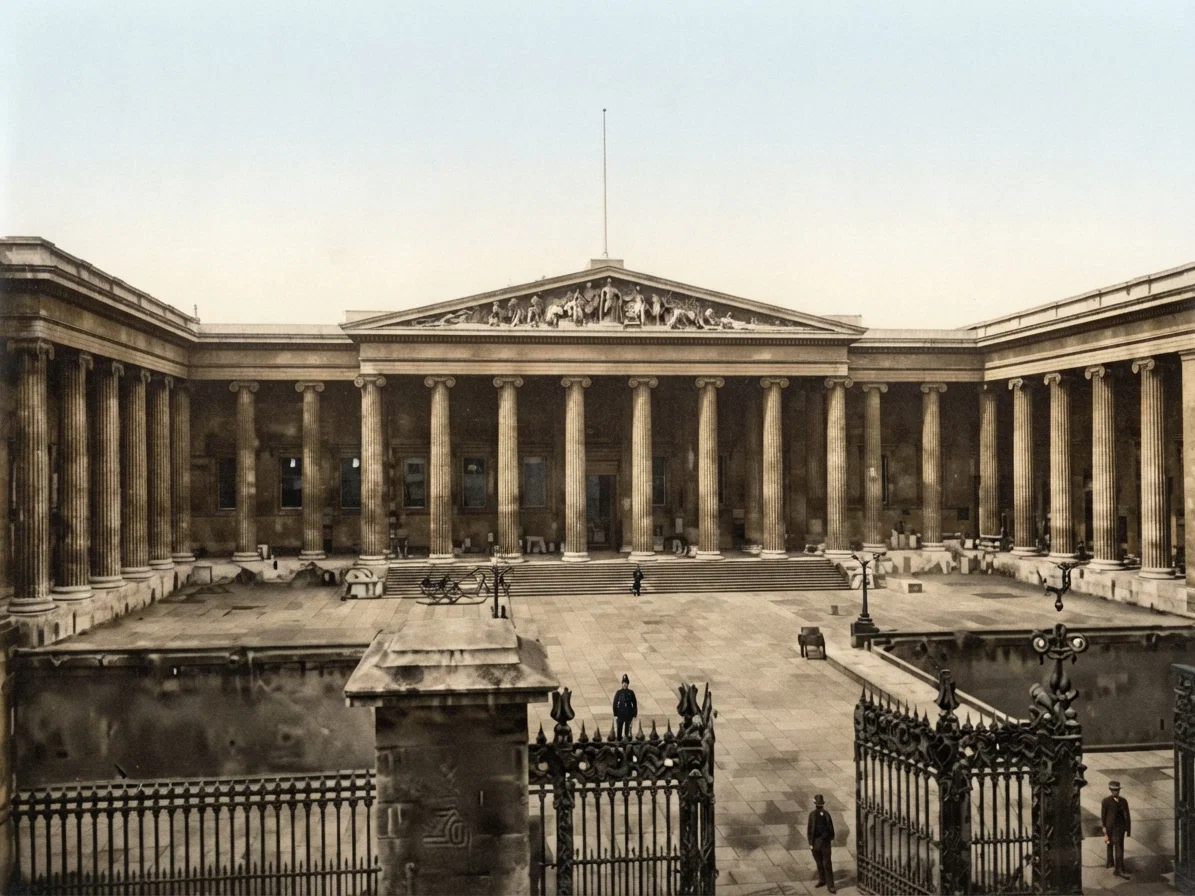
British Museum.
British Museum.
Straws show the way the wind is blowing. Meetings of this character held in the historic House of Commons itself, pleasantly remind us that the country has entered upon a new regime, and that some of the most pressing social evils will have genuine consideration at the hands of the government. Of course legislation can not do very much at the best, and one of the marked features of the committee meeting referred to was the general recognition given to this fact. Personal effort, it was repeatedly pointed out, must at every point supplement the hand of the law; otherwise but little could be accomplished.

The Colonies.

The Colonial Conference has created quite a stir of late. England is proud of her colonies beyond the sea, and is lavishing her hospitality upon their representatives. There have been any number of brilliant banquets, and on Wednesday they were entertained to luncheon in the historic Westminster Hall, the Prime Minister presiding. General Botha is the most popular man among them,—he who only a very few years ago was commander-in-chief of the Boer army. Now he is premier of a British colony! Truly the English are a magnanimous people.
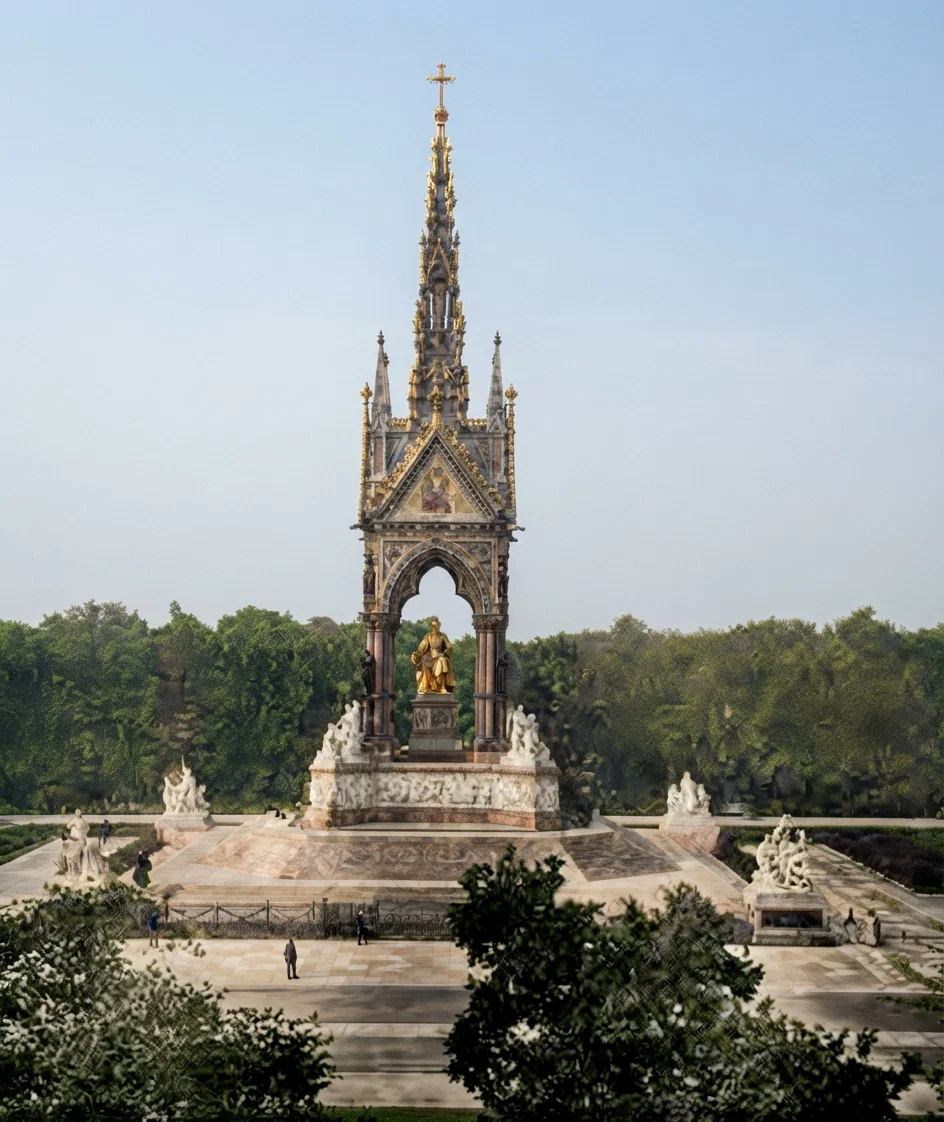
ALBERT MEMORIAL, LONDON, erected to the memory of Albert, Prince Consort to Queen Victoria, as a tribute of their "gratitude for a life devoted to the public good." Cost 120,000 pounds. The height of the whole, 175 feet.

Government Matters.

In the House of Commons the Opposition has used to the utmost its powers of obstruction, so that the government has made but slow progress. The Army Bill and the Budget have been occupying most of the time lately. Mr. Haldane's scheme for the reorganization of the army is too complicated to go into here; but its main purpose is to do away with unnecessary red tape and with over-lapping, and get something that will be efficient in time of war and not unnecessarily expensive in time of peace. The bill has received commendation from some of the leading Conservative organs, and is generally approved by Liberals; so it is likely to go thru, perhaps with some alterations.
The Budget is interesting chiefly as making provisions to the extent of some two and a half millions for old-age pensions. In other words, Mr. Asquith is setting this sum aside for that purpose. Next year a measure will probably be brought before the House authorizing the payment of such pensions. Old-age pensions have been talked about for years; this is the first time that any tangible move has been made by the government in behalf of such a scheme. We see here the influence of the Labor party, which suddenly came to the front as a shaping and controlling force at the elections something over a year ago.

The New Theology.

Mr. R. J. Campbell is still preaching the New Theology, and multitudes go to hear him. He went down to Bristol a couple of weeks ago at the invitation of some of the leading clergymen. Bristol is next to London the largest city in the south of England, and is generally considered a very conservative place.But the crowds that turned out to hear the famous preacher could not be accommodated. I happened to be in Bristol on business at the time, and was invited to attend a meeting of pastors, at which Mr. Campbell was to state his belief in an informal way, and then submit to be "heckled." Admission was by ticket only and yet a large church was well filled. Some pretty good questions were put, but the speaker carried the audience with him for the most part in his answers.
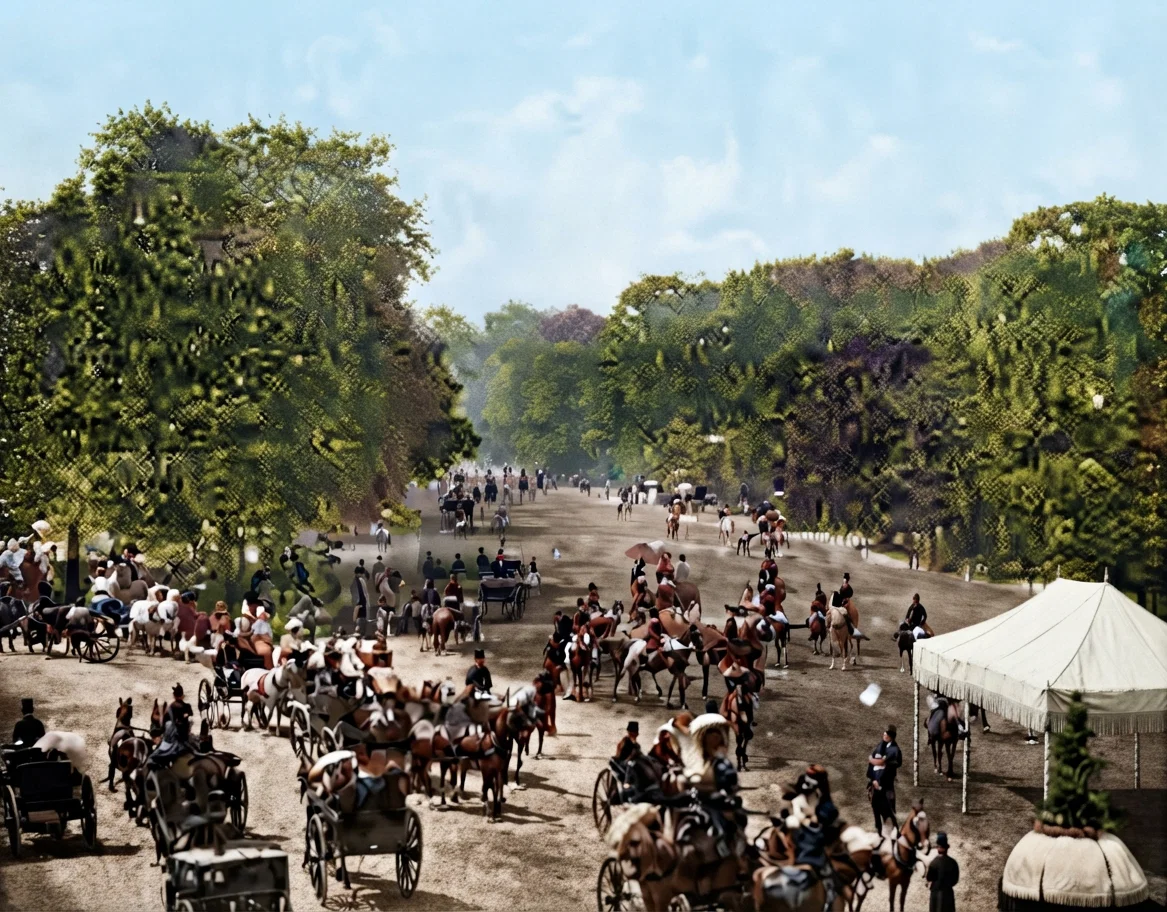
Rotten Row, Society Drive, London.
This meeting fully convinced me that the New Theology in its essence is a human philosophy very closely resembling if not wholly identical with what used to be termed infidelity or atheism. It has something in common with Deism, and is certainly not far off from modern Unitarianism. Perhaps it is best not to classify it too closely. One thing is certain, it is not founded on the word of God. But it is to be feared that the popular Christianity of to-day is not founded on the Infallible Word, nor are the great creeds of Christendom built upon that firm foundation; hence the disadvantage under which other clergymen labor in dealing with this heresy. They can appeal to the creed, but Mr. Campbell says it is man-made, and that his own creed fits the present age better than theirs. Neither acknowledges the word of God as final arbiter; hence there can be no real settlement of the questions at issue.
What the final outcome will be it is not possible to indicate definitely at the present moment. When the novelty wears away, Mr. Campbell's audiences will probably dwindle, tho while he continues to preach on present lines he is always sure to have quite a large following of those who have lost their hold on vital Christianity, and are looking for something to take its place.
Rather significant are Mr. Campbell's expressions of sympathy with Socialism. A few weeks ago he spoke from a Socialist platform for the first time in his life. In the course of his address he said: "I am a Socialist because I am a Christian as I understand the word." He went on to say that the church of tomorrow belonged to the Socialists. "In point of fact, the New Theology was the theology of their movement, and that was the theology of the kingdom of God. The Labor movement, which was international, was the true Catholic Church, although it did not know itself by that name." Socialism has shown itself bitterly antagonistic to the churches, and its leading organ, the "Clarion," is an avowedly agnostic in its teachings. Mr. Campbell's remarks are the more significant under these circumstances.
M. ELLSWORTH OLSEN. London, April 26, 1907.
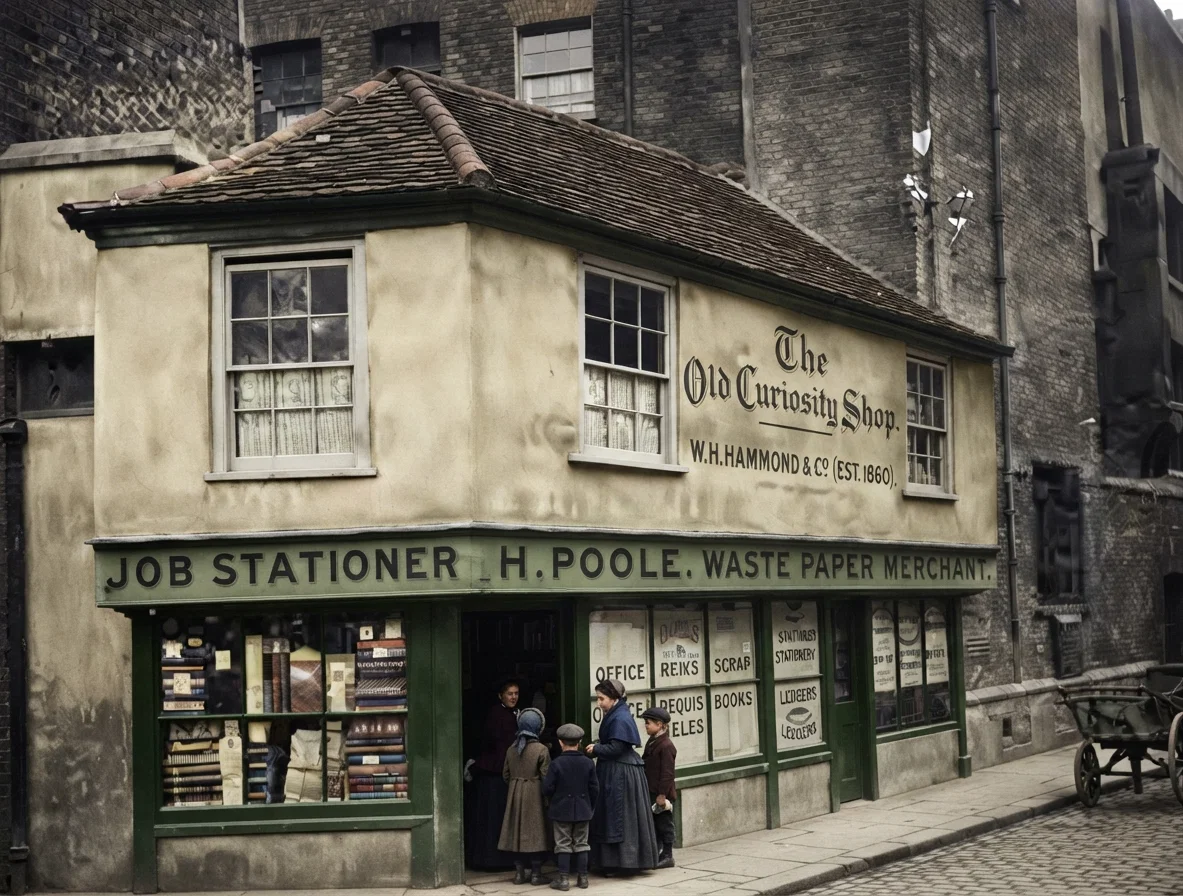
Old Curiosity Shop, London.