COMFORT OF GOD

8%

Pacific Press Publishing Company · Mountain View, California · Oct 4, 1905

FromSigns of the Times, Vol. 31, No. 40.

Read the full edition

COMFORT OF GOD.

NEARLY sixty miles Jacob traveled that day in the burning Syrian sun, as he fled in eager haste from the hot wrath of his brother Esau. He had gotten the appetite-loving, lust-loving Esau to sell him his birth-right by taking advantage of him while he was faint and hungry from the chase; and then by deceit he had obtained his father's blessing. And the two wrongs were too much for the not over-scrupulous wild hunter. He had spilled the blood of many an innocent animal, and his loose code of morals easily made his lust for Jacob's blood justifiable; and therefore he swore vengeance upon the more pious Jacob.
FEARING that the son, concerning whom God had spoken, might die at the hands of his vengeful brother, the parents sent Jacob away to Fadan-aram, where lived his mother's people. They gave him instruction to obtain from thence a wife. Jacob started, an exile from home through his lack of faith, never to see his mother again in this world. God had predicted His kinship and blessing; why did not he and his mother let God work it out in His own way? There is no device of man that can counterwork God's plans. Like many others, Jacob felt, and Jacob's mother felt, that they must do something, even tho it involved duplicity, in obtaining the promise of God. Out of this carnal policy grew years of sorrow, care, and anxiety.
FROM Beersheba, in the south of the Holy Land, to Haran, Jacob's objective point, was a long stretch of over four hundred miles, and Esau, the fierce hunter, might be trailing close behind, as he had often trailed the hunted hart. So Jacob hurries forward. He reaches a quiet, secluded place as the sun goes down. His heart is lonely and sad, and his conscience smites him sorely for the evil he has done. He has been a home boy all his life; now his overweening desire for the family birthright and blessing, which he coveted, evidently not for spiritual ends, but temporal, had driven him an exile from home, a wanderer in a strange land. Forced from his parent's home, hated by his only brother, truly he was alone; and the wild animals of the desert, seeking their prey as night settled down, must by their cries have deepened the utter loneliness of the night.
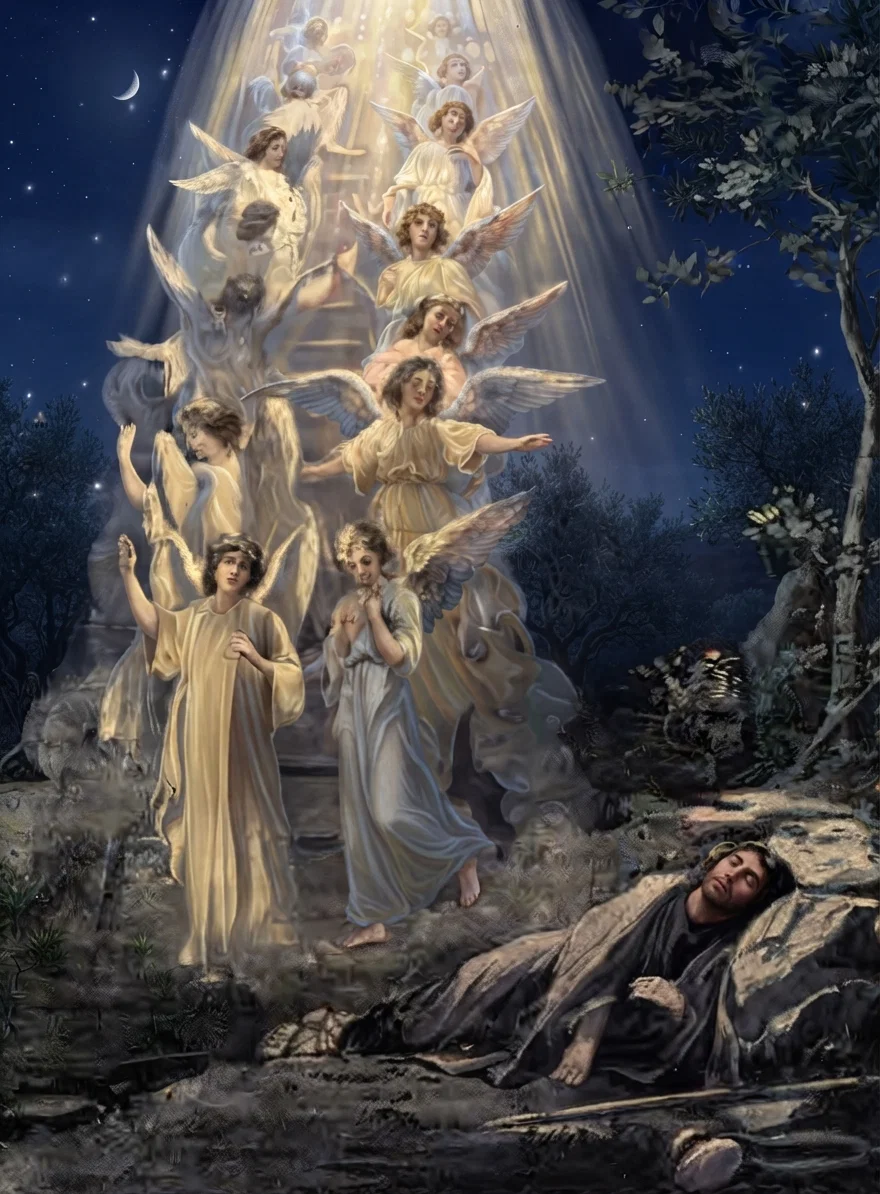
JACOB, utterly weary, takes a stone for his pillow, and lies down to rest. He does not even pray, for he feels that God has forsaken him. But it is such hearts as his that God delights to comfort. Here was beginning the repentance of Jacob, the humiliation of heart, which extended over years of his life. "Blessed are the poor in spirit; for theirs is the kingdom of heaven." Jacob was feeling his poverty of soul. "Blessed are they that mourn; for they shall be comforted." Jacob was mourning his sin and folly.
GOD had not forgotten. Despicable as Jacob's action may have seemed from a generous social standpoint, his heart was better than his sport-loving brother's heart. Jacob believed God. He remembered the Abrahamic promise. He had heard of the predictions of God upon the seed of Abraham and of Isaac. He regarded God's promise and blessing more than all else, while Esau was ready to sell his birthright to promise and blessing for a mere mess of pottage that he loved. Thousands are standing today where Esau did, ready to barter all the promises of God for lust, for pleasure, for power, for wealth, for fame. God knew Jacob's desire, and while He could not approve Jacob's method, He did his desire, and regarded his repentance.
THEREFORE, to the stone-pillowed sleeper heaven was opened, and God's love and care were revealed. The gulf of sin between earth and heaven was bridged by God's love, and heavenly messengers were passing to and fro between the throne of God and earth's needy ones. From that throne came this Voice to the heart-broken man: "I am Jehovah, the God of Abraham thy father, and the God of Isaac; the land whereon thou liest, to thee will I give it, and to thy seed. . . . Behold, I am with thee, and will keep thee whithersoever thou goest, and will bring thee again into this land; for I will not leave thee, until I have done that which I have spoken to thee of."
WHAT mighty words of comfort were these! They awaken the sleeping man, no longer weary. "Surely," he declares, "Jehovah is in this place; and I knew it not. And he was afraid, and said, How dreadful is this place! this is none other than the house of God, and this is the gate of heaven." And that experience cheered the wandering exile and patriarch all his days.
He rises early, takes his stone pillow, sets it up a monument of Jehovah's love, and names the place Beth-el, House of God. There he consecrates himself anew to God's service, that he may be a worthy son of Abraham.
NOT for Jacob's sake was this written, but "for our learning, that through patience and through comfort of the Scriptures we might have hope." Rom. 15:4. The gulf between heaven and earth has been spanned by the love of God in Christ Jesus. He is the connecting link between God and man—His name, "Immanuel"—God-with-us. And His mighty, white army of angels stand ever ready with willing wing to visit every troubled soul and minister to it the comfort of God. He is no respecter of persons. He is willing to help you to-night. He is just as near as He was to Jacob in that far yester-night, which broke with the dawn of new hope, and transformed a bed of earth to a house of God. He is as near California or America or Canada as He was and is Syria, and He would have us believe and sing with the poet:
"Henceforth my heart shall sigh no more For olden time or holier shore, God's love and blessing then and there Are now, and here, and everywhere."