WE have seen that the Jewish people fell far short of the purpose of God for them; and the book of Zechariah was written at the time when God was seeking to encourage them and to lead them to grasp by faith all the promises that He had given them. In order better to understand the book, let us review a little more carefully the circumstances under which it was written.
Going back to the time of the major prophets we find that even Isaiah and all who followed him warned that people of the danger of forgetting God. In 2 Chron. 36: 14-20 we have the following statement concerning them:—
"Moreover all the chief of the priests, and the people, transgressed very much after all the abominations of the heathen; and polluted the house of the Lord which he had hallowed in Jerusalem. And the Lord God of their fathers sent to them by His messengers, rising up betimes, and sending; because He had compassion on His people and on His dwelling-place; but they mocked the messengers of God, and despised His words, and misused His prophets, until the wrath of the Lord arose against His people, till there was no remedy. Therefore He brought upon them the king of the Chaldees, who slew their young men with the sword in the house of their sanctuary, and had no compassion upon young man or maiden, old man, or him that stooped for age; he gave them all into his hand. And all the vessels of the house of God, great and small, and the treasures of the house of the Lord, and the treasures of the king, and of his princes; all these he brought to Babylon. And they burnt the house of God, and brake down the wall of Jerusalem, and burnt all the palaces thereof with fire, and destroyed all the goodly vessels thereof. And them that had escaped from the sword carried he away to Babylon; where they were servants to him and his sons until the reign of the kingdom of Persia."
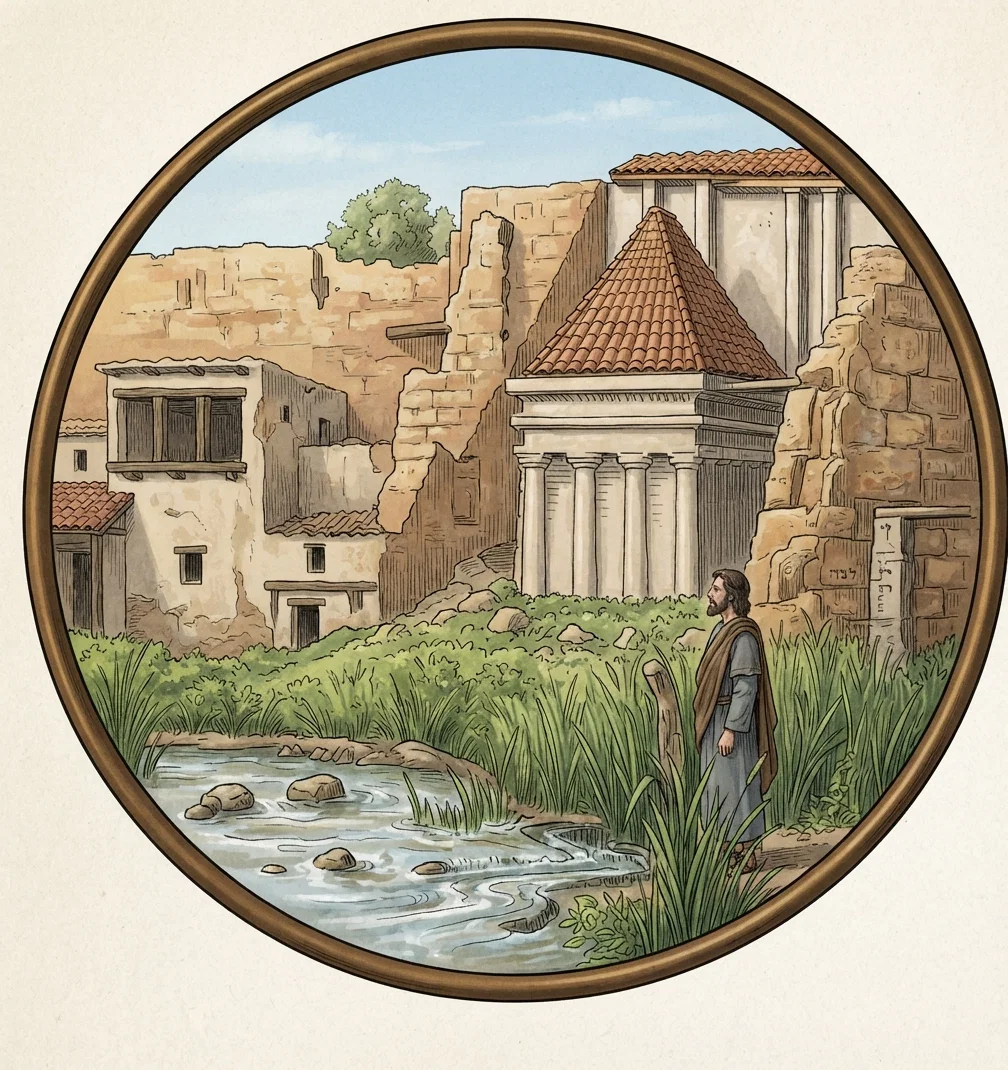
For a period of seventy years the city of Jerusalem was in ruins, the tombs of their fathers broken down, the walls of their city demolished, the beautiful temple a mass of ruins, and "Ichabod" written upon it all. At the end of this time the Lord moved upon the Persian monarch, Cyrus, to issue a decree for the restoration of the temple and to permit the people to return to their land. Under this decree some of the people returned, and the work of rebuilding was begun; but enemies beset them on every side. Only few, comparatively, had returned, and among them, fewer still had the faith in God which would enable them to grasp the fulness of His promise. Instead of laying a foundation of the temple grand and beautiful as the one described by the prophet Ezekiel, they laid the foundation of one far inferior even to the temple of Solomon.
At the laying of this foundation we find there was a mingling of the voice of weeping and the voice of rejoicing; for while the young men rejoiced, the old men who had seen the temple of Solomon gave themselves up to sadness. They were greatly disappointed; for God through Ezekiel had portrayed the building of a temple at Jerusalem which was to far exceed the glory of the temple of Solomon. At this time God raised up the prophets Haggai and Zechariah to encourage the people. By comparing the first verse of Haggai with the first verse of Zechariah it will be seen that these two prophets began their work in the same year and within two months of each other.
Haggai told the people not to weep or be discouraged at the prospect before them, but urged those who had seen the temple of Solomon in its glory to be strong in the Lord; assuring them that the glory of this latter house should be greater than that of the former; that altho they had come far short of God's purpose and plan, yet the Desire of all Nations should come to this house, and fill its courts with His presence. The Lord was ready to carry out His plan, even tho the people had failed in meeting His mind. With these facts before us, we will now enter upon a more careful study of the book of Zechariah.
We shall need to keep in mind that while God continued to encourage this people and to lead them to grasp all that was possible for them to grasp of the promises of God, yet God knew that they would fall short of it; hence in the symbols given by this prophet we shall have set before us not only the experiences of that people, but the experiences of God's people to the end of time, when God's purpose will finally be carried out.
After the introductory statement in the first verse giving us the time of the prophecy, and also stating the agent through whom God would speak, we have set before us in verses 2-6 the certainty of God's word. The statement is first made, "The Lord hath been sore displeased with your fathers." The prophet is to say to the people, "Turn ye unto Me, saith the Lord of hosts, and I will turn unto you. Be ye not as your fathers, unto whom the former prophets have cried, saying, Thus saith the Lord of hosts; turn ye from your evil ways and from your evil doings: but they did not hear, nor hearken unto Me, saith the Lord. Your fathers, where are they? and the prophets, do they live forever? But My words and My statutes which I commanded My servants the prophets, did they not take hold of your fathers? and they returned and said, Like as the Lord of hosts thought to do unto us, according to our ways, and according to our doings, so hath He dealt with us."
Thus the prophet was to call them to witness that the Word of the Lord had stood fast, while their fathers had passed away; and tho the prophets who had spoken the Word had passed away the Word had remained, and the thing spoken had been accomplished. From this they were to learn that the Word of God spoken in their day by the mouth of His prophet would just as surely come to pass; and if they, like their fathers, refused to heed His words, so they, like their fathers, would pass into darkness and oblivion.
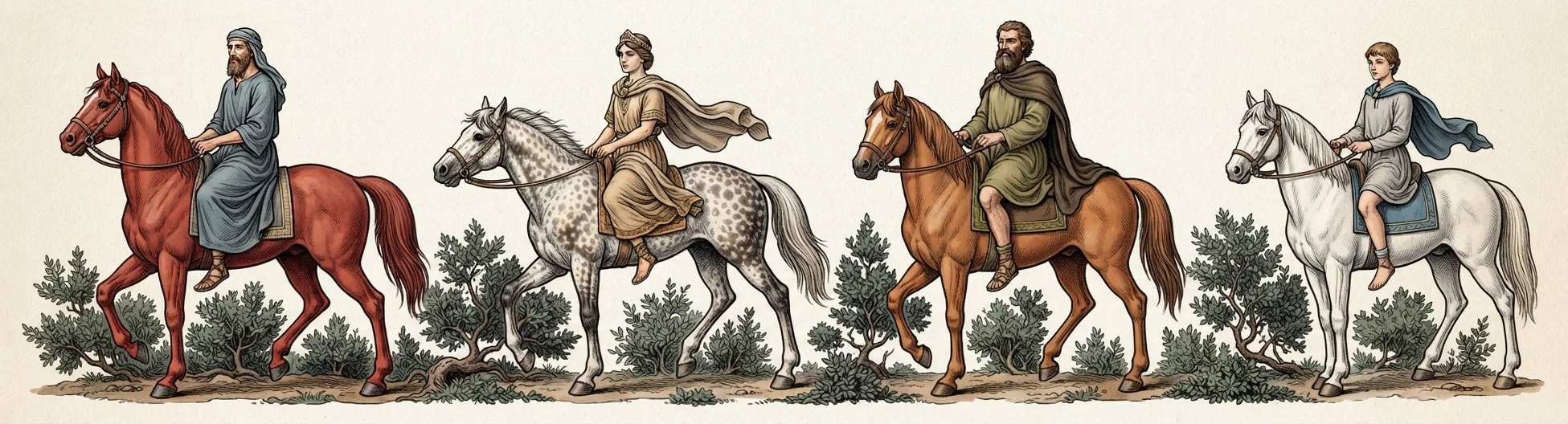
In verses 7-10 we have recorded the first symbolic vision of Zechariah. In this vision, given on the twenty-fourth day of the eleventh month, the prophet saw in the night vision "a man riding upon a red horse, and he stood among the myrtle trees that were in the bottom; and behind him were there red horses, speckled, and white. The prophet asked the question, "O my lord, what are these?" And the angel answered, "I will show thee what these be. And the man that stood among the myrtle trees answered and said, These are they whom the Lord hath sent to walk to and fro through the earth. And they answered the angel of the Lord that stood among the myrtle trees and said, We have walked to and fro through the earth, and, behold, all the earth sitteth still and is at rest."
In studying these symbols I wish first to notice the fact that there are three bands of horses following the first red horse, namely,—red horses, speckled, and white.
Trees are often taken to represent kings; so the myrtle trees here represent the kings of the earth. Another king, represented by the man riding upon a red horse, comes and takes his place among them; and following it are three other powers, symbolized by the three different-colored horses which were behind them. But we notice that the destiny of these is not simply to take their places among the myrtle trees, but that they are to walk to and fro through the whole earth, symbolizing a universal dominion. Thus we have four universal kingdoms brought to view.
When the prophet asked the meaning of the symbol, the answer is said to come not from the angel, but from the man on the red horse, or from the first of these powers. That the purpose and intent of these powers would be clearly set forth by the career of the first one, Nebuchadnezzar, as he went from nation to nation establishing his authority and extending his dominions until he walked to and fro through the earth, gave the answer to the question. That the kingdom of Babylon, under the leadership of Nebuchadnezzar, was one of those whom the Lord sent forth to walk through the earth becomes apparent from these words of Jeremiah:—
"I have made the earth, the man and the beast that are upon the ground, by My great power and by My outstretched arm, and have given it unto whom it seemed meet unto me. And now have I given all these lands into the hand of Nebuchadnezzar the king of Babylon My servant; and the beasts of the4field have I given him also to serve him. And all nations shall serve him, and his son, and his son's son, until the very time of his land come; and then many nations and great kings shall serve themselves of him." Ch. 27: 5-7.
His kingdom was to be followed by three others, each in turn to sway the scepter of universal dominion. Medo-Persia, Grecia, and Rome successively came to power, performed their part of the tragedy, and passed from the stage of action. But the prophecy says that when they have walked through the earth, then shall the whole earth sit still and be at rest. We find the explanation of this in the fact that when these kingdoms have fulfilled their appointed stations among the nations, then shall there arise the fifth universal kingdom, even the kingdom of the Son of Man, under whose benign and peaceful reign all the world will be at rest.
Standing to-day near the time when the kingdom of peace is soon to be established, we have opportunity to cast a glance backward over this world's history, and, what a picture do we behold!—the earth as one vast battle-field over whose sin-cursed surface the armies of the nations have chased each other to and fro with hands reeking with gore and clad in dyed garments of Bozrah. Here and there we see the vast columns of smoke ascending from the cities and villages fired by the incendiary hands of greed and blood. Other cities appear on the scene with walls falling before the violent assault and siege of the foe. The inhabitants are fleeing in terror only to be overtaken and slain. The babe is snatched from the breast of the mother, and despite her pitiful pleadings, is dashed against the stones. Age and youth are alike disregarded. The tottering grandfather, stooped with the weight of years, lies side by side with the toddling infant, their life-blood mingled in one common pool. Maranding hosts and conquering armies sweep over fertile regions, dotted with the homes of peace and comfort, and their track is marked by a trail of blood, fire, smoke, and desolation. Wreck and ruin, rapine and carnage, furnish both the background and the foreground of the picture, for the scene extends like a vast panorama from the dim centuries of the past down to our feet.
About us to-day the nations are getting angry; extensive preparations are being made; mighty engines of destruction are multiplying; magazines are being stored, mines are being laid, the hosts are marshaling. The hand of more than one power is extended to-day to grasp the scepter of universal empire, and to walk to and fro through the earth. But not one of them will succeed; for God's Word has said that there shall be but four universal kingdoms before the kingdom of peace. But that same Word foretells a terrible upheaval of strife, in which the nations of earth shall go down with a crash. Beyond it all will be the reign of Christ; and as we view these scenes and think of the change that will come, our hearts cry out, O, come, Thou King of Peace, and fill the earth with the ocean of Thy love, and let us hear the gentle rippling of its waves on the shores which have been so long lashed by the billows of sin.
Behold, a man riding upon a red horse, and he stood among the myrtle trees that were in the bottom; and behind him were there red horses, speckled and white.