ONE inexorable law runs through the history of nations. Luxury follows conquest; indolence comes with luxury; and disaster follows both. The world is a crowded cemetery, crowded with the faded glories of nations that have conquered other nations and reveled in their wealth.
The hosts of luxurious Babylon melted away before the onslaughts of the frugal Medes and Persians. They conquered Babylon, but they could not conquer a foe which their conquest let loose upon themselves. The vice of luxurious living came with the captured spoils of the fallen nation, and a weaker generation met the indomitable Alexander, and fled before him. And Alexander, with a conquered world at his feet, succumbed to its luxury, and paved the way for the division of his kingdom and its ultimate conquest by the iron-handed Romans. But this uncrowned conqueror of the nations was victor even over the iron kingdom. They dragged proud kings at their chariot wheels, and made slaves of their peoples to prove their power over the world. But with conquest accomplished, there came luxury, lust, and decay; and Rome went the way of all the world before her,—her legions scattered, her sovereignty broken, and her dominion shattered into fragments. The national intoxication that comes with conquests upon foreign shores is similar to the intoxication that overcomes the individual who tarries over the flowing bowl. Wrecks of intoxicated men and nations strew the earth. Of some the tombstones are standing yet; of others even the memory has faded like the spent cloud in the summer air.
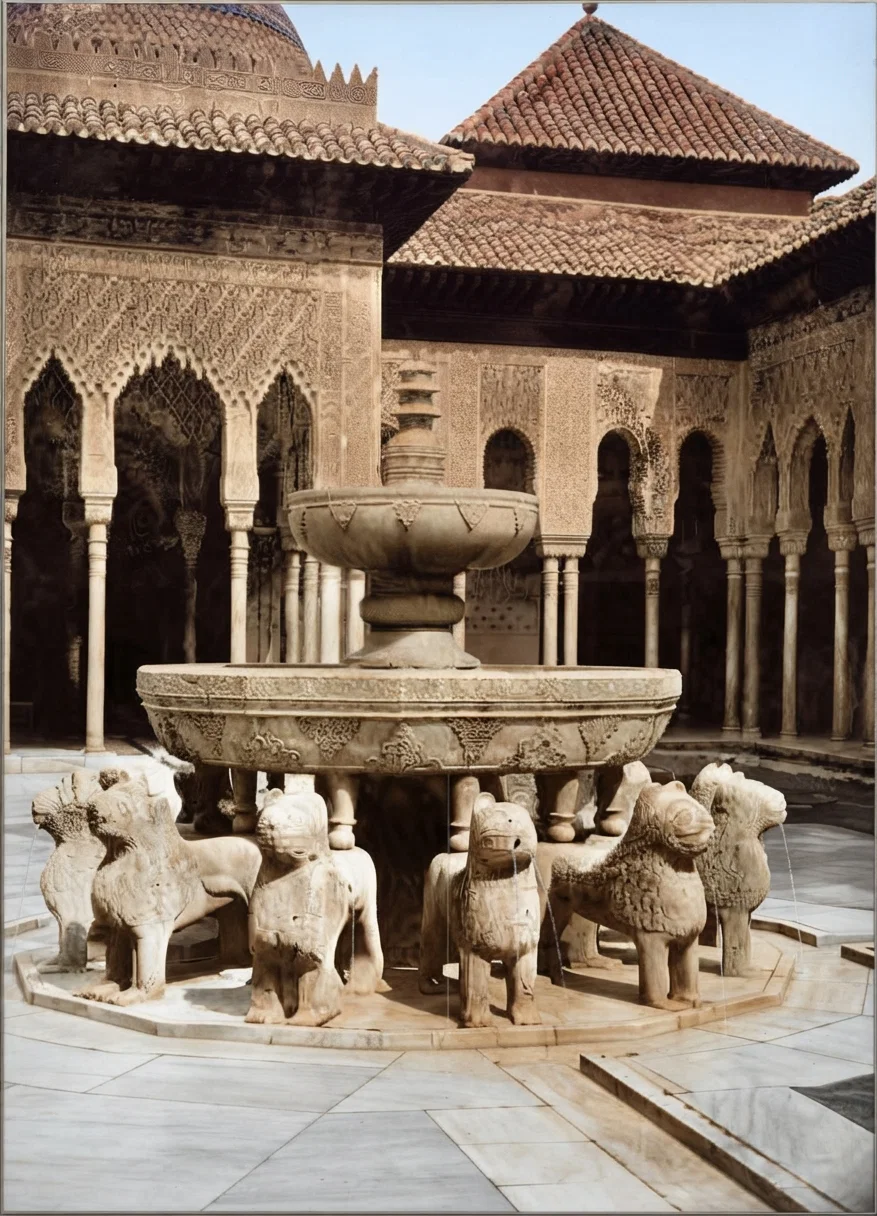
The Court of Lions, one of the many beautiful sections of the Alhambra. This building, situated in Granada, Spain, is a crumbling monument of the lost dominion of the Moors.
On the tomb of Babylon stands the crumbling, wind-harried heap of Birs-Nimrud, whose shifting dust was once raised high toward heaven in the sun-baked bricks of Babel. The memories of Egypt's ancient dynasties cluster round her naked pyramids. The glories of ancient Greece are memoried in her crumbling handiwork; and the written history of the rise and fall of Rome is her mausoleum of faded glories.
The lesson is one of experience, and no nation seems content to learn it from the experience of another. No nation that subjects another to itself can survive the results of its own victories. Napoleon was invincible while redressing the wrongs of Poland; but when he would make Europe his dominion, he met his Waterloo. America is a united nation to-day; but had she taken Mexico when it was at her mercy, she would have been cut in twain by the War of the Rebellion. And still she has not learned the lesson.
One of the greatest object lessons in the fate of the conqueror is seen in the rise and fall of the Moorish dominion in Spain. In 710 the leader of the Moors, the Saracens of the West, received permission from the Successor of Mohammed to carry "the faith" into Andalusia (Spain). Mohammed had died in 632, but the Khalifa (Successor) hoped to see this Mohammedan invasion of Spain sweep over the Pyrenees, and establish "the faith" with fire and sword from Gibraltar round to the Golden Horn.2
On one side were the zeal and vigor of the new faith; on the other, “the decaying remains of a Latin empire.”
The original inhabitants of Spain (Basques) had been driven by the Kelt-Iberians over the Pyrenees. The latter were subdued by the Romans, and adopted their language and customs. Spain was next overrun by the Vandals; and then followed a struggle between the Suevi and Visigoth (Western Goth), ending in 621 in the complete conquest of Spain by Swintila the Goth. The new conquerors gradually succumbed to the seductive influences of the Latin culture. The luxury of Rome ate like a canker into the vigor of the Goth; and when idleness and vice had ripened Gothic Spain for its overthrow, Tharyk, with his terrible host of Mohammedan Moors, landed at Gibraltar, defeated Roderick the Goth, and began (711 A.D.) the conquest of Spain. After a six years’ struggle, the conquest was complete, and Mohammedanism—Ishmael’s version of Judaism—was triumphant in the Iberian peninsula.
Beyond the Pyrenees they could not go; for the wave after wave of conquered peoples that had been swept up into these hills formed a barrier the Moor could never shatter. But Spain was his, and he seated himself before the luscious fruits of his victory. It was to him terrestrial paradise, and he lived accordingly. He cultivated art and philosophy, drew up astronomical tables, experimented with the polarity of the magnet, made curious clocks, and established the use of the mariner’s compass. He reared beautiful palaces, and embellished them with gilded stucco-work that has not tarnished with time. Probably no more beautiful wreck of former glory exists to-day than is seen in the delicate architecture of the Alhambra of Granada, slowly but surely sinking in decay. Its beautiful sculpturings in marble and alabaster are a cause of wonder to the tourists of every country. The Court of Lions shows little of the ravages of time. In its center stands a great fountain of alabaster, supported by twelve lions. The court is laid out in flower gardens, surrounded by light Arabian arcades of open filigree work, supported by slender pillars of white marble—all indicating a delicate, graceful taste, “a disposition to indolent enjoyment.”
Near the Court of Lions is the beautiful Hall of Abencerrages; named after the band of cavaliers treacherously slain by the father of Boabdil. Looking down into the Court of Lions is the grated gallery where Boabdil (Abou Abdallah), the last of the Moors, was imprisoned with his mother, by order of the king, his father. All around are towers and turrets, halls, palaces, aqueducts, fountains, and dungeons, some crumbling into ruin, and others courageously defying the slowly-conquering elements.
For eight hundred years the Moors held Spain, and looked upon its dominion as theirs forever; but luxury and idleness were a mightier foe than the “terrible horsemen of the desert” had ever met, and it beat them down from generation to generation, until Ferdinand and Isabella were able to scatter their armies and drive them back to the land whence their fathers had come eight hundred years before. Boabdil, the last of the Moors, in his flight looked back upon the Alhambra he could not defend, and wept over the dominion that had passed away. The Tharyk of conquest had given place to the Boabdil of luxury; and the lesson was repeated that one nation can not rob another nation and profit by the theft.
But the vices of that luxury which conquered Belshazzar, Darius, Alexander, Cleopatra, Cæsar, and Abou Abdallah, are found to-day in every nation under heaven. They are ripening for an overthrow, not at the hands of other nations, but at the hands of the Lord of hosts Himself. “And in the days of these kings [the kings or the kingdoms that are in existence to-day] shall the God of heaven set up a kingdom; which shall never be destroyed; and the kingdom shall not be left to other people, but it shall break in pieces and consume all these kingdoms, and it shall stand forever.” Dan. 2:44. And this last universal kingdom “shall be given to the people of the saints of the Most High, whose kingdom is an everlasting kingdom; and all dominions shall serve and obey Him.” Dan. 7:27.
This last great overthrow is near at hand, and the privilege of being an inhabitant of God’s great, universal kingdom of righteousness is still held out to every inhabitant of the earth. Let us as individuals be diligent, watchful, earnest, that we may not be taken in the snare of the nations and be overwhelmed in their destruction. C. M. SNOW.