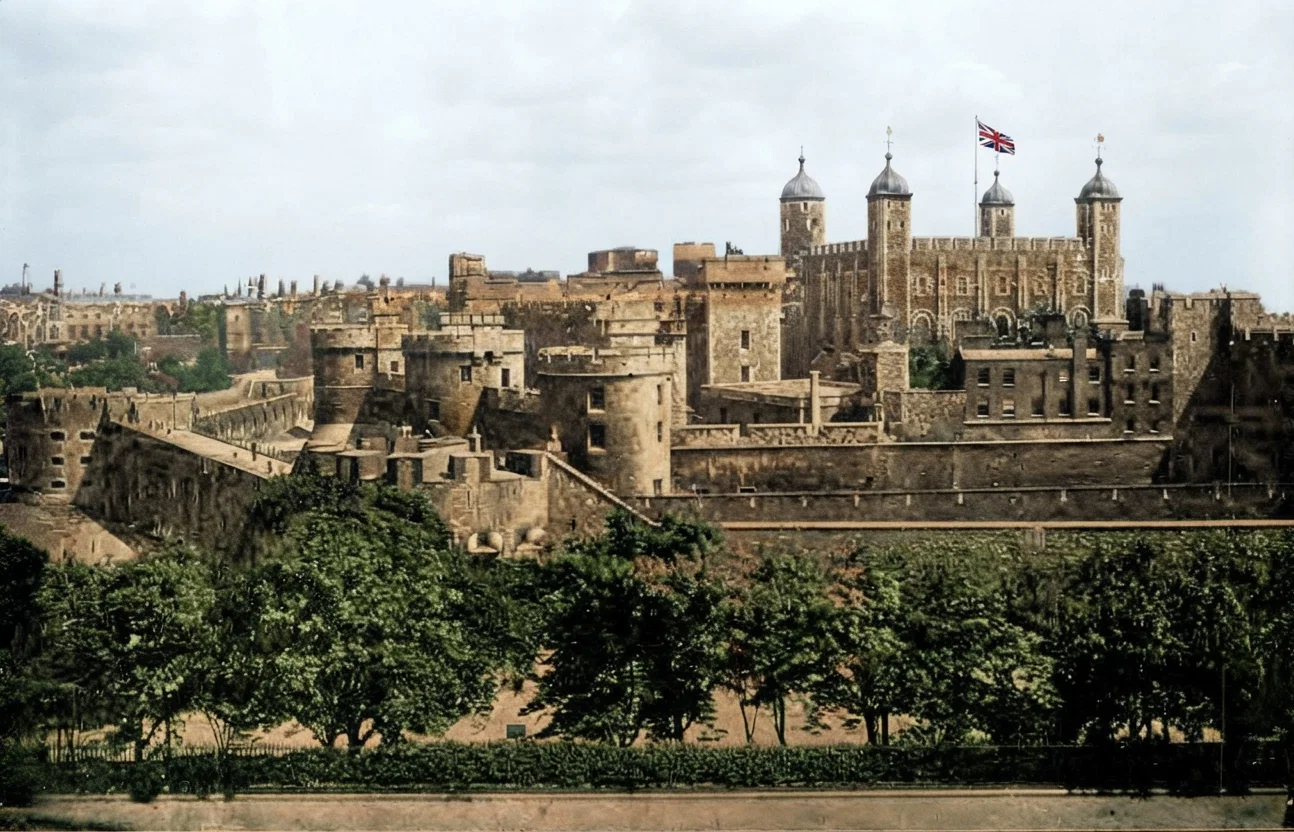
ONE of the most interesting places in England, or for the matter of that, in the world, is the Tower of London, a general view of which appears on this page.
THE present structure dates back to William the Conqueror, who built the White Tower. It was used as a royal residence by Henry I.
The surrounding towers and moat were constructed in the time of Henry III. Nearly all of the great mass, with the exception of the White Tower, has been rebuilt or restored since then. The total area covered by the Tower is thirteen acres, surrounded by a moat, drained in 1843, but which can at any time be flooded from the Thames.
THE great structure is entered by four gates, namely, the Iron Gate, the Water Gate, the Traitor's Gate, and the Lion's Gate. The Lion's Gate, where visitors enter, is so called because a royal menagerie was once kept near it. At the Traitor's Gate the State prisoners were formerly brought. Within the enclosure are the Byward Tower; St. Thomas' Tower; the Bloody Tower, in which it is said the two children of Edward IV. were murdered; the Wakefield Tower, erected in the reign of William Rufus, in which is kept the Regalia of England, and where Henry VI. is supposed to have been killed; the Bell Tower, in which the Princess Elizabeth was confined by her sister, Queen Mary; the Brick Tower, where Lady Jane Grey was imprisoned; Beauchamp Tower, in which Lord Guilford Dudley, husband of Lady Jane Grey, together with his father and brothers, was confined; Bowyer Tower, where the Duke of Clarence, brother of Edward IV., was drowned in a butt of wine; and more interesting than all, the White Tower, built by the Conqueror in 1078, with its walls thirteen to fifteen feet in thickness. Here Richard II. abdicated in favor of Bolingbroke in 1399; here Prince James, son of Robert III. of Scotland, endured his long imprisonment; here Sir Walter Raleigh was confined when he wrote his 'History of the World.' All these towers help to compose 'the Tower of London.'
TOWER OF LONDON. GENERAL VIEW.
THE Tower has been in turn a royal residence, a fortress, a State prison, an armory, a mint and public record office, a museum. If its old walls could speak, it would tell many a tale of horror and cruelty forever sealed to the human till God's books reveal it. But we know enough. Suffice to speak of the imprisonment of John Baliol, king of Scotland; of William Wallace; of King David Bruce; of the 600 Jews barbarously treated by Edward III.; of Sir Simon Burley, executed for his faithfulness to his young sovereign; of Henry VI., who became insane and died in captivity; of Anne Boleyn, of Catherine Howard, of Sir Thomas Moore, victims of the sensuous and brutal Henry VIII.; of Anne Askew, tortured and afterward burned at Smithfield for denying the doctrine of transubstantiation; of Cranmer, Ridley, and Latimer, victims of Queen Mary's bigotry; and many, many more, we have not space to mention. Many of these were cruelly tortured, and many were executed, if not in the Tower, elsewhere.
IN the Armory is a wonderful display of ancient armor, both English and foreign, for both horse and man. Here also are seen the instruments of torture, removed from the stifling dungeons below, where can still be seen2the marks in the floor where these inventions of Satan were placed. Here is the block on which some were beheaded, with its ancient ax. Here also are gyves, thumb-screws, and the rack.