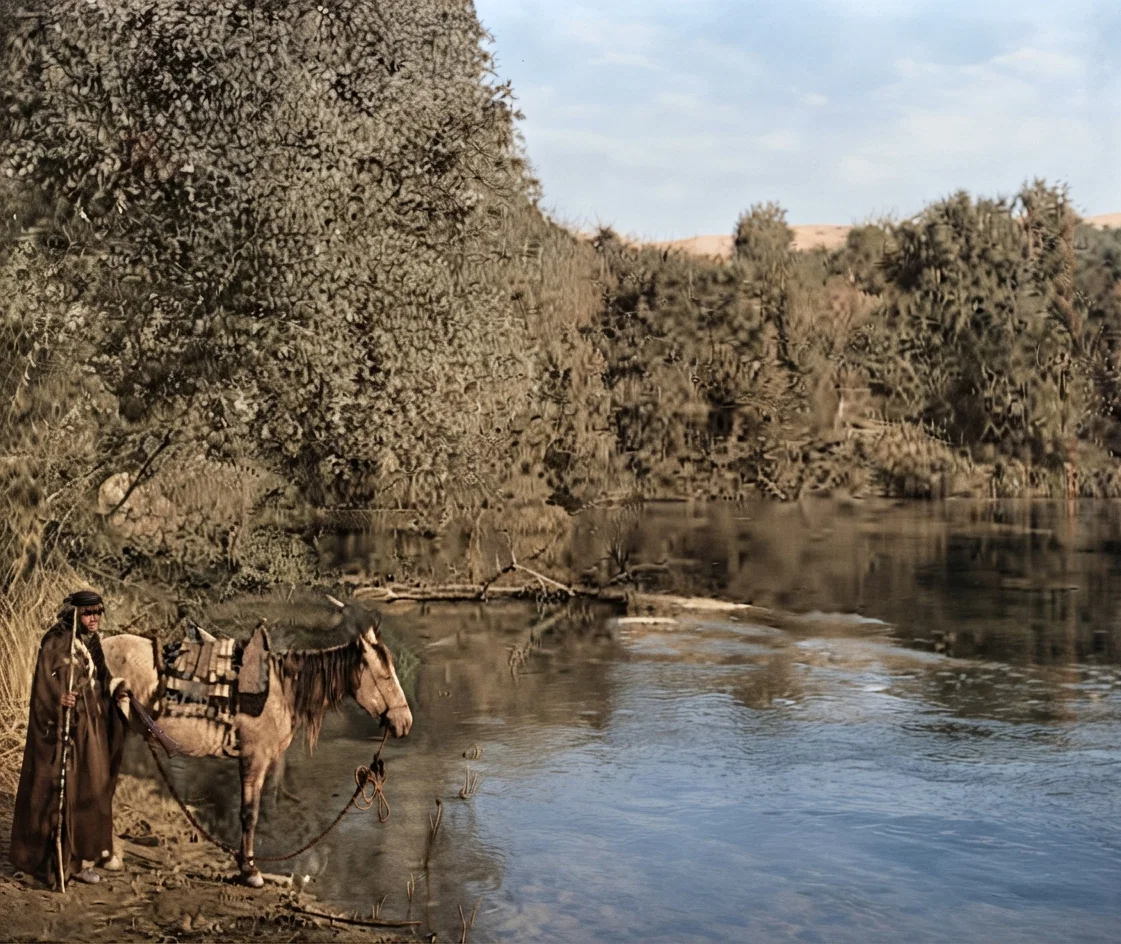
MOHAMMED'S perversion of the Gospel has built its temple where once stood the magnificent temple of Jehovah. Where the priests of Israel offered sacrifices morning and evening, the muezzin's call to the worship of Allah rings out from lofty minaret. Where Jesus, the anointed of God, the Prince of Peace, walked and talked, healing the people and planting the seeds of the everlasting Gospel, Mohammed, with his doctrine of fire and sword, walks at will to-day in the person of his followers as the one and only prophet of the Most High. Where John, the forerunner of the Messiah, baptized the Lamb of God, the son of Ishmael to-day, with weapon in hand, with his hand against every man and every man's hand against him, stops to rest and water his jaded steed. O, what lessons the River Jordan holds for the people of this world! Mohammed has the promised inheritance of Isaac, the child of promise. Its sacred river is his; its city is in his possession; the hills of the Holy Land are no longer in the hands of those whose poets made them immortal in song and story. The followers and defenders of Islam stand guard over the promised inheritance of the children of Isaac, the promised inheritors of the world. They to whom nothing was given have all; they to whom all was promised have nothing, and are strangers and sojourners in lands that give them scant welcome.
WHAT is the solution of this enigma, this seeming perversion of purpose, this apparent overthrow of God's design? It is found in Israel's attitude toward the commands of God. Had they obeyed Him, heeded His precepts, honored His law, walked in His ways, Israel would have been established in Palestine, and would have remained in possession of the land until Messiah came to usher them into that greater inheritance—the whole purified, rejuvenated earth.
AT the close of Israel's forty year's wandering in the wilderness, the people, now under the leadership of Joshua, came to the bank of the River Jordan, ready to cross over into the land of promise. Because of their murmurings and their unwillingness to walk in the light of the commands of God, all who had come to the estate of manhood at the time of leaving Egypt had died in the wilderness. Even Moses found a grave outside the promised land because of an error committed on account of the stubbornness of the people. But now only the Jordan separates between the hosts of their descendants and the land that was promised them. Still there is something yet remaining to be done before the Lord can permit them to set foot in the land He had promised them. It had been many years since the law of God had been given in thunder tones through the fire and smoke of Sinai. The greater part of the present host had not witnessed that awe-inspiring demonstration of the importance of God's great law. The millions of Israel must again be reminded of the fact that the law contained in the ark, which was borne before them was still the law of Jehovah, and must still have first place in their consideration, that they were still amenable to all its precepts; that when it went before them and they followed as directed, every obstacle was removed.
A Son of Ishmael by the River Jordan.
JORDAN was now overflowing all its banks, and the problem of transporting all Israel's host across the swollen river was a prodigious one for human powers; but the Lord had a way of accomplishing the undertaking. Joshua was instructed to have the priests take up the ark containing the law of God, and go before the people down into the river. Here is the Lord's own assurance of the opening of a way into that land of rest: "And it shall come to pass, as soon as the soles of the feet of the priests that bear the ark of the Lord, the Lord of all the earth, shall rest in the waters of Jordan, that the waters of Jordan shall be cut off from the waters that come down from above; and they shall stand upon an heap." Joshua 3:13. Then the priests were to advance with the ark into the midst of the river bed and stand there with it, as a barrier against the heaped-up waters of the Jordan, while the people crossed to the other side. Twelve stones were taken from the river to be set up on dry land as a memorial of what God had done for them that day, that their children might have ever before them something to remind them of how God had led and provided for His people. A similar memorial was set up by Joshua in the midst of the river, where the priests stood with the ark, while the host was going over. When this act had been accomplished, the priests, with the ark, came up out of the river, and Jordan went on its way again, unhindered as of old. As long as the ark, representing the throne of2God, and containing the unchanging law of God, remained in the bed of Jordan, that river must cease to flow. That law and ark, representing God's throne and government, can not be overwhelmed by any power of earth, and the people following that law are bound to triumph.
BUT the Lord cautioned His people in reference to that ark and its contents before the move was made that day to cross the Jordan. They were to follow the ark at a certain specified distance, "that ye may know the way by which ye must go; for ye have not passed this way heretofore." Joshua 3:4. That admonition was applicable to Israel in all their course from that day on. That day's work was a success, because they obeyed the Lord's directions. Their campaign against Jericho, immediately after, was also a success for the same reason, and the ark with the law had a leading part in that work. But just as soon as they began to follow their own ways and devices they found trouble in abundance. They seem to have forgotten that they had not passed that way before. Moses, before his death, warned them again and again that if they refused to keep and do the commandments of the Lord, they would be destroyed like the heathen nations whom they dispossessed; they would not continue to inhabit the land into which they were going. The Lord told Moses that if the people forsook Him, and broke His covenant, He would forsake them and hide His face from them till, as a nation, they would be devoured. On the other hand, if they would do His commandments, He would set them "on high above all nations of the earth," and make them "the head and not the tail." See Deuteronomy 28.
GOD had a wonderful purpose in view for the people of His choice, and all who were willing to come under the rule of His government. The only thing that stood between them and the fulfilment of all that God purposed concerning them was their unwillingness to obey His law. Because they would not come under the beneficent rule of His government, He was compelled to leave them to become the plaything of the tempests of tribal strifes and the ambitions of other nations. In place of being a light to all the nations around, their refusal to keep the law put out their light, blotted out their inheritance, and scattered them like the "chaff of the summer threshing-floor" into every corner of the earth, till their very name has become a byword. Mohammed on the Jordan, with his temple of worship on Zion's hill, witnesses to Israel's disloyalty to God, and, through that disloyalty, the complete frustration of the glorious purpose God had in view for them as a nation. They would have been the greatest nation in the world—God so declared it, if they had kept His law. They would not keep it, and now they are nothing. That law and the blessing of God upon their keeping of it would have made them more than even their brightest hopes could ever picture. What a contrast, and what a lesson for this generation! Every calamity that overtook them as a result of their disobedience was faithfully pointed out to them before ever they crossed into Canaan. The twenty-eighth chapter of Deuteronomy is a faithful presentation of the end to which the nation would come if they turned away from God and His law. They came to that end, and their history is written as an admonition and warning for the people of this very age, this generation which is to witness the entering in of the spiritual Israel into the real land of rest. The law went before ancient Israel, and made a way through every obstruction. It will do the same in this generation for the faithful and triumphant children of God. His orders are: "Bind up the testimony, seal the law among My disciples" (Isa. 8:16); and He says of the redeemed: "Here are they that keep the commandments of God, and the faith of Jesus." Rev. 14:12. The victory is assured, and that inheritance will not be taken by another.