In this article we will speak of some of the curious things found in the vegetable and animal kingdoms of Jamaica. More than sixty varieties of fruits and vegetables flourish here. Of these, only the pimento (allspice) and a few other species of comparatively little value, are natives; the rest have been brought here purposely or by accident. Every season of the year brings some kinds of vegetables or plants to maturity. Not infrequently a tree will contain blossoms and fruit in every stage of development at the same time. Indeed, fresh fruits and vegetables may be had every day.
The nutritive value of many of these tropical productions is remarkable; it has been proven by the natives that certain species, if eaten alone, will sustain life. It is said that one year, when all other crops failed, the people lived for months on boiled green bananas, laboring daily in the field. Many of these fruits require no cooking, while others are prepared in a variety of ways. The breadfruit, if nicely baked, sliced, and spread with avocado pear, makes a very good substitute for bread and butter.
To the European visitor the almost infinite variety of trees are peculiarly novel in appearance; he is hardly able to identify even one with the trees found in his own land. Some are so compact in grain that they will not float in water, and when cut they take a high polish. On many of these trees grow thousands of parasitic plants, with flowers of the most delicate and gorgeous hues. Certain of the creepers entwine themselves around the trunks of these kings of the vegetable world, and throw out their tendrils from the branches on all sides, sometimes running down fifty feet before reaching the ground, thus forming immense cables, as if designed to protect these forest giants from the fury of the elements.
A seed, carried by the wind or dropped by a passing bird on the limb of a tree, or on an apparently barren rock, takes root and grows, altho there is no visible way in which it can be supplied with nourishment.
A short distance from Port Antonio is a wild fig tree, growing from the top of a sugar-house chimney, seventy-five feet from the ground. At another place twelve such trees are flourishing on the stone walls of a deserted dwelling; but the roots of these have reached the ground.
What a wonderful architect is the great Creator! No two trees, no two blades of grass are exactly alike. No two persons look, act, or think alike. The human mind can scarcely conceive the possibility of so endless a diversity; and yet the Master Artist goes on year after year adding to the list, without any diminution of His resources. "Many, O Lord my God, are Thy wonderful works which Thou hast done, and Thy thoughts which are to usward; they can not be reckoned up in order unto Thee; if I would declare and speak of them, they are more than can be numbered."
Aromatic shrubs and flowers of every variety and size are abundant. After the autumnal rains the whole interior of the island has the appearance of an immense garden, and the air is perfumed with the most fragrant odors. Among the less attractive, but not less useful, plants are the wild pine and the traveler's palm, which have the curious property of containing water. From these sources the Maroons were supplied with refreshment during the extremities to which they were frequently reduced in their conflicts with the white inhabitants of Jamaica.
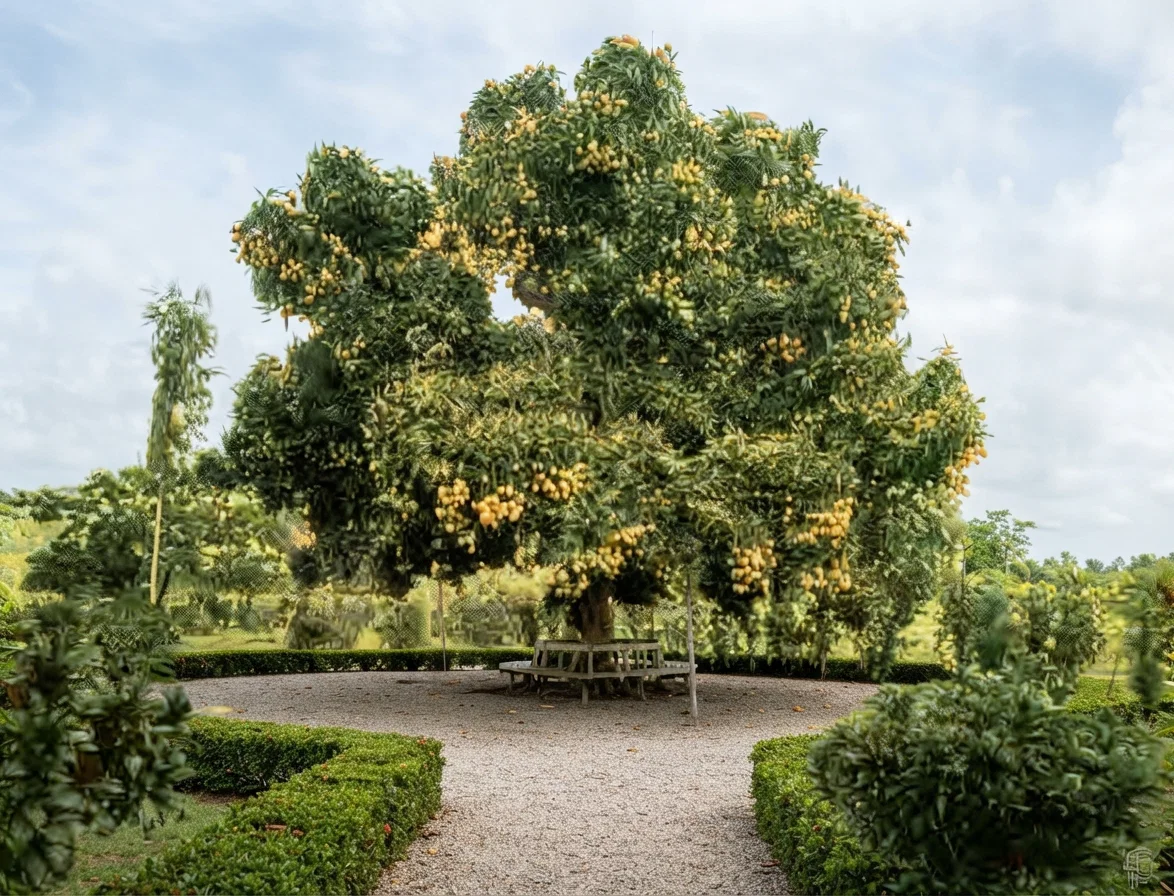
A Mango Tree, Jamaica.
Lest some may be led to think, from our descriptions, that this land approaches a second Paradise, we assure them that the effects of Adam's sin are seen here as well as in other parts of the world we have visited. One may not roam in our forests, as in northern lands, for trailing creepers and thorns and brambles, according to the Word in Gen. 3:18, block the way. Animals and insects, destructive to crops and annoying to mankind, abound. Several years ago rats became so numerous that the people began to fear the island would be depopulated. Nothing in the house or field escaped their ravages. At length the mongoos was imported, and began its work of destroying these pests. The rats were greatly reduced in numbers, and the snakes were totally annihilated; the mongoos also preyed upon the birds until very few songsters are left.
But some birds of beautiful plumage still remain;
among them are several species of humming-birds, whose beauty in form and plumage defies description, exhibiting alternately, as they flutter and shift their position in the sun, all the colors of the rainbow. The most beautiful is the long-tailed species. It has plumes about six inches in length, which cross each other and expand into a fan-shaped tuft. This beautiful bird might be more appropriately styled the "bird of paradise" than the one now having the honor of that name.
With the destruction of the birds arose a new pest—the grass lice. At certain seasons it breeds in countless numbers in the grass lands. This is a tick about half the size of a pinhead. Once on man or beast, it buries itself in the skin, thereby giving rise to a very annoying inflammation, which frequently causes horses and donkeys to lose their ears.
The chigo (commonly known as the jigger, because it makes a short backward jump before taking a forward one), is about the size of a flea. It penetrates the skin of the toes and feet. It makes a nest, deposits its eggs in a little bag, and hatches a num-
erous progeny. The bag can be extracted with a needle. When full grown it is of the size and has the appearance of a blue pea. If suffered to remain in the flesh any length of time, its progeny would so multiply, (as each young one produces a separate bag) that violent inflammation, and, perhaps, amputation of the affected part, would result.
Scorpions are common. Their sting is very painful, but seldom fatal. Centipedes, tarantulas, and black spiders are found here, but their poison does not often cause death. Fleas, mosquitos, and sandflies are plentiful.
Ants cover the whole face of the ground. They so completely infest the places where food is kept that the ingenuity of housewives is thoroughly taxed to keep eatables from destruction. One species is particularly destructive to houses. The duck-ants build their nests in trees and on the roofs of houses. They construct covered roadways from the ground to their nests.
"There are two or three species of land-crab. That distinguished by the name of mountain-crab has been considered a great delicacy by some. The habits of these animals are remarkable. In their retreats in the mountain districts, which are generally13
about one or two miles from the beach, they inhabit the earth and the stumps of trees. They go down to the sea once a year to deposit their spawn, and perform their march in a straight line with exact order, allowing no obstacle that can be surmounted to obstruct their course, even climbing over houses and precipitous rocks. Here they remain until the young ones have attained sufficient size and strength for the journey, when they return to their habitations followed by the young fry."
Lizards are plentiful. They are welcomed in the houses, as they are harmless to man, but destructive to various noisome and poisonous insects, even destroying scorpions. Thus it would seem that God, in His infinite wisdom, has so arranged the animal kingdom since the fall, that, if left to themselves, they are a check to each other. This will be the case until the dreadful time spoken of in the first chapter of Joel, when His restraining power will be withdrawn, and an army of destructive insects will be let loose to accompany the plagues recorded in Revelation 16, which will visit those who are found out of the ark of safety.