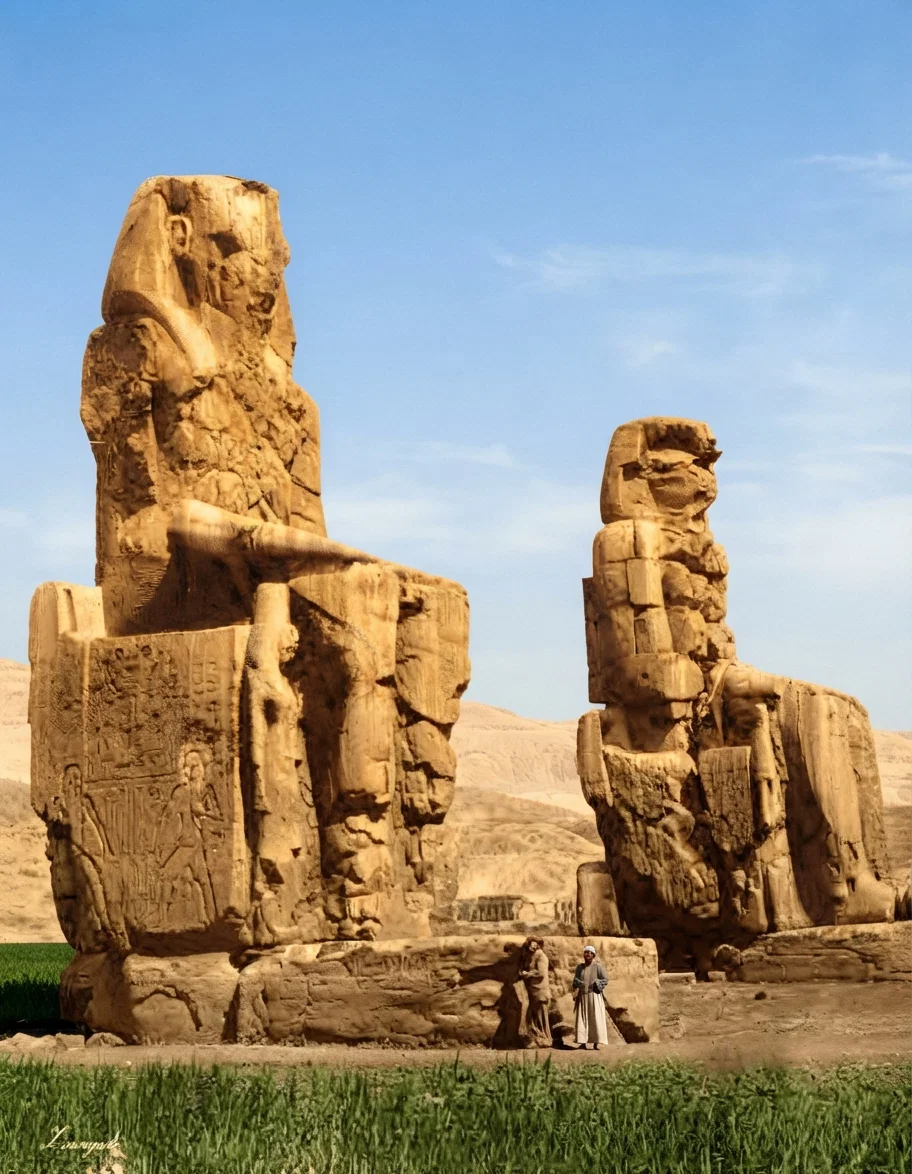
THE illustration on this page carries us back to the time of Israel's sojourn in Egypt, B. C. 1500, when the Egyptian empire was at the height of its glory. The reigning Pharaoh was Amenhotep III., or sometimes called Amenophis, or Maatneb-Ra. This king was not noted for his warlike deeds, as were some of his ancestors; but he was a great monarch, a dealer in slaves, and a mighty builder. Doubtless much of the wealth possessed by the Egyptian kings, available at this time for the building of these great monuments, came through the administration of Joseph, and the laws made at that time for the support of the realm. The government came into possession of all the land save that which belonged to the priests, and received as its revenue one-fifth of all the income. But, be this as it may, we know the revenue must have been large from the mighty buildings, monuments, statues, temples, and propylons erected.
AMENHOTEP III.,
like many other kings and men, was very vain and egotistic. The mighty temples and statues everywhere reflect himself. It is a common vice. There is much professed love of country which is but expanded egotism. That is, we love the country because it is our country. "It is a great country; we have many great men; we are a great nation." The "we" is but the plural of the "I." With Amenhotep III., and many other puny mortals, it was and is all the "I." They lift themselves above their fellows and assume to be one of the god-head.
OUR illustration is a photo-engraving of the two great colossal statues of Amenhotep III.;
No 660 Thèbes colosses de Memnon.
they are the mightiest in the world. Each was originally formed of a single block of sandstone, and at the time when set up must have been not less than seventy feet high. As placed by the sculptor they have sat there on the west bank of the Nile, in ancient Thebes for more than three thousand years. One traveler calls them "the most immovable thrones that have ever been established upon this earth." The sculptor who carved them, whose name is almost identical with that of the king, sings thus of his own greatness and the permanency of his work:—
"I immortalized the name of the king, and no one has done the like of me in my works. I executed two portrait statues of the king, astonishing for their breadth and height; their completed form dwarfed the temple tower—forty cubits was their measure. They were cut in the splendid sandstone mountain on either side, the eastern and the western. I caused to be built eight ships, whereon the statues were carried up the river; they were emplaced in their sublime temple; they will last as long as heaven."
AND for more than three millenniums they have sat with hands on their knees, in wonderful majesty, dignity, and repose, looking straight on as if their sightless eyes would pierce the future. But time has left its traces. In the year A. D. 27 a mighty earthquake shook Thebes to its foundation, and decapitated one of the huge images. Then for two centuries at sunrise it occasionally gave forth sounds, as attested by many witnesses, doubtless owing to cracks in the stone and changes of temperature, reaching the climax about sunrise. Man sought to mend the broken colossi by adding a head, but the sound ceased forever. The action of the weather has also greatly affected the sandstone, and the crowns and much of the heads and faces have disappeared. And so in time the softest, gentlest things of nature—the falling rain, the wind, and the sunshine—would crumble them to dust.2SO WILL perish all the works of men which have been wrought for self and self glory. Better was one poor slave, who swept these magnificent temples, than all the mammoth works of art and skill piled up by Egyptian rulers; for to every human is given the privilege of existing forever, while all the works of men shall crumble to everlasting decay. And this is the lesson which God would teach all the children of men by these remains of human glory. Read from the Gospel-prophet God's ever-present message to the men of this world:—
"The voice of One saying, Cry.
And one said, What shall I cry?
All flesh is grass,
And all the goodliness thereof is as the flower of the field.
The grass withereth, the flower fadeth,
Because the breath of Jehovah bloweth upon it;
Surely the people is grass.
The grass withereth, the flower fadeth,
But the Word of our God shall stand forever." Isa. 40:6-8.
And God's admonition to us is:—
"Fear God, and give Him glory;
For the hour of His judgment is come;
And worship Him
That made the heaven and the earth
And sea and fountains of waters." Rev. 14:7.
The glory of man, however great and enduring it may appear, will pass with the world and its lusts and unholy ambitions; "but he that doeth the will of God abideth forever." 1 John 2:17.