THE recent seismic disturbances in Russia and Central America, and the volcanic eruptions in Martinique, St. Vincent, and Mexico are giving general interest to the questions so long puzzling scientists. What is the cause of earthquakes? What do they mean? Science has endeavored to answer these questions at different times, but is still in perplexity.
IT was formerly held that the whole interior of the earth was a molten mass surrounding which was a thin shell similar to that of an egg, gradually thickening, as the interior cooled down. But according to the Scientific American this theory "is now entirely discarded by scientists." This authority says: "Tidal waves [caused by the attraction of sun and moon] are continually sweeping around the earth in a direction contrary to the earth's rotation. In comparison with this we can easily see what a tremendous drag to the rotation of the earth would result were the entire earth a liquid mass covered by a mere shell of solid matter. Scientists tell us that the wave produced would be so powerful as to make even a solid steel crust of 300 miles of thickness yield like India rubber to its deforming influences."
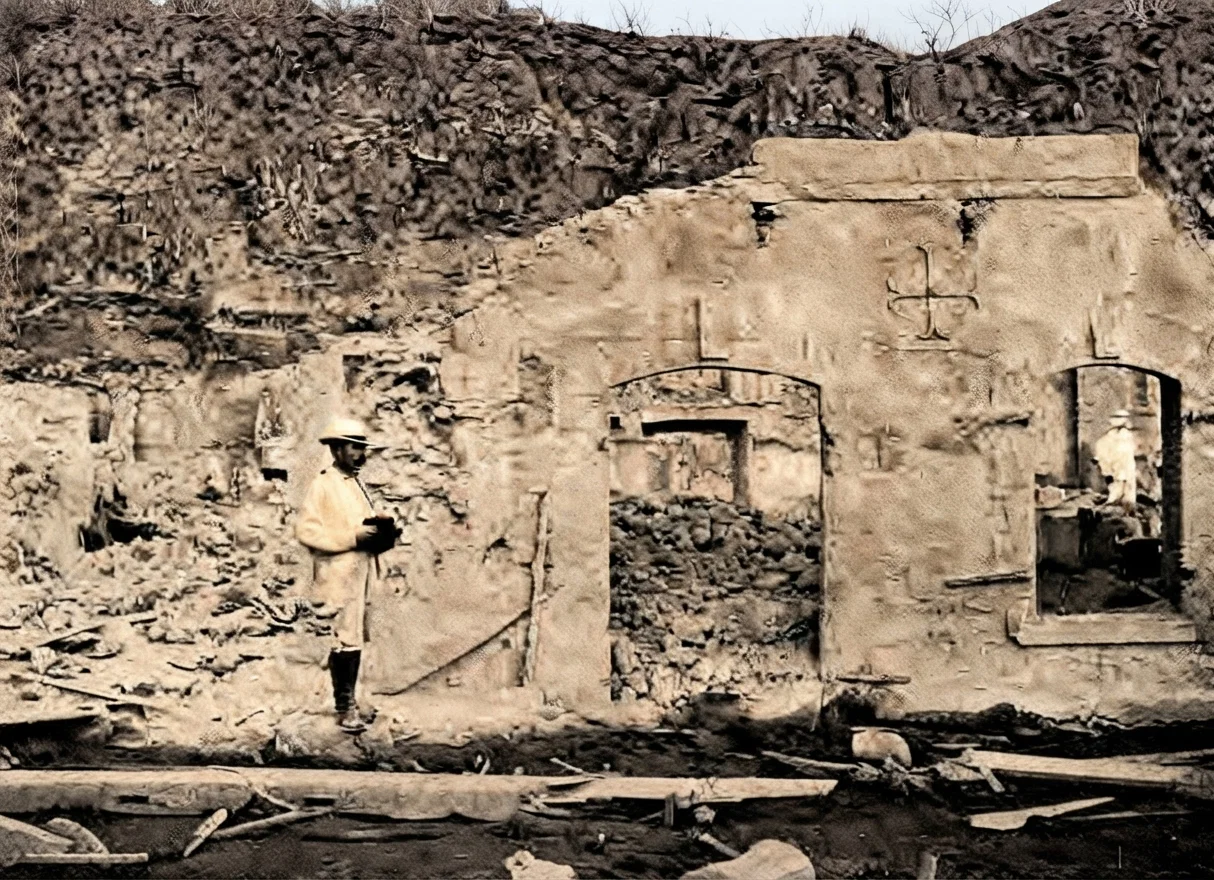
Exterior of the Bank of Martinique, at St. Pierre, after the Eruption.
ANOTHER hypothesis was put forward that the earth had a great solid core, an outer crust, and between these a mass of fiery, melted matter. "Any displacement of the crust covering this liquid layer, whether resulting from contraction of the earth or other causes, would force the lava to the surface through the weakest spot." But this molten-layer theory was refuted by the volcanoes in Hawaii. Mauna Loa and Kilauea are both filled with lava, and are only thirty-five miles apart. The former is 13,650 feet above sea level, the latter only 4,040 feet. Surely if both were connected with a great internal lake of melted matter running around the earth, such vast difference in levels could not be maintained.
STILL another hypothesis is that the interior of the earth is intensely heated, but through enormous pressure is solid; but when this pressure is in any way removed, it immediately liquifies and pours out as molten lava. Others have contended that as volcanoes were generally near the sea, the eruptive force is caused by water leaking down into the heated region, where it is converted into steam. But on the other hand it is declared that water, in the nature of the case, could not flow down to such depths of enormous pressure, and, if so, it would be converted to steam before it reached them, and forced back through the channels it entered. Thus goes down another theory before the bowler of truth.
THE theory "now pretty generally accepted," says the paper above quoted, "accounts for the presence of water in heated rocks as having occurred during their crystallization period. These rocks, in the course of time, were deposited in the sea by the action of rivers. After many ages, the water-bearing rocks are covered to a great depth under layers or 'blankets' of deposited matter, and the heat there encountered finally brings the water to a sufficient tension to cause an explosion." But if this were the case, why should we find these volcanoes so many times near where no river ever poured its mineral deposits? And how could volcanic activity be kept up so constantly and over such long periods by such means? Surely the water pockets would long since have been exhausted. There seems also to be quite decided and sympathetic seismic action between widely separated places, which this theory could not account for. This theory, too, is merely hypothetical.
ALL these theories proceed on the supposition that the earth had an igneous or melted fiery origin, whereas the Bible first presents it in an aqueous or watery condition. There are also scientific works which hold to this hypothesis, notably, "A Revolution in the Science of Cosmology," by Professor Campbell, who contends that "the fact is established that the earth was never in a state of fusion." So much for what men do not know. In the darkness of all earthly, it is better to cling to the light which shines from the Old Book. It surely would seem the wiser way to flee from the smoke and ash-laden atmosphere of uncertain science to the clear and ambient air of the sun-radiant heights of God.
WHAT changes took place in that primitive period when "the earth was waste and void, and darkness was upon the face of the deep," we know not. We do know that at the time of the universal deluge evidence of which is world wide, mighty convulsions of which we have faint conceptions took place. "The fountains of the2great deep were broken up; the windows of heaven were opened." Water from above met water from below. Tempest, black and wild and fierce from the sky, met earthquake and cataclysm in the earth. Cities disappeared in a moment. Mountains sunk into the beds of the seas. Sea beds became mountains. Mighty rocks split in twain, between which rivers flowed and valleys were formed. Diverse and dangerous elements were stored in close proximity. Enormous deposits of lime were made under great pressure, generating heat. Prodigious drifts of tropical trees, ferns, and foliage, driven by such winds and currents as mariners never faced, filled deep valleys, and the heavings of earth cast these up into hills and mountains covered with debris. Pressure generated heat, and out of these deposits grew our coal mines. Heaving earth and swelling sea and electric storms played strange pranks in the year of the flood. Even the earth itself seems to have been shaken out of place by the convulsion of nature over the increase of transgression. Earth's millions who would not be warned, who thought they knew more than God's prophet, perished; eight souls were saved by God's goodness and power in the ark.
BUT never again will the world be destroyed by water. The promise of God stands sure. "The world that then was . . . perished; but the heavens that now are, and the earth by the same word have been stored up for fire, being reserved against the day of judgment and destruction of ungodly men." 2 Peter 2:6, 7. The margin reads, "stored with fire." This may refer as well to the elements, the union of which causes fiercest fire, as to the actual fire itself. The coal, the oil, the lime, and water, the various gas-producing agencies, the chemicals, whose combination or contact means destruction, are all stored in the earth, waiting for that great day, of which all lesser similar days are predictions. The destruction of Sodom and Gomorrah were prophetic of world destruction and the perishing of its people, an example of those that should afterward live ungodly. 2 Peter 2:6; Jude 7. Pompeii and Herculaneum were a warning; Lisbon was a warning; Caracas was a warning; Krakatoa was a warning; Charleston was a warning; St. Pierre was a warning—all merciful forecastings of the great cataclysm to come, when "the heavens shall pass away with a great noise, and the elements shall melt with fervent heat, the earth also, and the works that are therein shall be burned up." That men may escape all these, God has given these warnings all through the ages, more frequently repeated now in these days of intensity. Over and over has God told us that the atmospheric heavens and earth "shall perish; . . . they shall all wax old as doth a garment; and as a mantle shalt Thou roll them up, as a garment, and they shall be changed." "The earth shall reel to and fro like a drunkard, and shall be removed like a cottage." Then it shall be said: "The earth is utterly broken down, the earth is clean dissolved."
WHAT is the lesson? It is that men shall not plant in earth their affections nor bury here their treasure. When the prophet tells us that the earth is waxing old, he is also careful to tell us that God continues, that He is the same, that His years have no end. Heb. 1:11, 12. In the great convulsion to come, all that is of God and righteousness will not be shaken. "The kingdom that can not be shaken" He offers freely to the weary wayfarers of earth and its disappointments. Heb. 12:27, 28. He pleads with all, "Love not the world, neither the things that are in the world. If any man love the world, the love of the Father is not in him. For all that is in the world, the lust of the flesh, the lust of the eyes, and the vain glory of life, is not of the Father, but is of the world. And the world passeth away, and the lust thereof; but he that doeth the will of God abideth forever."