NOT UNWARNED

6%

Pacific Press Publishing Company · Oakland, California · Jul 23, 1902

FromSigns of the Times, Vol. 28, No. 30.

Read the full edition
NOT UNWARNED.
It is ever true that God in some way warns men of impending dangers and judgments, but almost never will they heed the warning till the heart and conscience and sensibility can no longer appreciate His goodness or hear His voice. Yet it is His constant purpose still to warn. Thus the prophet states it:—
“Will a lion roar in the forest, when he hath no prey? will a young lion cry out of his den, if he have taken nothing? . . . Shall the trumpet be blown in a city, and the people not be afraid? shall evil befall a city, and Jehovah hath not done it? Surely the Lord Jehovah will do nothing, except He reveal His secret unto His servants the prophets. The lion hath roared; who will not fear? the Lord Jehovah hath spoken; who can but prophesy?” Amos 3:4-8.
When about to destroy the primitive world-arrangement by a flood, “Jehovah said, My Spirit shall never pronounce judgment upon men unwarned. They are but flesh. Their days shall therefore yet be one hundred and twenty years.” Gen. 6:3, Boothroyd’s translation. When about to destroy Sodom and other wicked cities of the plain, “Jehovah said, Shall I hide from Abraham that which I do?” And He did not. He has revealed coming judgments to His prophets, and the prophets have ever warned and will ever warn, whether the people will hear or forbear.
Sometimes He warns in other ways, and always on the part of more or less of the people with an apprehension of dread of impending danger. Thus it was in the city of St. Pierre. For days before that fatal May morning, when the whole city was made a ghastly morgue, the people were warned of the great danger. This is shown in news that came from Paris ten days after the awful calamity. People who perished in St. Pierre wrote letters to friends in the French capital, letters breathing alarm five days before the horrible outburst of Pelee. Yet strange to say, while fearing the danger many flocked to the city; none left it. Some of the expressions are quoted from these letters by Murat Halstead, in his very recent work, “The World on Fire” (International Publishing Society, Chicago). One from a young woman, dated May 3, after describing the town lit up with flames from the volcano, everything covered with ashes, and the people greatly excited, contains this:—
“My calmness astonishes me. I am awaiting the event tranquilly. My only suffering is from the dust which penetrates everywhere, even through closed windows and doors. We are all calm. Mama is not one bit anxious.
“Edith alone is frightened. If death awaits us, there will be a numerous company to leave the world. Will it be by death or asphyxia? It will be what God wills. You will have our last thoughts. Tell Brother Robert that we are still alive. This will, perhaps, be no longer true when this letter reaches you.” The Edith mentioned was a woman visitor among the rescued. This and other letters inclosed samples of the ashes which fell over the doomed town. The ashes are a bluish-gray impalpable powder, resembling newly-ground flour, and slightly smelling of sulphur.
Another letter written the afternoon of May 3 says: “The population of the neighborhood of the mountain is flocking to the city. Business is suspended, the inhabitants are panic-stricken, and the firemen are sprinkling the streets and roofs to settle the ashes which are filling the air.”
Still another letter says: “St. Pierre presents an aspect unknown to the natives. It is a city sprinkled with gray snow, a winter scene without cold. The inhabitants of the neighborhood are abandoning their houses, villas, and cottages, and are flocking to the city. It is a curious pell-mell of women, children, and barefooted peasants, big, black fellows, loaded with household goods. The air is oppressive; your nose burns. Are we going to die asphyxiated? What has to-morrow in store for us? A flow of lava, rain of stones, or a cataclysm from the sea? Who can tell? Will give you my last thought if I must die.”
“A St. Pierre paper of May 3, received by mail, announces that an excursion arranged for the next day to Mont Pelee had been postponed, as the crater was inaccessible. Mr. Halstead tells us that “it was the fashion of St. Pierre to indulge the pleasant theory” that there was added interest in living near a dangerous mountain; “there was a charm in living so near” to an imminent peril; that it gave “a peculiar zest to life.” They felt that the town never had been destroyed and never would. The governor of Martinique assured the people “that there was nothing important likely to happen.” It is also reported that Professor Landes of the University of St. Pierre, after examining the volcano, reported to the governor that the destruction of the city would “not happen later than the 8th of May,” the very day of its destruction. American correspondents on the ground state that the despatch of Professor Landes predicting the end of the city is held a secret by the government. — “World on Fire,” p. 91.
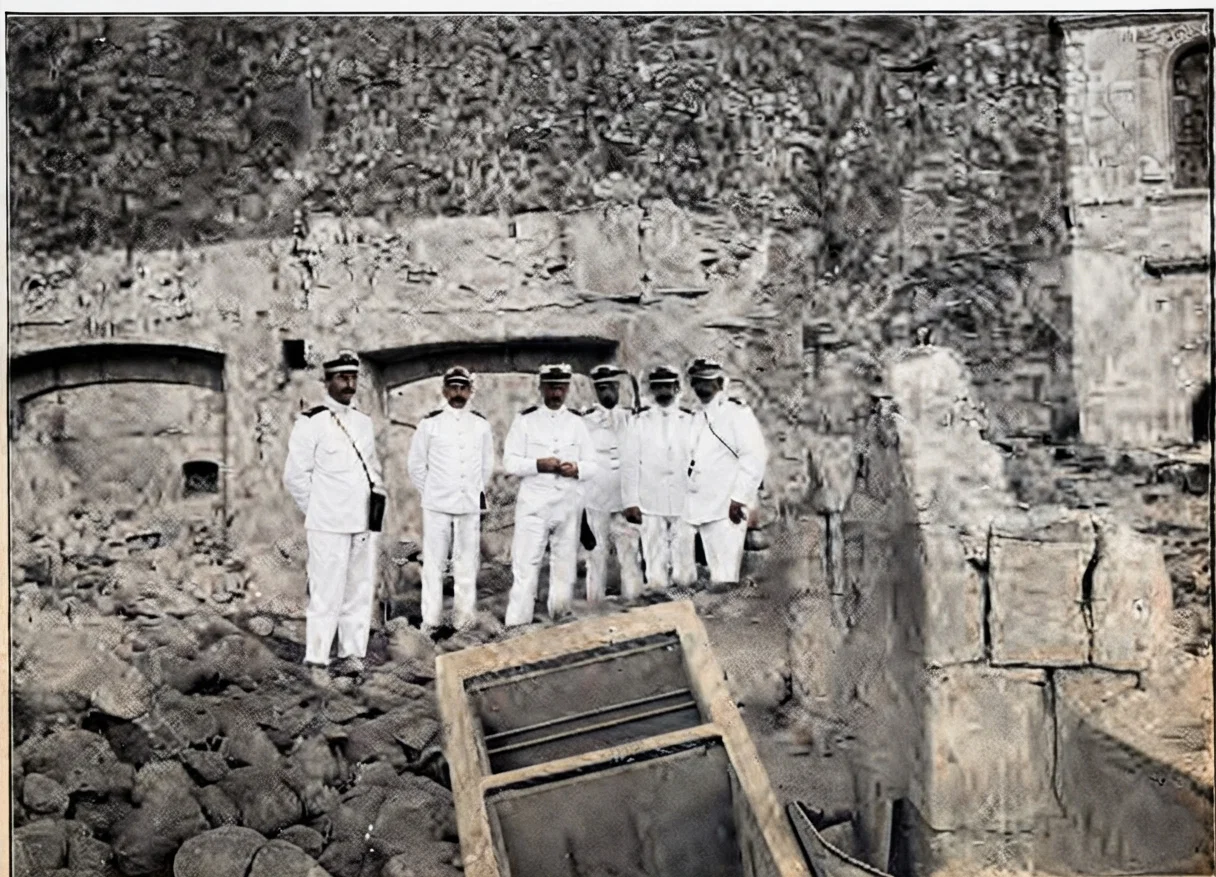
Interior of Bank of Martinique, Showing Group of Officers from Dutch Cruiser, Konigan Regentes.
The governor of the island went from Fort de France to St. Pierre, saying if St. Pierre were destroyed, he would be destroyed with it. He managed to keep the people from leaving, while he himself escaped. The Italian consul, warned by a sea captain, escaped. Mr. Le Clerc, a wealthy landowner, escaped the very morning of the disaster. He said to the United States consul, “I am getting out, and you’d better get out of this.”
The consul replied, “There is no need of any one going away.”
The gentleman responded, “It is better to be safe than sorry.”
Amid pleasure and revelry, alarm and fear, warned and yet held by the power of foolish fascination, 30,000 people perished and less than a dozen were saved.
When the great final convulsion and catastrophe of this sin-laden world shall take place, the division between the people will be strictly on the line of character. “The righteous shall be saved out of it.”