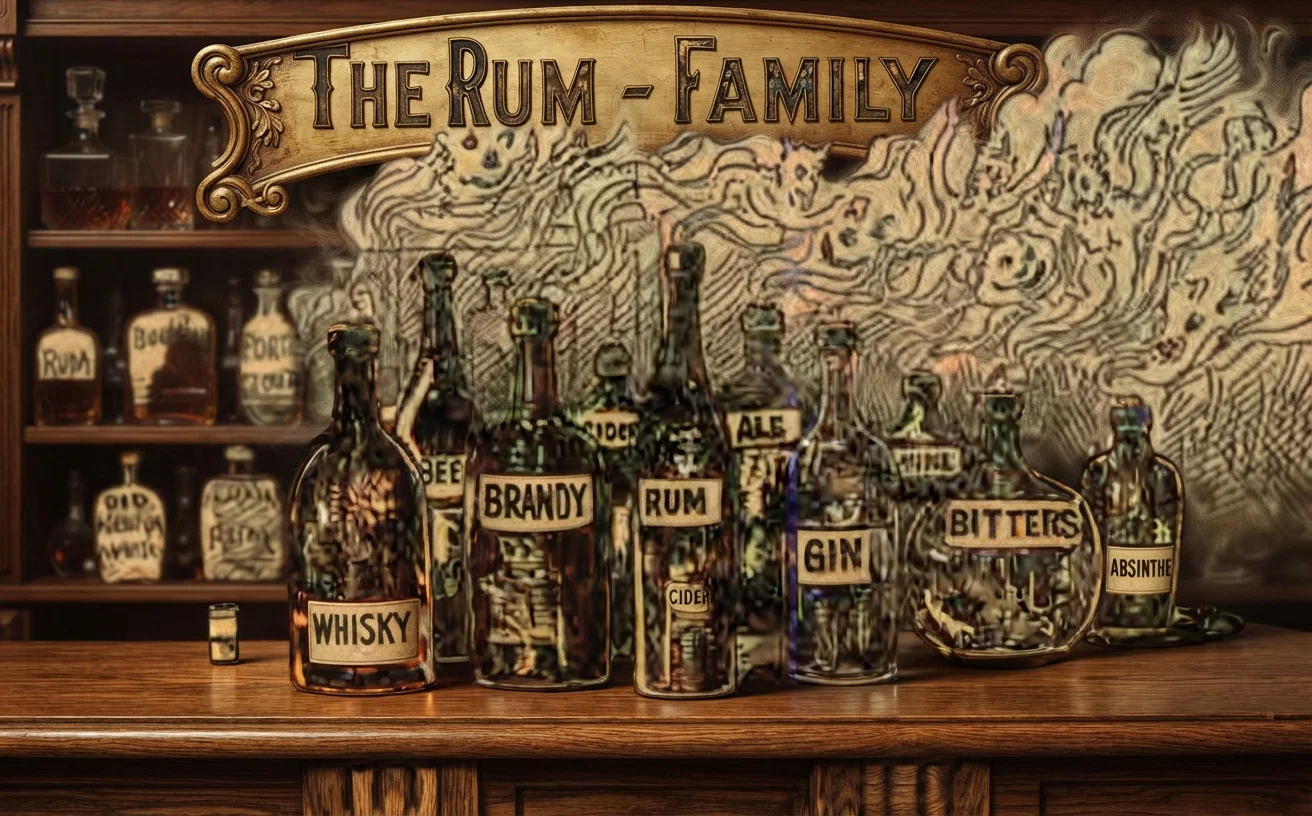
All Are Poisons

7%

Pacific Press Publishing Company · OAKLAND, CALIFORNIA · Sep 23, 1897

FromSigns of the Times, Vol. 23, No. 37.

Read the full edition

All Are Poisons

No GREATER calamity can befall a quiet, peaceful community than to have a bad family move into it. But no neighborhood ever suffered more from the bad influence of a family of wicked persons than from the effects invariably produced in any city or village by the advent of the rum family, with its numerous progeny of vices, irregularities, and crimes. We propose to devote this paper to a consideration of the leading traits and characteristics of the rum family, and to make our readers sufficiently well acquainted with the various members of the family to convince them that they are all unsafe associates for any one who wishes to maintain self-respect and his standing as a useful member of society.
The original alcohol family contains half a dozen or more members, some of whom, altho naturally inclined to evil, have become useful members of society, while others have been the means of a vast deal of harm. The four best known to the public have been supplied with names by the chemist, to distinguish them from each other, and are known as methylic alcohol, ethylic alcohol, amylic alcohol, and butylic alcohol.
The first of these, methylic alcohol, is commonly known as naphtha. Methylic alcohol, or wood naphtha, is derived from the distillation of wood. It produces intoxication very quickly when drunk, but its effects are very transient, owing to its great volatility. It is not often used as an intoxicant, but has been so employed by persons of peculiar taste, or confirmed inebriates who were prevented from obtaining their customary allowance of grog. The author once had a patient who on several occasions swallowed half a pint of naphtha, when brandy or whisky could not be obtained.
Ethylic alcohol, or wine spirit, is the intoxicating element of spirituous liquors, and is obtained by the distillation of fermented liquids. The most common form in which it is used as a beverage is in brandy, whisky, beer, wine, etc. It is seldom found pure in commerce, being usually mixed with water. This variety of alcohol is more intoxicating in its effects, and more injurious to the vital tissues, than the preceding.
Butylic alcohol is generally obtained by the fermentation of the beet root. It is also, perhaps, produced in the fermentation which occurs in butter and cheese when they become old and rancid, since these substances contain an acid known as butylic acid, which is derived from this kind of alcohol. It is this which gives to frowy or rancid butter and very old cheese their peculiar flavor. This member of the family is still more active in intoxicating properties than those already mentioned, producing an intoxication which is very slowly recovered from, and in which there is great prostration, trembling of the muscles, and extreme coldness.
Amylic alcohol, or fusel-oil, is produced by the fermentation of potatoes, and also, to some extent, in the fermentation of grains and fruits. It has a burning taste and pungent odor, and is the characteristic constituent of bad whisky. A few drops of fusel-oil will produce as profound an intoxication as a considerable quantity of ordinary alcohol, which accounts for the infuriating and deadly effects of bad whisky, as well as its rapidly fatal effects, as often seen among miners, negroes, and Indians. The deadly effects of cheap rum from the West Indies have become so manifest in some of the South Sea islands, controlled by the English Government, that it has become necessary to prohibit its introduction.
There are several other alcohols closely allied to those mentioned, and with similar properties, besides numerous other compounds, which are classed by chemists in the "alcohol series," among which are the well-known substances, carbolic acid and creosote, the caustic and poisonous properties of which are too well known to require other than mere mention. If not own brothers, these compounds are at least cousins of "the demon of the cup."

All Are Poisons.

All the alcohols are poisons. No one questions this respecting fusel-oil, naphtha, or any of the alcohols, with the exception of ethylic alcohol, or wine spirit, which some scientists claim to be able to show is a food, tho all the rest are poisons. If some one should bring to us half a dozen varieties of a newly discovered substance, possessing similar properties, evidently all members of a common class, and all capable of producing death, each having its fatal dose, and should say to us that all of the half dozen members of the family were poisons but one, and that was an excellent food, we should certainly be very incredulous. No one in his senses could be made to believe a statement so widely at variance with common sense, and yet this is exactly what is said to us by those who maintain that wine spirits is a food, while potato spirit, wood spirit, and all the other members of the rum family, are poisons. The fact is that a man may drink a quantity of naphtha with less danger to life and less effects than would be occasioned by a much smaller dose of wine spirit, in the form of whisky, brandy, rum, or gin.
All the alcohols are antiseptics; that is, they will preserve perishable substances, by preventingdecay and decomposition. There are those who imagine that this property recommends alcohol for use for human beings. Some years ago the writer heard of a man who was reputed to be 117 years old. Thinking he must have been a man of very temperate habits, to have attained so great an age, he took the pains to hunt him up in a large eastern city, and, to his disappointment, found that he had for more than a century been an inveterate smoker, and taken his pint of whisky every day. Advocates of the use of alcohol point to such exceptional cases in triumph; but let us not be too hasty. Whisky had not done this ancient human being so much good after all. He hardly had the semblance of a man. He was so wrinkled, and dried, and shriveled up, he looked more like one of those strange creatures that Stanley saw in Africa. He may have been preserved by alcohol. If so, he was a fair specimen of a human pickle. Altho reputed to be alive, he had really been dead for thirty years or more, tho his friends had neglected to bury him.
The fact that a man can pickle himself with alcohol, and yet live to be a centenarian, is not evidence that alcohol is good, but that the man is uncommonly tough. If a man could live 117 years in spite of it, he ought to live a century and a half under favorable conditions.
J. H. KELLOGG, M.D.