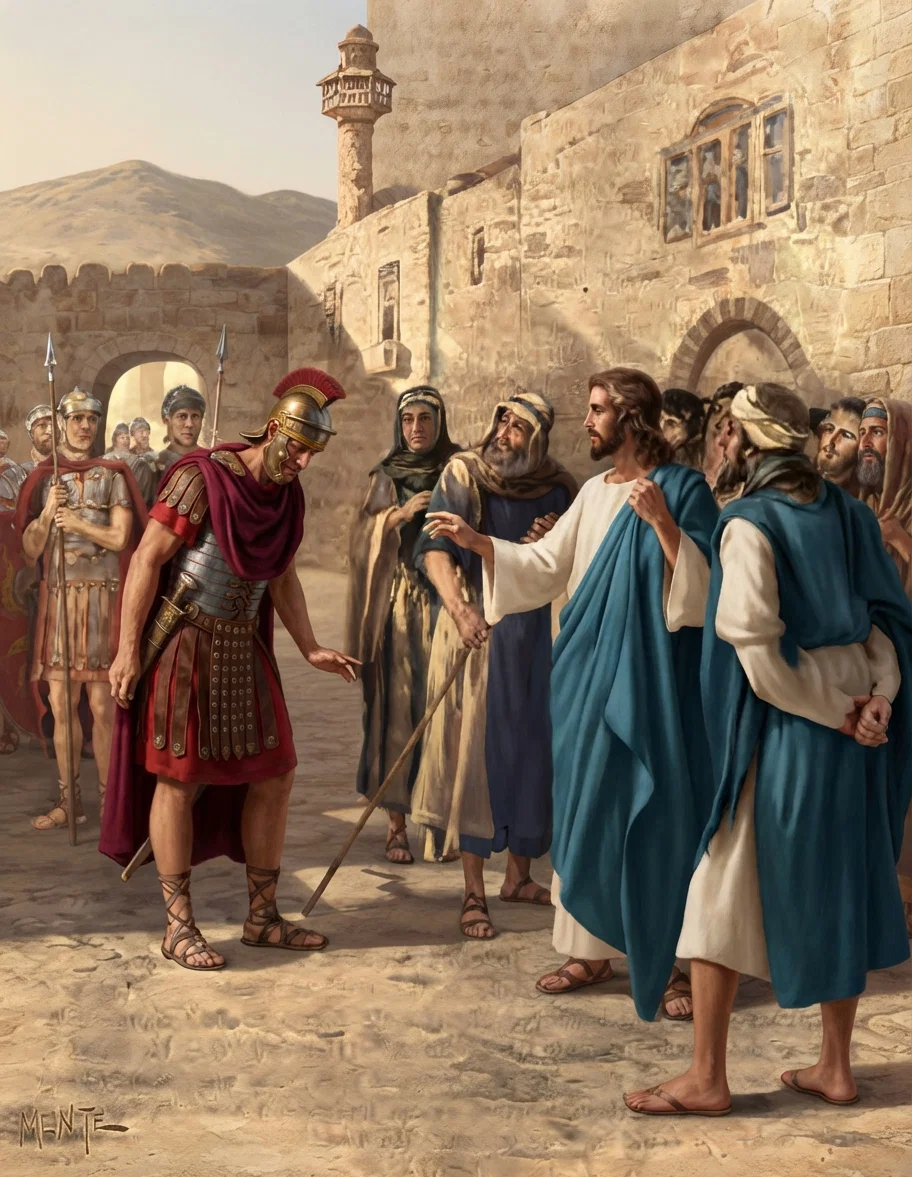
THE place is Capernaum, noted for many miracles. The time is shortly after the Sermon on the Mount. The record is found in Matt. 8:5-13; Luke 7:1-10.
THERE was no question of faith on the part of the centurion. It takes both of the records to give us all the facts. From Luke we gather that already the Roman captain had opened his heart to receive the truth. He had come to believe in the one true God. He had come to love the Jewish people on account of their true worship and superior morality. He had shown his love by building them a synagog.
HE was a humble man. He did not think that his good works entitled him in any way to special recognition. He recognized in Jesus One sent of the Most High, in whose sight he was most unworthy. He therefore gathers the elders of the synagog, lays the case before them, and asks them to entreat Jesus to come and heal his servant. And they hasted and performed their mission faithfully, declaring to our Lord he was worthy, and Jesus went with them.
“Go thy way; and as thou hast believed, so be it done unto thee.”
It seems that the centurion almost feared that the Jews would flatter him. He therefore sent other friends, who bore this message for the Roman officer: "Lord, trouble not Thyself; for I am not worthy that Thou shouldest enter under my roof; wherefore neither thought I myself worthy to come unto Thee; but say in a word, and my servant shall be healed." But this is not all. Seemingly fearful that the elders and his friends would not fulfil their mission, as Jesus nears his house he himself, moved by the suffering of his servant, goes to meet Jesus, and pleads: "Lord, my servant lieth at home sick of the palsy, grievously tormented." Jesus replied, "I will come and heal him." And in humility the proud Roman officer again repeated the message he had sent: "Lord, I am not worthy that Thou shouldest come under my roof; but speak the word only, and my servant shall be healed. For I am a man under authority, having soldiers under me; and I say unto this man, Go, and he goeth; and to another, Come, and he cometh; and to my servant, Do this, and he doeth it."
JESUS recognized the grasp of the truth and the faith of the Roman. He ought to have seen many such evidences among His own people, but they were wanting. But here was a Roman proselyte who had grasped it. And as the joyful words fell upon the ears of the Master, His human heart marveled; and He said to those who followed: "Verily I say unto you, I have not found so great faith, no, not in Israel. And I say unto you, That many shall come from the east and west, and shall sit down with Abraham, and Isaac, and Jacob, in the kingdom of heaven. But the children of the kingdom shall be cast out into the outer darkness; there shall be weeping and gnashing of teeth. And Jesus said unto the centurion, Go thy way; and as thou hast believed, so be it done unto thee. And his servant was healed in the selfsame hour." "And they that were sent, returning to the house, found the servant whole." Thus reads the simple record. What are the lessons? We note four.
FIRST of all, Christ's power to heal at all times, under all circumstances, in response to faith. "I am Jehovah that healeth thee," is God's message to His people, and all His fulness is found in Christ Jesus our Lord. O, that men would look away from men to the Maker of men, the Redeemer of the world, the Lifegiver! In Him is balm for every bruise, healing for every hurt. The God that gave life giveth life still, and "abundance" of life to those in harmony with His law.
SECONDLY, we must come with our sense of need and utter unworthiness. Our benefactions to God's cause or to charity entitle us to nothing. If we give largely, of His own we have given. If we have been righteous, we have only done simple duty. Our mighty twofold plea with God is His exceeding goodness and our need.
THIRDLY. In what did the superior faith of the Roman consist?—Not merely that Jesus could heal; for many in Israel believed that. But the people of Israel, instructed tho they had been of God's superhuman agencies, could not believe that Jesus could heal unless He were personally present. Even at the home of Lazarus, the sisters could only moan, "Lord, if Thou hadst been here, my brother had not4died." The centurion believed that He could heal whether present or not. He himself had been commissioned by higher power. He had soldiers under him. This in the civil world. Was not the spiritual world better organized? Jesus was the Sent of God. Surely, He had spiritual powers or servants at His disposal whom He could send with power sufficient to do His bidding. The simple faith grasped the plan; and Jesus honored the faith. Of old it was said, "He sent His word and healed them." He is the same to-day. Angels of light may bear the word to suffering soul or body, but its potency is not thereby diminished. The power of the Roman was not in himself, but in the imperial power at Rome. God's agencies must be clean, that the word be not corrupted, but the power is in the word and its life; and, if the agency have power, it is because of the indwelling Word by faith. Christ ministers in heaven; we may not be worthy that He should come under our roof; but, praise God, as ever, He will send His word, and heal, full with the potency of God.
LASTLY, our fathers, our birth, our name, our present position, will not commend us to God or give us a place in His kingdom. We may trace a succession in the priesthood; we may be a blood-descendant of Luther or Calvin or Wesley; we may have had hands laid upon us by priest or bishop never so holy; but all these or any of these will not avail unless by faith in Jesus Christ He is formed within, and His Word is all potent in us. And it may be; He wants to heal both soul and body.