JAPAN is one of the youngest of mission fields. The growth of the Christian church and of its influence in the country has been almost a miracle. The deep-rooted prejudice toward Christianity which prevailed among the people for centuries has died its natural death. It was some thirty years ago that a Japanese was arrested and finally suffered the first and, perhaps, the last martyrdom of the Protestant Christianity for the simple fact that he was reported to have had a Bible with him. A few months ago the Minister of Education said, in a magazine in reference to reading matter for school children, that the Bible is the most unique of all books and a copy of it should be kept in every library, public or private.
Doors are open everywhere for Christian workers, but the opportunity is greatest among students; and it is among them that Christianity has many advantages other faiths have not. The exclusion of religious instruction from the government school, which the authorities so rigorously carried on for many years, has seen its best days. The ever-growing desire of students for a religion better than those they have been taught at home, no longer tolerates the restriction. In Tokyo, a mecca of the Japanese student, where the student population is estimated to be about 50,000, the best selling books are religious.
On his way home from India last spring, President C. C. Hull, of New York, as a Haskell lecturer of the University of Chicago, lectured on Christianity in principal cities of Japan. Everywhere he was greeted by an overflowing audience composed of educators, students, and citizens. Mott, Torrey, and Pentecost did each very much for the cause of Christ in Japan, but none left such a deep impression on the minds of the thinking class of people as he did.
His was not "the imperialistic assertion of the supremacy of Christianity, but a bearing of witness on the relation of belief to personal experience." Such a message was timely; and, moreover, he left behind him a strong personal impression. A native paper said of him, "A perfect specimen of Christian gentleman."
For many years the Japanese Government employed a large number of the American and English men as English teachers in high schools. Many of them proved to be "soldiers of fortune,"—as they were often called—unqualified for the task, and discouraged the authorities from employing more English teachers. An increasing demand for English teachers, however, compelled them to seek another source for the supply. Secretaries of the Y. M. C. A. in Tokyo were asked to secure half a dozen men for such positions. These men were sent from two American universities, and their service was so satisfactory that the authorities are now depending upon this new source for the supply of the English teachers. Applications for such positions are received by representatives of the Y. M. C. A. in New York, so that they can send a man at once upon the receipt of cable from Japan. Nothing less than the spirit of a missionary induces them to enter into this field of teaching; they pay their own traveling expenses and live on seventy-five dollars a month. They are mostly members of the volunteer movement.
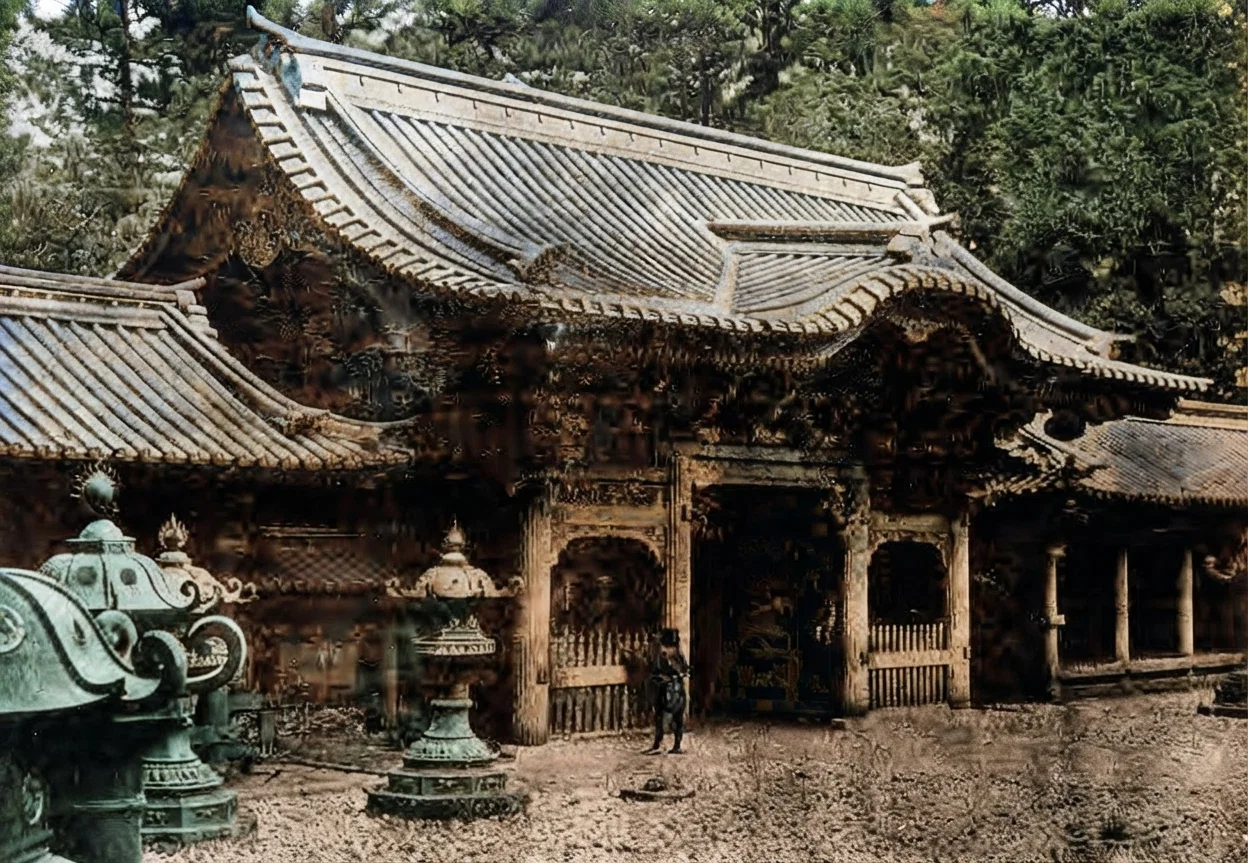
Temples of the First Shogun, Japan.
I quote from a report of the annual gathering for these teachers, which was organized last year in connection with the Japanese Y. M. C. A. summer school, "Perhaps the most impressive group was the band of university graduates who have come to Japan to represent Christ as teachers in the government schools. Fourteen of these men have been brought out under the Association. Several Christian teachers from England were also present. The reports of what these men are doing in the Bible classes and personal work among pupils and fellow-teachers were an inspiration to all who listened. Being under government pay and daily standing before students in an official relation, they have access to many circles which it is hard for missionaries and others to reach." They are the best commentaries on Christianity, not only in the school, but also in the community in which they live. Some of these men became so impressed with the importance and value of Christian work in Japan that they returned to America to take up theological courses, or to fit themselves for higher positions as English teachers in colleges and universities.
This unique movement promises to be a powerful, self-supporting agency for the propagation of Christianity among the rising generation of Japan; it is a mighty reinforcement to the religious activity in schools, where there are already fifty-two organized Christian students' associations, with over eleven hundred members enrolled for systematic Bible study. The international convention of the World Christian Students' Federation for 1904 is to be held in Japan, and it will be one of the most significant gatherings ever held in Japan.
The social and philanthropical sides of Christian activities are by no means neglected. One-fourth of the organized benevolent institutions are carried on by Christians. Their good works are recognized and appreciated by every unprejudiced man. Count Okuma, an ex-premier and a father of modern Japan, recently said in course of his lecture: "Efforts Christians are making to supply to the country a high standard of conduct are welcomed by all right-thinking people. As you read your Bible you may think it is antiquated and out of date; but the noble life it holds up to admiration is something that will never be out of date, however much the world may progress. Live and preach this life, and you will supply to the nation just what it needs at the present time."
It should not be conjectured that Japan as a nation adopted Christianity as a religion; this she has not yet done. Nor will the cause of Christ in future be an easy, unopposed march to victory. But her laws and institutions are becoming more and more Christian. Her influence is reaching out in every direction,13and, if made Christian, she might yet prove to be, as John Mott puts it, a key to the Christian conquest of the Orient.