God and Caesar

4%

Pacific Press Publishing Company · Mountain View, California · Jul 10, 1907

FromSigns of the Times, Vol. 33, No. 28.

Read the full edition

God and Caesar

THAT is a most significant statement made by the Saviour to those who thought to make Him stultify His teachings regarding the kingdom of God. The incident came about in this way: A delegation of Pharisees and Herodians, the former noted for their strict conformity to Jewish religious traditions, but opposed to the reigning family; and the latter, political Jews who favored the Herodian dynasty for Judea, came to Christ with a question, an answer to which both parties felt sure would involve Him in serious difficulty. In fact it would appear that these parties, tho strongly antagonistic to each other, for the time had buried their differences in order to force Christ to commit Himself to some position which would expose Him to the open attack of one party or the other.

Attempting to Entangle Him.

After attempting to put the Lord at ease thru flattery of His extended knowledge, the spokesman of the party said: Tell us what you think. "Is it lawful to give tribute unto Caesar, or not?" To have answered this studied question by a positive Yes or No would have well served the intended purpose. Then one or the other party would have good reason for compassing His death. Seeing all that was involved in the question, Christ answered it in a way that could not fail to commend His wisdom and discretion. To pave the way for this answer, He said: "Show Me the tribute money." When a coin of the class mentioned had been produced, Jesus asked them to tell whose likeness and inscription it carried. They quickly replied "Caesar's." Very well. "Then saith He unto them, Render therefore unto Caesar the things that are Caesar's; and unto God the things that are God's." Matt. 22: 15-21.

An Eternal Principle.

Concerning the eternal principle enunciated in these words of Christ, it ought not to seem strange to us that those mischief-makers were silenced, and returned whence they came. The only wonder is that men of our own time, holding views as adverse to the spirit of Christianity as were theirs, can not see in the same saying of Christ that which would cause them to lay their hand upon the mouth in mute recognition of the claim of the "higher life."

The Obligation of Christians to the State.
To see more clearly, if possible, our duty in relation to this fundamental declaration, let us consider for a time what it involves. The question at issue was, whether a citizen of God's kingdom, meeting all of his obligations thereto promptly, is bound to recognize the claims of civil government against him, because he is within its jurisdiction. The answer of Christ established for all time the broad principle that any and all who hold and deal in those things, upon which the civil power has a rightful title, must, upon demand of the government, render back to it that which is its own.
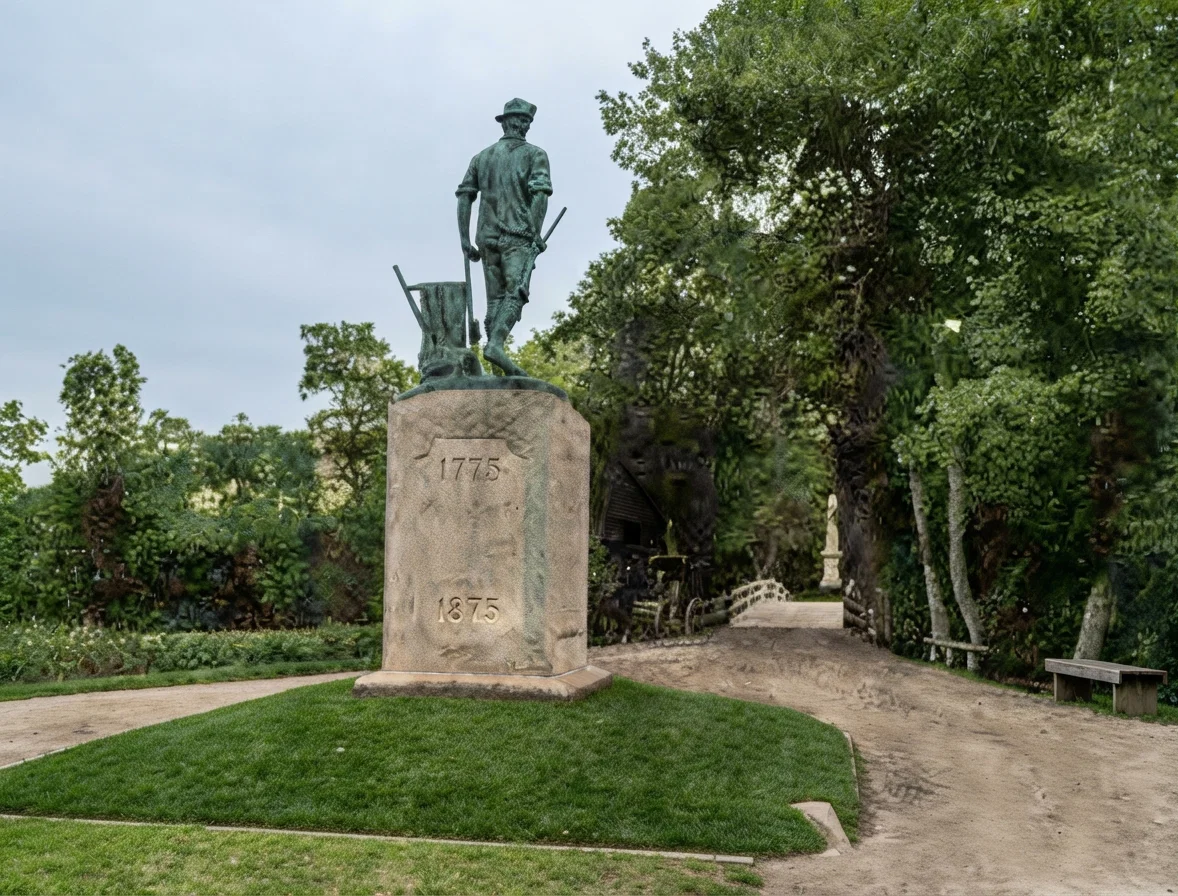
Patriot monument of the "Minute Man," near Concord, Mass., where the first battle of the Revolution was fought. The inscription on the other side of the monument is found on page 4. Just beyond is the "rude bridge," and beyond that the monument where the first British fell. The inscription on this monument is also found on page 4. Thank God the nations here recalled are at peace.
All coin of any realm comes under this head. While claimed as an asset of the civil power, because of the government stamp upon it, which gives it current value, and for which the nation stands surety, this coin is passed into circulation among the government's subjects, that they may with it uphold and sustain the policy of the government, while enjoying prosperity for themselves, under the protection of the government.
It matters not what relation one may sustain to other governments. He may legally be the subject of a foreign power, but so long as he continues in the land of his adoption, under its protection, having possession of visible property, representing a specific part of the coin of his adopted country, he must render to the powers of that country a proportional part of his income for benefits received, just the same as one born in the land.

The Alien's Rights.

Having done this, even an alien is entitled to the same right of protection as native born citizens, simply because he steadily returns to the government from its own, the same as all others, for such protection. So much for one's property rights to civil security. Of course, any government has the right to do what it will with its own. While a government may permit every one of any color or nationality freely to use its coin or property in accordance with its laws, it may, and does, withhold its political franchise from all who have not, by birth or naturalization, been declared citizens of its realm.
All this comes under the head of civil rights, which are granted by every liberal or constitutional government. But no government can rightfully pass the sphere of its own dominion in bestowing or withholding patronage. In other words, it can not give to its subjects that which is not its own; neither can it rightfully withhold from them those privileges which are birthright inheritances. From the foregoing reasoning it is plain that civil rights depend more upon one's use of the State's possessions entrusted to him and his treatment of others similarly situated as he is, than upon any direct claim the State has upon the individual.

The Creator's Claims.

The fact is that the State holds no chattel claim upon any human being. He is the handiwork of God, and bears His "imageand superscription." God's ownership being so indelibly stamped upon man, his first and highest duty is toward the One who gave him existence, and by whose life he is constantly preserved. Every pure impulse in man is therefore prompted by the life that sustains him among men. When that life, however, is prostituted to sordid ambition, its godlike qualities are degraded, and every heavenly attribute is suppressed. But when the native instinct of man's God-given life is permitted to bear sway, his conscience becomes quick to respond to the mysterious promptings of his soul in carrying out the precepts of God's word.
No civil power has any right whatever to interpose any requirement, or to prohibit any privilege, which would in any degree prevent such conduct. In responding to the demands of God, the individual is simply replying agreeably to his acknowledged proprietor who, as his Creator, holds an infinitely higher and therefore stronger right to his services than the State can possibly have.
From this it seems clear that God's moral government is to be administered by Himself thru His mysterious influence over the conscience, after its enlightenment by His inspired word. Thus in moral lines, God administers His own government directly with each individual conscience. With His government, the State can not have any participation, because God's government has to do wholly with heart promptings, of which civil government knows nothing. The mission of human government does not include even that of giving sanction to divine law, much less to enforce its observance upon the people. It can properly concern itself only with public order and social interests.

Laws Touching Religious Rites.

This prerogative of the State does not permit it to make laws touching religious rites on the plea of its own responsibility, for the one great reason that its citizens do not need such laws, since each member of a commonwealth is personally responsible for his standing in such things to another tribunal, infinitely higher than that of the State. Therefore all that the State ought to attempt regarding morals, is to enact laws prohibiting any man, or set of men, from interrupting others in their peculiar form of worship. Any law in violation of this principle has always worked, and will ever work gross injustice, because that which is made by law to interfere with the conscientious discharge of moral duties on the part of one may be, and is likely to be, extended to every other one.
Such a law would be in the nature of a conscience regulator. But religion being a matter between the individual soul and its God, no person, or combination of persons, associated as civil lawmakers, have any right to make their consciences a rule by which to control others in spiritual lines. This, indeed, would be to exceed their own rights of conscience, by trampling on the personal rights of others.

Civil Government and Morals.

Civil government is not, and never was needed to define moral duties, because the knowledge of these was in man's possession before the formation of civil government. Indeed, had man acted in accordance with his knowledge of these things, he would not have sinned, and thus opened the way for another form of government than that given to man in the beginning. The moral law alone was then given for man's entire guidance, and always would have been sufficient for that purpose had its precepts been heeded. That same divine code still exists, and its requirements are infinitely more binding on the conscience than any civil enactment bearing the stamp of its human origin.
The moral law having emanated from Jehovah and being a perfect transcript of His moral mind, no human government may contravene one of its precepts with impunity. In fact the State has no more power against moral law which controls conscience than it has against physical laws which govern matter, because both of these have the same origin, and are alike inexorable, since their Author is above the citizen and the State.

The Attitude of the State to Religion.

All, therefore, that civil law can properly do with reference to religion is to respect every form, and favor none, recognizing all of them as matters outside of its jurisdiction. The reason for this has been set forth so clearly by Dr. Schaff in his work, "Church and State," that this article may well close with his words:
"Freedom of religion is one of the greatest gifts of God to man, without distinction of race or color. He is the Author and Lord of conscience, and no power on earth has a right to stand between God and the conscience. A violation of this divine law written in the heart is an assault upon the majesty of God in man. Granting the freedom of conscience, we must, by logical necessity, also grant the freedom of its manifestation and exercise in public worship. To concede the first and deny the second, after the manner of despotic governments, is to imprison the conscience. To be just, the State must either support all or none of the religions of its citizens."