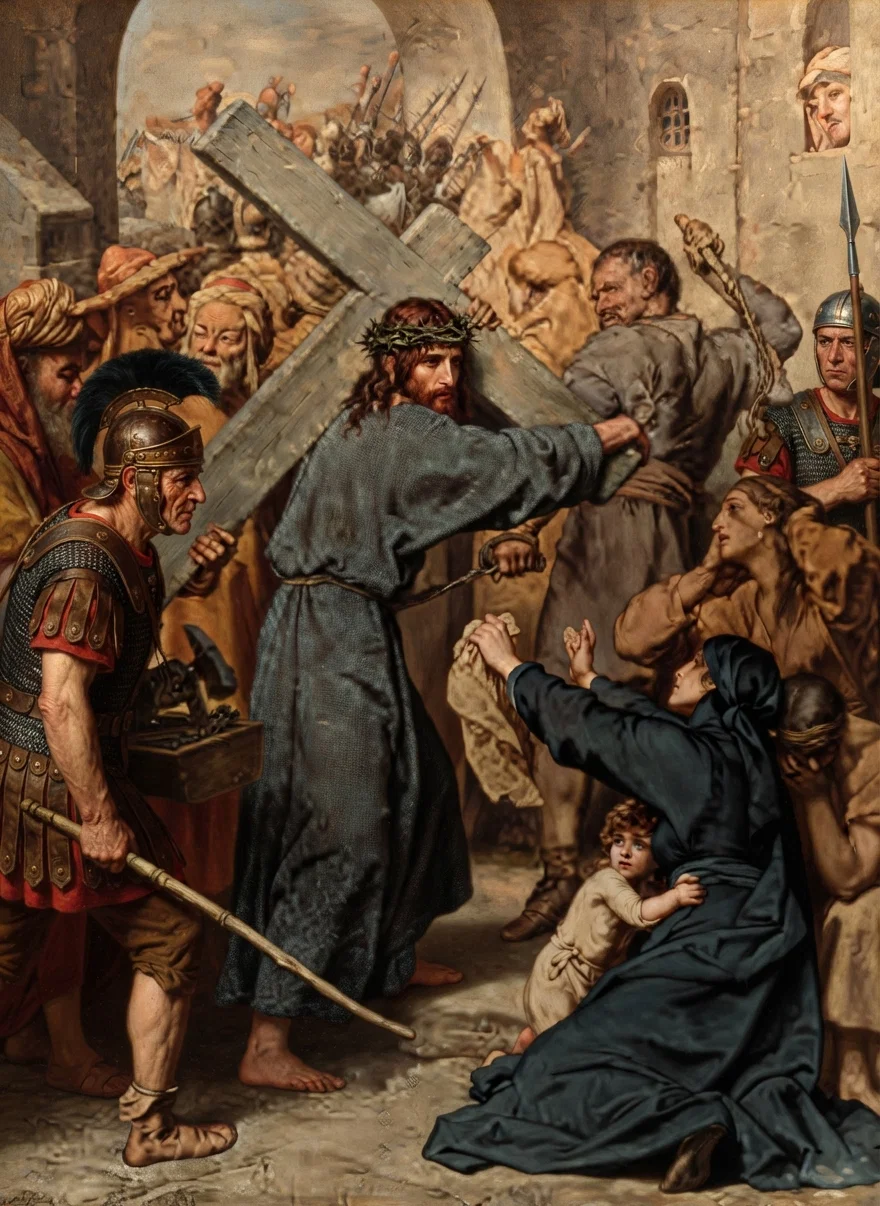
THOUSANDS of earnest, sincere Christians have been led into the mischievous delusion that this or any other nation can be transformed, thru the medium of legislation, into the kingdom of Christ. By the enactment and enforcement of certain religious laws, they think, a nation can be made essentially Christian. Many honest people actually go so far as to teach that the kingdom of Christ can and must be ushered into this world "thru the gateway of politics." But this whole theory is radically anti-Christian. It is hopelessly at variance with the explicit teachings of Christ Himself.
When Christ was a prisoner in the custody of the Roman government, He categorically asserted: "My kingdom is not of this world; if My kingdom were of this world, then would My servants fight, that I should not be delivered to the Jews; but now is My kingdom not from hence." John 18:36. This divine declaration is couched in language so simple, so concise, so lucid, that a child should not mistake its meaning. The Master here positively disclaims any direct authority in the political affairs of this world. Why not take our Lord at His word, and believe that He meant exactly what He said? Why is it that millions of those who profess to be the followers and representatives of Christ put themselves in a position directly antagonistic to what He Himself taught regarding His relation to the governments of earth? Is it not a zeal without knowledge that can lead men, otherwise intelligent, thus to stultify themselves? It must, as a rule, be a mistake of the head, and not of the heart.
When They Sought to Forcibly Take Him.
It will be recalled that when His mistaken friends essayed to take Him and place Him upon a throne, He instantly placed Himself beyond their reach by seeking the solitude of the mountains. By so doing He circumvented the foolishly short-sighted scheme of those who posed as His friends.
Inspiration declares respecting our Lord that "He came to His own and His own received Him not." And nothing is more certain than the fact that His own nation rejected Him BECAUSE He refused to assume the honors and powers of royalty. Without an iota of scriptural warrant, the Jews had made up their minds that their expected Messiah must come a king with all the splendor and ostentation incident to the imperial office.
They had become a proud, worldly, ambitious people. They could not brook the thought of a Messiah or King whose office would be a purely spiritual office—One who should be imbued with the power of love instead of the love of power. They must have a Deliverer who would deliver them from the political power of Rome, and thru the medium of the sword attain to universal sovereignty, and thus make the Jewish nation supreme in the politics of the world.
Just as Foretold.
But, as foretold by their own prophets, the Redeemer came "as a tender plant, and as a root out of a dry ground." He came in lowliness, in poverty,—with no ambition but to raise the fallen, succor the perishing, in short, to "go about doing good." Consistently with His pronouncement that His "kingdom is not of this world," He never meddled with politics or interfered in matters distinctly civil. His policy of complete aloofness from all matters that properly lay within the province of the civil courts or of other civil institutions is strikingly illustrated by an incident in His life recorded in Luke 12:13, 14. One of His hearers came to Him with this request: "Master, speak to my brother, that he divide the inheritance with me." Christ promptly answered: "Man, who made Me a judge or a divider over you?" Jesus instantly recognized the question involved in the request as one that must be referred to the courts for adjudication. Hence He refused to touch it. It was a matter that must be rendered to Caesar, and not to God. And it was just because He refused to assume the role of a military conqueror, and by conquest set up His kingdom in this world, that "He was despised and rejected of men" and ultimately condemned to suffer the fate of a malefactor.
H. Hofmann. Instead of exercising authority over men Christ submitted to authority, even unto death. But in it all He did not compromise righteousness. As He said, "My kingdom is not of this world."
The Kingdom in Reality.
It is true, thank God, that Christ has a kingdom in this world; but it is a subjective, not an objective, kingdom—it is spiritual, not temporal. The subjects of this kingdom are made up of individual human hearts dispersed thruout all nations and tongues. They, like their King, are in the world, but not of the world. They are those who, by the grace of God, have cast down false reasonings and every high thing that exalteth itself against the knowledge of God, and have brought into captivity every thought to the obedience of Christ. This unique kingdom is a kingdom of grace, of the unmerited favor of God. It knows no physical coercion, no police power, no power but the power of love—the power of God who is love.
We who are of this kingdom have a glorious Priest-King who is Touched with a feeling of our infirmities; for, tho sinless, He was tempted in all points just as we are. Hence all are divinely invited—yes, urged—to come boldly unto the throne of grace, and there we shall find abounding grace to help in every time of need. O, how our hearts ought to well up in thankfulness to God for such a kingdom, such a throne—a throne of grace, of favor, of complete salvation, of ENDLESS LIFE!
Weapons of His Kingdom.
True it is that the subjects of this kingdom of character and of life wield weapons of warfare; but their weapons are not carnal, but mighty thru God to the pulling down of strongholds. They are commanded to put on the whole armor of God, not that they may oppose and destroy their fellows, but that they "may be able to stand against the wiles of the devil." They wield a sword, but it is "the sword of the Spirit, which is the word of God." They have enemies, but they are admonished to love their enemies and to do good to them that despitefully use them. Ah! this is the kingdom of God "within you."
But the reader may ask, "Is it not declared in the Scriptures that the kingdoms of this world are become the kingdoms of our Lord and of His Christ, and that He shall reign forever and ever?" True, the Scriptures do so declare. But when? The context clearly shows that this solemn proclamation is made in the time of the sounding of the seventh trumpet,7when the nations are angry, and the wrath of God, unmixed with mercy, is poured upon the unrepentant world, and when the dead shall be judged. Rev. 11:15-18. It is at the time that Christ's kingdom of glory is about to supplant all the kingdoms of earth; when the King of Kings is preparing to break the hopelessly wicked nations with a rod of iron and dash them to pieces like a potter's vessel. No, the kingdom of Christ will never be set up in the nations of the world, but will, in God's own good time, be erected upon the ruins of all earthly nations, in the earth MADE NEW, purified, rejuvenated, and brought back to its pristine perfection and glory.
The Prophetic Symbol Shows It.
This same great truth is strikingly enunciated in the record and interpretation of the King Nebuchadnezzar's marvelous dream found in Daniel 2. The several parts of the great image symbolize the empires and kingdoms of this world to the end of time. Then a "stone" is cut out without hands, which smites the image and dashes it to pieces, and the fragments become "like the chaff of the summer thrashing-floors; and the wind carried them away, that no place was found for them; and the stone [representing the kingdom of Christ] that smote the image became a great mountain, and FILLED THE WHOLE EARTH." It is evident that the kingdom of God, when it is ushered into the earth will be a world-wide kingdom, and must therefore supersede all others. Unlike worldly nations, "the kingdom [of Christ] shall not be left to other people, but it shall break in pieces and consume all these kingdoms, and IT SHALL STAND FOREVER."
The Time When.
We must never forget that it is not until the wicked, by means of the final judgment, are winnowed from among the righteous, that our Lord will issue the glorious invitation, "Come, ye blessed of My Father, inherit the kingdom prepared for you from the foundation of the world." Until that eternal day shall come the people of God are in the world as wheat among tares. They have access to a throne of grace and live in the kingdom of divine favor, but when their Lord shall come in glory, and all the holy angels with Him, then, with Him, they will enter into that timeless kingdom of glory that their Master has gone to prepare. It is THEN that "the ransomed of the Lord shall return and come to Zion with songs and everlasting joy upon their heads." Then the kingdom of Christ will be of this earth (not of this world), but of this earth purged from every taint of sin, and reinstated in its Edenic perfection and glory.