Friends of Jesus.—One of the most wonderful miracles of our Lord is recorded in John 11. We have not space to give the story as it is given there, we can only bring out some of the most striking lessons for our comfort and edification. First we are introduced to the friends of Jesus, a young man named Lazarus, who lived in the village of Nazareth with his sisters, Mary and Martha. It was a place where Jesus often stopped in His journeys to Jerusalem, and there He found true hospitality in both heart and home. These souls so dear to Him, and to whom He was so dear, had received of His teaching, and doubtless all were devoted disciples.
Sickness.—In the last year of Jesus' ministry Lazarus was taken sick. His sisters sent the news to Jesus, "Behold, he whom Thou lovest is sick." He listened to the message, remarking that the sickness was not unto death, but went on with His work for two whole days,—a strange thing for a warm friend to do, a very strange thing for an earthly physician to do; but the Master of life knew the disease, knew the remedy, and knew His mission, and while God called Him to remain there He must remain, however seemingly urgent the call elsewhere. At the end of two days He called His disciples together and said unto them, Let us go into Judea again. But they said, Why should we go there, when the Jews seek to kill Thee? He replied, "Our friend Lazarus is fallen asleep; but I go, that I may wake him out of sleep." They say unto Him, "Lord, if he is fallen asleep, he will recover"—one of the blessed means that God always has for restoring the sick. Jesus then told them that Lazarus was dead. He seems to have died about the time of the reception of the message from the sisters, for the subsequent narrative informs us that he had been four days dead when Jesus reached there. It certainly could not have taken him more than two days to go there, so that by the time the message from the sisters reached the Master their brother was dead. To relieve the misunderstanding of the disciples, Jesus plainly said, "Lazarus is dead," and then told them that He was glad that he was dead that this sickness should be for the glory of God.
At Bethany.—On reaching Bethany He found that Lazarus had been entombed four days. The sisters were still mourning, many friends were at the house to console them.
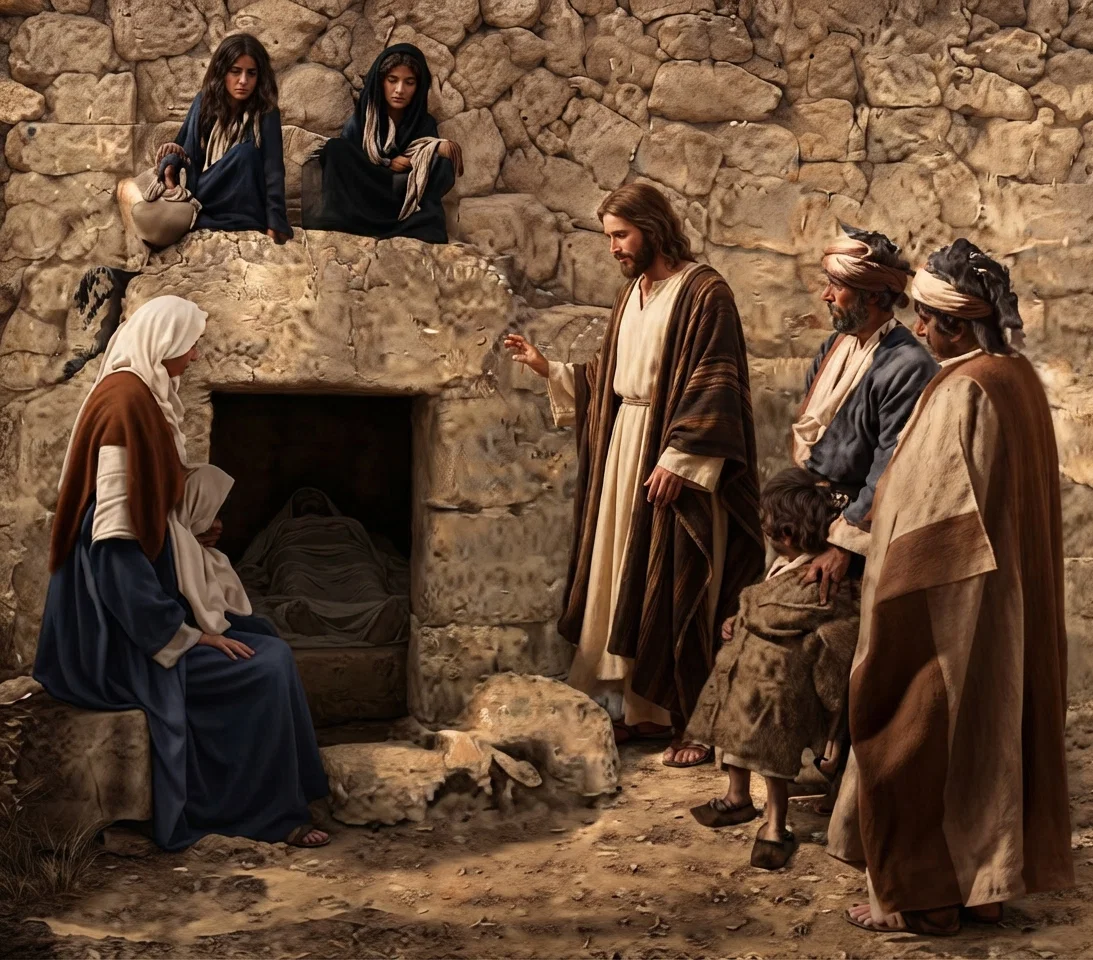
THE GRAVE OF LAZARUS.
Messengers came in and told them that the Lord was coming. Martha ran to meet Him with the words, "Lord, if Thou hadst been here, my brother had not died. And even now I know that whatsoever Thou shalt ask of God, God will give Thee." Jesus replied, "Thy brother shall rise again." Martha's response clearly shows that she did not believe that her brother still lived, did not believe that he had gone to some other sphere of happiness, and that only his dust remained in the grave. She replied, "I know that he shall rise again in the resurrection at the last day." And then Jesus brought before her the one necessary thing, the very core of Christianity, the personal Christ, "I am the Resurrection, and the Life; he that believeth on Me, tho he die, yet shall He live; and whosoever liveth and believeth on Me [at that day] shall never die. Believest thou this?" She saith unto Him, "Yea, Lord; I have believed that Thou art the Christ, the Son of God."
"Jesus Wept."—And then she went away and called her sister secretly and said, "The Master is come, and calleth for thee." What a blessed message it was to the sorrowing heart, and how eagerly she went to Him who had cleansed her from her sins! but she greeted Him with the same words as did Martha, that which had doubtless been expressed many times each to the other, "Lord, if Thou hadst been here my brother had not died." And then she wept, and the Jews who came with her also wept, till the heart of the Master was itself moved, and He groaned in spirit and was troubled, and asked, "Where have ye laid him?" They led Him to the sepulcher, and there "Jesus wept." Why did He weep? He knew that He who there slept, His friend, would soon rise, He knew that the sorrow of those persons would soon be assuaged, and their hearts comforted, but He saw in those weeping sisters and those mourning friends the bereaved and mourning ones of all generations to come, and His great heart of love and pity could but weep with those who wept.
At the Sepulcher.—Still groaning in Himself He came to the tomb. The margin reads, "moved with indignation in Himself." He saw in that death the great enemy, sin. It is the blasting, blighting curse of all the ages of time; the death of the fair, the true, the good, the pure, was sin's work, and to be laid to sin's charge; and despite the sadness and sorrow, His heart was indignant against it. Would God that all the mourning race might see the cause of disease and death upon the world. How much sooner would they find4the remedy and seek the true Physician.
The tomb was in a cave, a stone was placed at its mouth. Jesus said, "Take ye away the stone." Practical, matter-of-fact Martha, still not realizing the meaning of the words which Jesus had spoken to her, could not believe that her brother was to arise, and she mildly protested, "Lord, by this time the body decayeth; for he hath been dead four days," and her words were doubtless true. But Jesus merely reminded her, "Said I not unto thee, that, if thou believest, thou shouldest see the glory of God?" They rolled away the stone. He turned His eyes heavenward and said, "Father, I thank Thee that Thou heardest Me. And I knew that Thou hearest Me always; but because of the multitude that standeth around I said it, that they may believe that Thou didst send Me." And then, with a loud voice, which pierces the ears of the dead, sends the life-blood through every artery, and wakes the whole man, He cries, "Lazarus, come forth." And he that was dead came forth, bound hand and foot with grave-clothes, and his face was bound about with a napkin. Jesus saith unto them, "Loose him, and let him go." And he went forth whole in body and soul. And yet the hearts of that nation in the very midst of whom such a mighty miracle had been wrought sought to take the life of not only Him who wrought the miracle, but of him upon whom the miracle had been wrought, in order that nothing might stand in the way of their own self-seeking honor and exaltation.
What Is the Lesson?—First, it is that the same Jesus lives to-day, and is just as able to strike from the hearts and lives of those who are enshackled and enslaved by sin the mighty fetters that bind them as He was to break the bonds of sin which held Lazarus in death. He would be life, eternal life, now, to every believer, giving present power over present sin. Secondly, He asks us to do all in our power to make way for the life which He would place within us. There are hearts before whose doors stones of prejudice and selfishness in all their various forms have been placed. He would have us remove the stone. And there are those to whom Christ has spoken pardon and peace who have been given new life by His word, yet who are still bound by various ties of earth, even as was Lazarus with his grave-clothes, and the Lord tells us to let them go free. Put away the sins. If we will meet all that He requires of us on our part we will find in Him now the resurrection and the life to call from the graves of lust, of love of the world, of selfishness, of error, our own selfish hearts and make us new creatures in Christ Jesus. More than this, we may die, the grave may cover us, and we may molder to dust; but the voice of the Son of God will call to the loved ones, and they that hear shall live.