FIVE and a half million Methodists, now scattered in three denominational bodies, will be united when the federation is completed between the Methodist Episcopal, Methodist Episcopal South, and Methodist Protestant churches. The membership of the Methodist Episcopal Church is 3,485,983; of the Methodist Episcopal Church South, 1,817,732; and of the Methodist Protestant Church, 188,806; giving a total membership of 5,492,521 in all three churches.
A subcommittee of nine, three from each church body, met in Cincinnati, Ohio, January 19, and laid their plans for uniting the three bodies. A report is to be made at Chattanooga, Tennessee, May 17, to the joint commission of twenty-nine, which appointed the subcommittee. The joint commission was itself appointed by the general conferences of the three churches. It met last November, considered the feasibility of uniting the three churches, and appointed the subcommittee. The declaration made at that time reads:
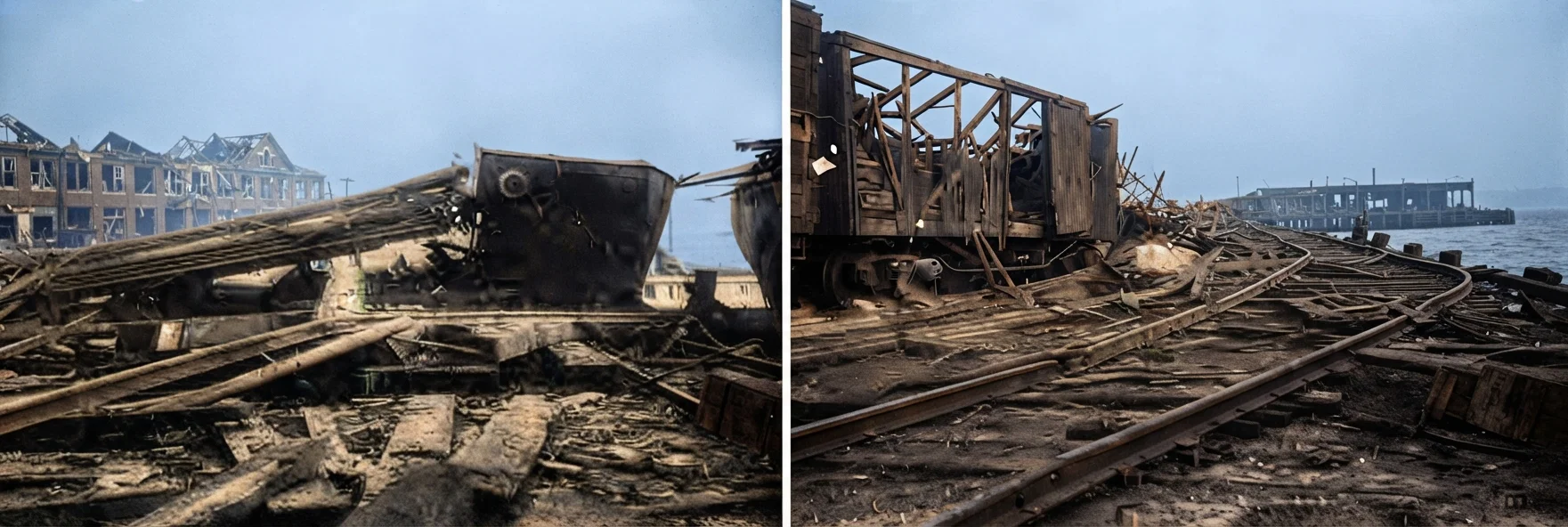
Photographs of some of the results of the fearful explosion of twenty-five tons of dynamite and ten tons of gelatin at Communipaw, near Jersey City, at a pier of the Jersey Central Railway, February 1, by which from thirty to fifty lives were lost and one thousand injured. Many of the bodies were blown to atoms. Two boats, one of which seems to have been unlicensed to carry explosives, were utterly destroyed. Many on the bay were greatly damaged, and passengers injured. Property loss will run into millions. Many persons in Manhattan, a mile away, were injured in the streets by falling glass. It was felt on Long Island, fifty miles from the scene of the explosion. Providentially, officials feel, there were few immigrants on Ellis Island when the explosion occurred, or many more would have been injured. Those there were greatly frightened, believing it to be an earthquake, as were thousands in New York City, where the great stone and cement structures rocked and swayed. One of the strange things is that a car-load of dynamite on the track close by did not explode, tho the car was wrecked and the boxes of dynamite scattered. Officials declare that the damage would have been beyond computation. The cause of the explosion is not known. Officials have been arrested, and diligent investigation will be made. But as in many instances of this kind, the criminally careless and those who knew were killed by the explosion. (Photographs by Transatlantic News Service Company.)
Resolved, That a joint committee of nine, three from each commission here represented, be appointed to consider the causes which produce friction and waste, and injure rather than promote the common cause — namely, the spreading of Scriptural holiness through these and other lands; and, if found practicable, to bring to this joint commission a plan for submission to the general conferences and people of the respective churches, said plan to provide for such unification through the reorganization of the Methodist churches concerned as shall insure unity of purpose, administration, evangelistic effort, and all other functions for which our Methodism has stood from the beginning.
It is recommended that this committee meet promptly for organization and the division of its preliminary labors among necessary subcommittees, each church to be represented in the membership of each subcommittee, and the chairman of each commission to have authority to designate another member of said joint committee to serve on any subcommittee in place of a member of said subcommittee who may be necessarily absent at any subcommittee meeting.
Bishop Earl Cranston, chairman of the subcommittee, said after the meeting at Cincinnati, that the committee of nine had found a workable plan upon which the three churches can be united.
Let us consider for a little the differences which now exist between the three churches, and a little of the history of the disagreement. The split in the Methodist Episcopal Church, which led to the formation of the Methodist Episcopal Church South, dates back to 1844, sixteen years before the breaking out of the Civil War. The underlying cause of the separation was a disagreement as to the right to hold slaves. Francis A. Harding, a member of the church, came into possession of a number of slaves, and about the same time Bishop James O. Andrew also became a slaveholder. Both men obtained the slaves either by inheritance or marriage.
The Methodists of the North insisted that Bishop Andrew should be retired. The Methodists of the South insisted that he should continue to hold his place, even tho he continued to hold slaves. The question then arose whether the general conference had the power to set aside the bishop without formal trial. Thus the construction of the constitution of the church was called in question, the Northern Methodists holding one view, and the Southern Methodists another. In 1845 the Methodist Episcopal Church South was organized. It has remained a separate organization ever since.
There is really not very much difference now, however, between the Methodists of the North and those of the South. The Methodists of the North, at the general conference of 1900, adopted a revised constitution. Before that time the constitution of the Northern and Southern Methodist churches was the same, the only difference being in its interpretation. But the revised constitution is to all intents and purposes the same as the old one, the only changes being in matters of church legislation. There are practically no changes in matters of faith.
A few instances of the changes will suffice. The Northern Methodist Church now has district superintendents in place of presiding elders, while the Southern church still retains the old term, "presiding elder." The Northern church body has extended the terms of the district superintendents to six years, while the presiding elders' terms in the Southern church are of four years' duration. The Northern Methodists have removed the five year limit formerly placed upon the pastoral term, while the Southern Methodists still retain a four year limit. This makes it impossible for a minister to remain as pastor of one church more than four years at one time, altho he may return to a charge after he has served at another place.
In both churches there was formerly a probationary period of six months. New members who were not sufficiently informed as to the tenets of the church, were put on six months' probation, at the end of which time, if they had acquainted themselves sufficiently with the church doctrines, they were received into the church. But the Northern Methodists have stricken off the limit, placing this in the discretion of the pastor and official board of each local church. The Southern Methodists have abolished the probationary period entirely.
There are more differences in church government between these two churches and the Methodist Protestant Church than there are between the Northern and Southern Methodists. The Methodist Protestant Church has no bishops.
The three commissions, appointed by the three bodies, who are working as a joint commission, are composed as follows:
Methodist Episcopal — Bishop Earl Cranston, chairman; Bishop J. M. Walden; Bishop L. B.11Wilson; Rev. J. F. Goucher, D.D.; Rev. G. A. Reeder, D.D.; Rev. W. W. Evans, D.D.; Mr. R. T. Miller; Mr. Hanford Crawford, secretary; Mr. J. A. Patten.
Methodist Protestant—Rev. T. H. Lewis, D.D., chairman; Rev. M. L. Jennings, D.D.; Rev. George Shaffer, D.D.; Rev. G. D. Helmick, D.D.; Rev. C. D. Sinkinson, D.D.; Mr. S. R. Harris; Mr. J. E. Peterson; Mr. W. N. Swift, secretary.
Methodist Episcopal South—Bishop A. W. Wilson, chairman; Bishop E. E. Hoss; Bishop Collins Denny; Rev. W. J. Young, D.D.; Rev. F. M. Thomas, D.D., secretary; Rev. C. M. Bishop, D.D.; Mr. M. L. Walton; President R. S. Hyer; and Mr. W. B. Stubbs.
At the meeting in Baltimore in November all the members of the joint commission were present except Dr. J. F. Goucher, who was absent in China.
Bishop Cranston expressed his views of the situation thus:
"First of all, I take it that we are God's men, solemnly chosen by other men of God to consider what God's wisdom and will may require of us and of them in our conduct of God's business so far as it is committed to us and to them. I see no escape from this identification of ourselves and our mission in this place at this time. It involves a tremendous test of our religious integrity, and demands of us the complete subordination of all considerations that are human in their origin and motive.
"If we are here simply as credentialed expert negotiators between three human institutions to test our wits against each other for the advantage of our respective principals, we want no prayers or sacraments in such an adventure. Diplomacy, wary, shrewd, mistrustful, but carefully veiled — that is our dependence in that case. That our people have sent us on such an errand, or that the men of this company would undertake such an errand, is unthinkable.
"Let us examine our credentials. Our commission is authorized to confer with reference to either federation or organic union, as may seem more desirable to other branches of Methodism concerned. Another commission is "directed to further, so far as is consistent and practicable, a closer relation" between the several Methodist bodies, and its principal, leaving the commission to interpret by facts in its own knowledge what may be "consistent and practicable." The third commission is "instructed to promote and complete, so far as may be possible, the reunion of Methodists in America."
"For my own church I am warranted in saying, after consultation with my colleagues, that we are ready to proceed under either head of our instructions; to confer as to either closer federation or organic union, as our brethren may desire; to meet all issues frankly and deal with them without reserve or diplomatic finesse, and to discuss all related questions in a spirit devoid of controversial feeling, so far as in us lies."
In passing the resolution to appoint a sub-committee of nine, the joint commission said:
"We are agreed that the churches represented by us are equally apostolic in faith and purpose, and having a common origin, the Methodist Episcopal Church, organized in 1784, they are joint heirs of the traditions and doctrinal standards of the fathers, and that they have proved their loyalty to the evangelical faith and spirit which characterized early Methodists."
Before the three bodies can be united, the question must be submitted to the State conferences, which meet annually. It must then be taken before the general conferences of the three bodies. The general conferences of the Methodist Episcopal and Methodist Protestant churches meet in May, 1912, and that of the Methodist Episcopal Church South in May, 1914. Thus it will be at least four years before the union is finally effected, unless a special conference is called, which is possible under the constitutions.