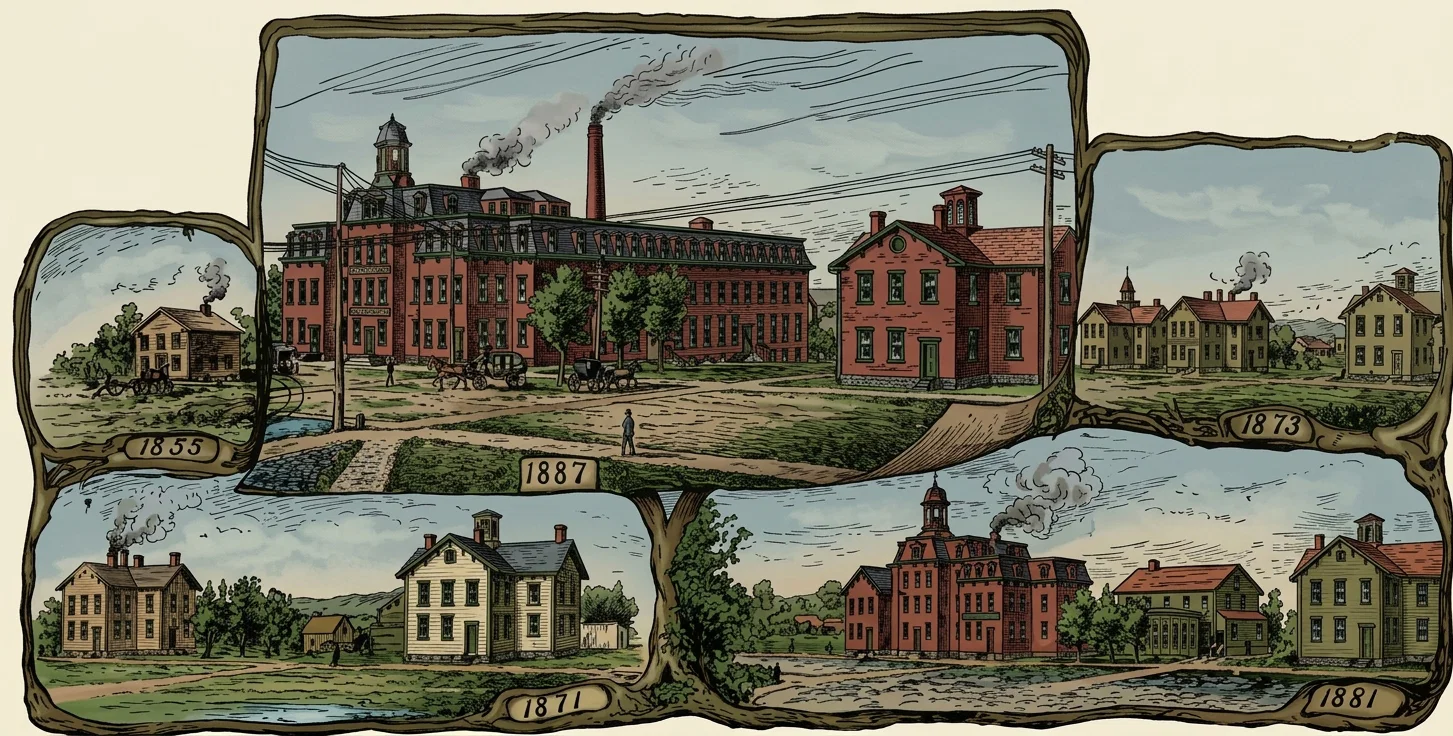
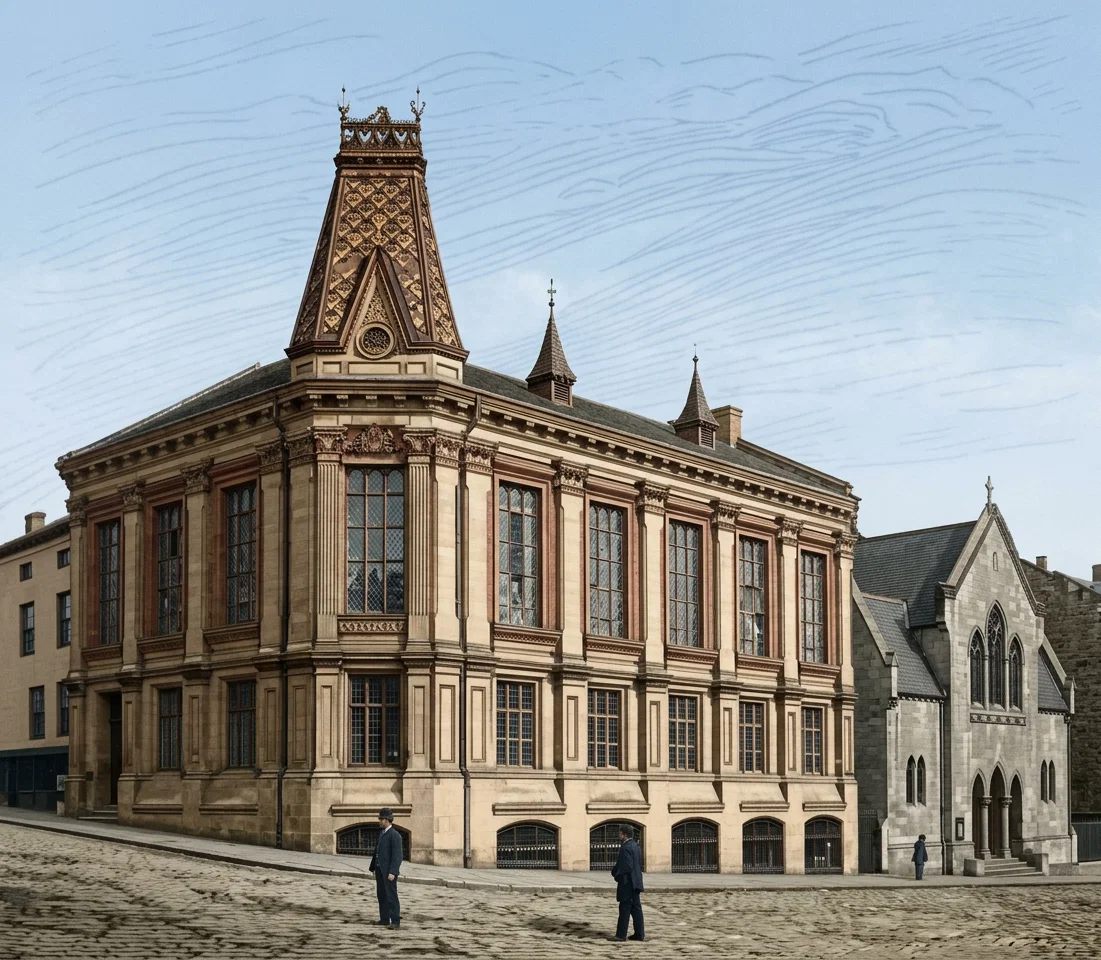
Central Publishing House in Battle Creek, Mich., East Building.
PROGRESS AS INDICATED IN THE PUBLISHING WORK
By Uriah Smith
[By the Editor Review and Herald.]
THE publishing work of which we here speak is that of the Seventh-day Adventists, which began in 1849, and has just now reached the termination of its first half century. In estimating its progress, and the influences which have contributed to its success, something more than merely statistical figures are necessary. We must take into account the conditions under which it commenced, the work it was established to accomplish, the opposition it has had to meet, and other difficulties it has had to encounter.
The cause in which it boldly threw to the breeze its banner, was no less than a new theological departure in the religious world. Some of the principles and views it was designed to promulgate were not such as received any countenance in Christendom, nor such as would naturally find favor in the human heart. It started with no prestige of great names, nor endorsement from earth's high places; and the only human means behind it were the daily wages drawn by the day laborer from the harvest-field and the wood lot.
In addition to this, consider the field it was to occupy, and the work it was intended to do. It was established in the wake of a movement which had stirred the whole eastern portion of the United States to its profoundest depths; a movement which had caused more agitation, and aroused more antagonism and opposition, than any religious movement for a hundred years before; a movement which had apparently proved false in all its pretensions, and lay buried under the stigma of ignominious failure. The task it was to undertake was to vindicate this prostrate cause, to remove this stigma, to show to an incredulous and scoffing world that the failure was only apparent, not real, that a wrong application of only one prophecy, in only one particular, had led to all the apparent failure and the disappointment. It was to show that the prophecy did not warrant the claim that the Lord was to come in 1844, or on any particular day that could be specified, but only that the sanctuary was to be "cleansed"—a different event of a different nature (see works on the subject of the sanctuary); that consequently the doctrine of the soon coming of Christ was still a current and pertinent theme; but that before that event there was to be a reform in the practise of the people, touching the law of God, specifically in reference to the Sabbath, against which all Christendom, with the exception of one denomination, was set in hostile array; and that the church was to have in exercise the gifts of the Spirit, which all men stood ready to denounce as fanaticism, deception, or, worse still, as demonology.
Central Publishing House at Battle Creek, at Different Periods.
What hope was there that a publishing interest inaugurated for such a purpose, could possibly succeed? What warrant could any one see to induce one to embark in such an enterprise as this?—It was simply this: The great advent movement which had just preceded, had called out a study of the prophecies, more thorough and exhaustive than had been witnessed since the days of the apostles; and the new light then arising showed additional steps to be taken, a further work to be done. A few devoted persons whom God was evidently teaching, read their duty in Rev. 10:11. The message that came to John (who there stands as the representative of the church after the trial of verses 8-10, symbolizing the great disappointment of 1844), namely, "Thou must prophesy again before many peoples, and nations, and tongues, and kings," was to them an announcement that a further message, or rather a continuation of the same message, with additional and important features, must be given anew to the world; and when the prophecy says "must," those to whom the light is given, if they maintain their integrity, have no alternative but to obey. Implicit faith, unhesitating obedience—these were the motives which nerved the pioneers in this work to their boldness and activity. But what fruit could be expected from their efforts? In the lamentation of the ancient prophet, it would seem that they might
have exclaimed, "Who will believe our report, and to whom will the arm of the Lord be revealed?" The thought that it was of God, and that some would be found who would themselves yield to the impulses just named, gave the movers the only ground of hope for progress in their work.
The means first used for the promulgation of new views is usually the living voice, or word of mouth. The next is the printed page, a periodical, or a means of communication among the friends of the movement, and books as permanent and continual advocates and defenders of the cause and its purposes. Beginning in 1845, adherents brought in by the spoken word soon became so numerous that some publication was demanded to acquaint the workers with one another, and to unify the work. Accordingly, in 1849, a small sheet called The Present Truth was started by Elder James White, the pioneer in the publishing work, in Middletown, Conn., and published more or less regularly there for two years, when, enlarged in size, and with name changed to The Advent Review and Sabbath Herald, it was moved to Paris, Maine, and issued as a semi-monthly. Under the latter title it continues to the present time, weekly, as the organ of the denomination.
The first number of the first paper, the Present Truth, named above, when ready for the mail, and addressed to all the then known friends of the movement, was easily contained in a single hand satchel, and carried by the editor, on foot, to the post-office, five miles away. The Advent Review, after being issued for a few months in Paris, Maine, from the year 1851, was moved to Saratoga, N. Y., and afterward to Rochester, N. Y. In 1855 it was moved to its present location, Battle Creek, Mich., where the brethren had erected a humble building for its future use, and where it has since had a local habitation of its own. Nothing was done in the line of tracts, pamphlets, and books till 1854, and then in a very small way.
Echo Publishing House, Melbourne, Australia.
In 1861 there was formed a legally incorporated association, under the laws of Michigan, which took into its hands the management of all the then denominational publishing interests. Previous to this move, it had all been in the hands of one man, Elder James White, the pioneer above mentioned. To this time he had been the sole manager. In this year, 1861, a new brick building was erected. To this, as the growth of the work demanded, additions and consolidations followed in 1871, 1873, 1878, 1881, 1887. See illustrations bearing these dates. The main structure, three stories in height above the basement, has a street frontage of 120 by 165 feet, comprising 80,000 square feet of floor space. The building is supplied with 2 steam elevators, and equipped with all facilities for doing first-class work in every department of book and job printing, bookbinding, electrotyping, drafting, and engraving by all processes. It has twenty-five presses of various sizes, steam paper cutters, machinery for folding, stitching, embossing, ruling, and trimming, and every form of facility which modern ingenuity and inventive genius5have produced for the purpose of accomplishing first-class work in all branches of the publishing business; and all the machinery, from the electrotype foundry to the electric-light plant, and the elevators, is run by a hundred horse-power engine, and boilers of still greater capacity. Across the street from the main building, as shown in the illustration, is the so-called "west building," in which is located the banking department, attorney's office, packing and shipping rooms, wholesale and retail, salesrooms, besides storerooms sufficient to hold $90,000 worth of finished books. These two buildings are as closely connected by telephones and speaking tubes as if under one roof. The capital invested is $250,000. From 275 to 350 hands are employed, varying according to the pressure of the business. Nearly a quarter of a million dollars' worth of work is turned out each year. It is often necessary to put on a night force of workmen to keep pace with orders. And from two to four hundred tons of Gospel literature is sent out every year.
Publishing House, Christiania, Norway.
Should the reader now wish to take his bearings in reference to the progress which these facts indicate, let him place beside this steam-driven, busy establishment the one solitary man, in 1849, wending his way on foot toward the post-office, bearing in a single satchel the entire first month's output of the publishing work as it then existed.
The foregoing has been spoken only of the central publishing house located at Battle Creek, Mich. But the message, being world-wide, was prophetically designated in the divine program to go, not only to all parts of this country, but "to every nation, kindred, tongue, and people." Work was commenced on the Pacific Coast in 1868, and a publishing house was incorporated in Oakland, Cal., April 1, 1875. Not to enter into particulars, this office, in all its equipments, equals, and in some respects surpasses, the Battle Creek house. It is one of the largest and most complete publishing houses west of the Rocky Mountains. The investment amounts to over $225,000. Some 200 persons are employed. Both of the offices named maintain branches at important centers; the first, in Chicago, Ill.; Atlanta, Ga., and Toronto, Ont.; the second, in Kansas City, Mo., and New York, N. Y.
Publishing House, London, England.
An office of publication was established for Central Europe, at Basel, Switzerland, in 1884; and a large building was there erected for its use, $60,000
being invested in the enterprise.
The publishing work was commenced in Christiania, Norway, in 1880, and was prospered till the building shown in the illustration became a necessity, and was erected in 1885, at a cost of $60,000. Over 35 hands are employed, and the output in the different Scandinavian languages is large.
In 1885 also, mission work was commenced in Australia; and in the following year, 1886, a monthly, now weekly, journal was started in Melbourne, called the Bible Echo. Published at first in a rented office, a lot was subsequently bought, and the building shown in the illustration was erected. The ground, building, and office fixtures involved an outlay of about $25,000. A youth's paper and a religious liberty journal are now published there.
In 1884 the General Conference started a monthly journal, called The Present Truth, in Great Grimsby, Eng. In 1887 this was moved to London, where it is still published, having now a weekly circulation of 16,000 copies.
Papers are also published in Cape Town, South Africa; Calcutta, India; Buenos Ayres, Argentina; Kingston, Jamaica, West Indies, and Guadalajara, Mexico. Besides these there are local or State papers issued in nearly every conference in this country. In the seven leading offices about 40 periodicals are issued in the leading languages of the world. Nearly twoscore languages are now found in our catalog of books and pamphlets. Thus the publishing branch of the work is doing its part to speed the message to the accomplishment of its designed purpose, to carry to all nations, tongues, and kings the warning of the coming of the great day of the Lord.
What has led to the wonderful growth and expansion exhibited in the foregoing facts and figures?—It is the blessing of God upon the onward march of study and investigation to which the students of prophecy have been inspired in these last days, accompanied by the faithful preaching of the Word, and the multiplication of friends to the views presented. Growth of publishing facilities to meet these conditions was the natural and inevitable consequence.
But, aside from the increased labor and expense necessary to achieve these results, the message has shown its vitality and vigor by the way it has surmounted other obstacles. One of these has been the opposition it has had to meet. The opposition from without, from non-professors and hostile religious denominations, was easy to bear. That simply acted as a tonic to give vitality and vigor to the cause, and inspire its friends with new zeal. Thus it tended to the furtherance of the work rather than to its hindrance. But opposition from within was more ominous of mischief. As even the apostles had false brethren in their day, so in this cause opposition has from time to time developed in the very ranks of its professed friends, bringing out elements calculated to reproduce the scenes of Acts 20:29, 30.
In more recent years religious professors, not understanding what they were doing, have been taking advantage of the remnants of some old medieval laws still remaining on the statute-books of many States, and have tried to hinder the work by legal pains and penalties. But so far they have not been able to accomplish any visible results. They seem to overlook the fact that in dealing with this cause, the one great element they must reckon with is the heaven-born vitality with which it is endowed.
Polyglot Publishing House, Hamburg, Germany.
Pacific Press, Home of the "Signs of the Times," 1899.
So over all these disturbing factors—opposition from prejudiced professors and the openly profane worldling, over internal defection and financial burdens, the work has moved steadily forward, thereby showing that a providence higher than any worldly wisdom, and stronger than any earthly power, was working in its behalf. And this has inspired its friends to rest down calmly in the same assurance that Gamaliel expressed in regard to the work of Christ in his day: "If this counsel or this work be of men, it will come to nought; but if it be of God, ye can not overthrow it." Acts 5:34-39.