Beginning of Our Printing Work in the Interior of China
By H. W. Miller, M. D.
By H. W. Miller, M. D.
F ever an institution can be said to have been begun on a small scale, it can truly be said of our publishing work in China. Our first publication was a single sheet, and our first printing-press was a little army press, the total weight of which would not be over three hundred pounds and could go inside of a steamer trunk complete. Besides this we had a box of English job type which we brought with us from the States.
This little press, being a donation, was brought out to China in the fall of 1903 and remained boxed up until the spring of 1904, when we unpacked it. But since none of us knew anything about printing, fearing to go too far in unpacking, we nailed up the box, concluding to wait until a printer came out. And in this box it remained for another year, until the spring of 1905, when we had a small amount of literature translated into the Mandarin language, and decided to publish a monthly paper for use at the different stations. The press was to be installed at the mission station of Shang Tsai Hsien, in the province of Honan, about twenty miles distant from the railway.
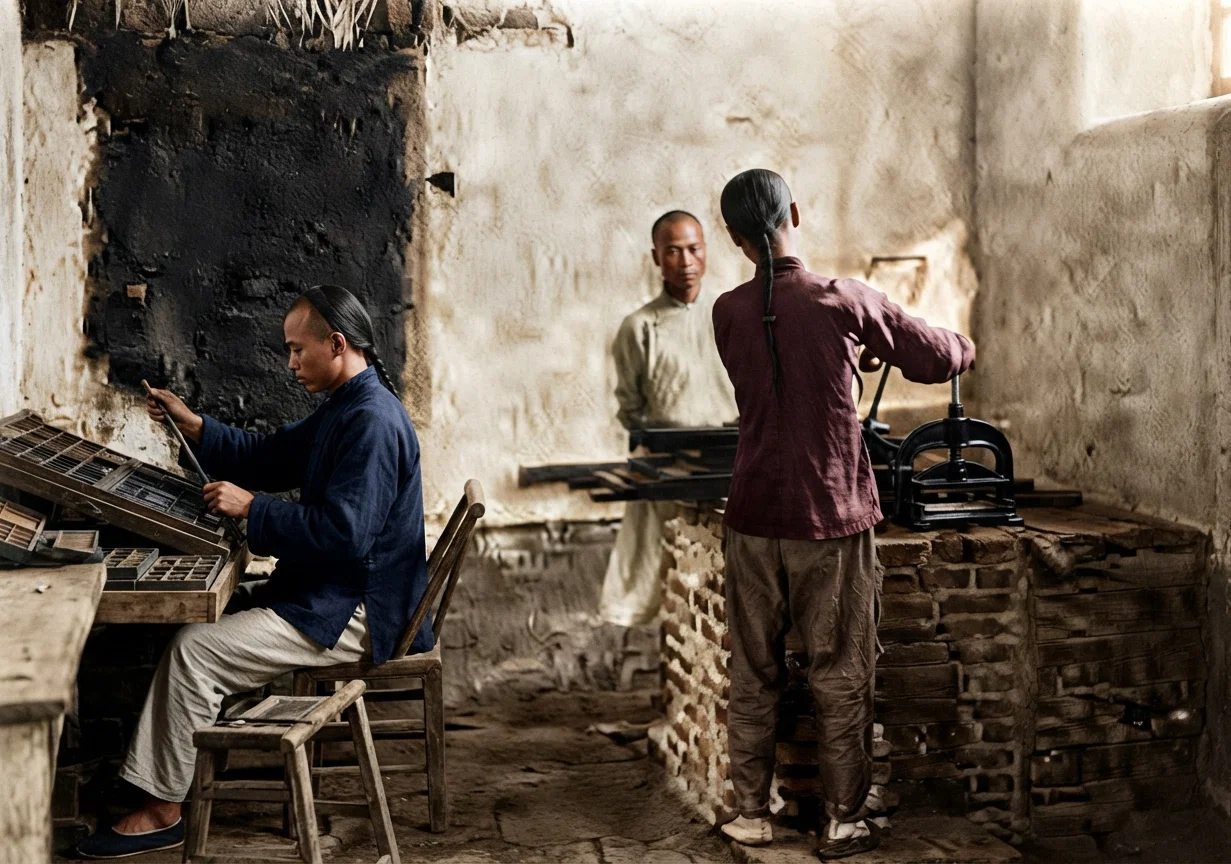
The natives, who had never seen a machine of any kind before, were greatly interested in this enterprise. They came from the country villages to see this press. We explained to the carpenter how to make the cases for the three thousand type we had secured, and he purchased some lumber for us. The only seasoned lumber that could be secured was what had already been sawed out for coffins. (The Chinese make their coffins out of boards from five to six inches thick, which are wedge-shaped, being from six to seven inches wide at one end and from four or five at the other, sawed by hand with the cross-cut saw.) They were three weeks in finishing the type-cases.
Army Press with which our work started in China.
After putting out one issue of the monthly paper and a few smaller publications, we found that working with three thousand characters was a difficult task, so we decided to wait until we could secure a larger font of type and different varieties. We at once
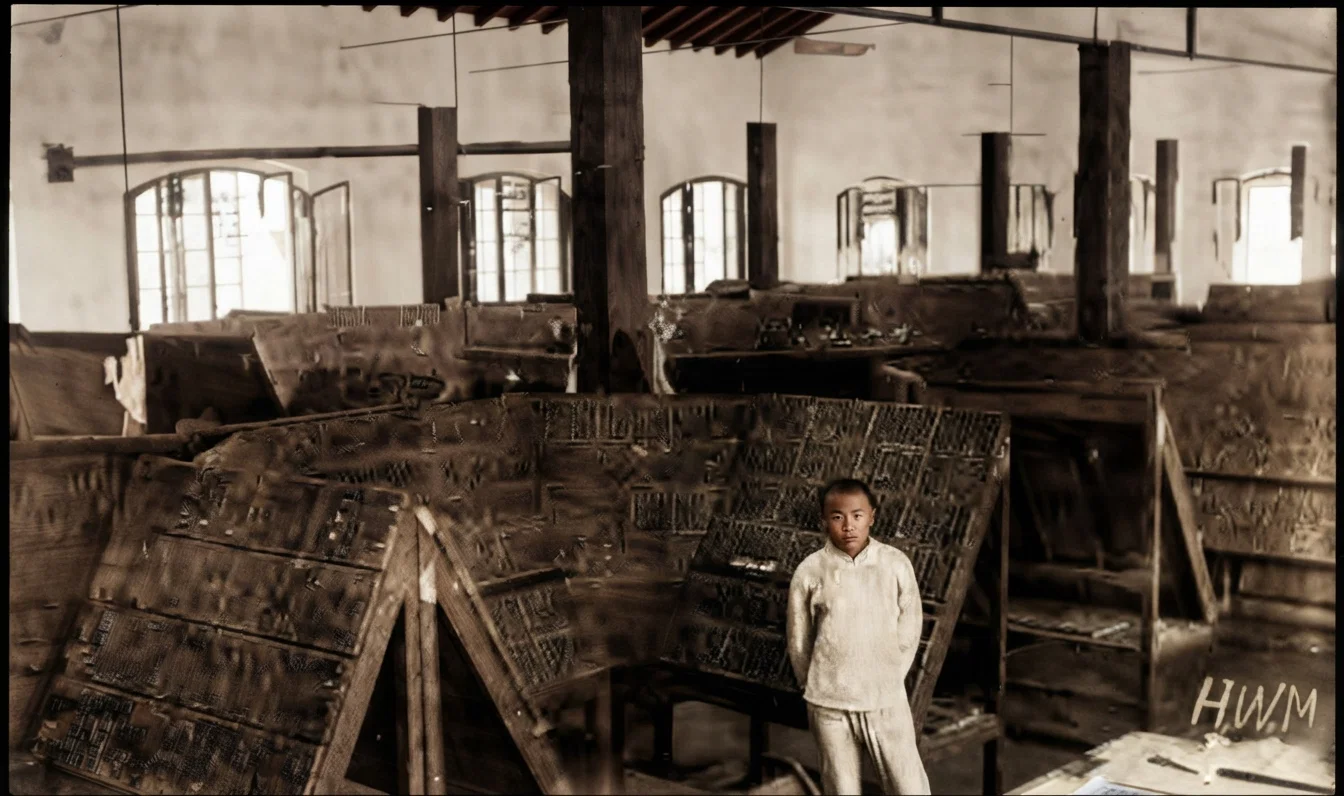
sent an order for enough type to make our number up to seven thousand. When these arrived, we had an even greater task of making the type-cases, and it was difficult to find room in the native houses to store all of them; and by placing them the best way we could in these native houses, they were inconvenient to get at.
In a short time we wore out our inking roller, then we had a new problem to solve as we were so remote from modern facilities. I had some glycerin in my dispensary, and we had some gelatin, and since the rollers looked much like a composition we had used in the laboratory for media, we varied one of the formulas and made up a composition for a roller. Then we took a pasteboard tube and lined it with oil-paper, and by placing the core in the center of the tube and filling in the bottom with pasteboard and sealing wax, we proceeded to cast our first roller. It proved to be a success, altho it was not perfectly circular. We found that the oiled paper adhered to the gelatin, so we had to wash it off. By cutting a length of stove-pipe and spreading it on a board it answered well for an inking slab. By utilizing such materials as could be found in the kitchen and dispensary, together with the ingenuity of the natives, we were ready to proceed with the equipment then in hand.
Composing-Room of Chinese Printing-Office.
We published the "Gospel Primer," a hymn-book of 125 hymns, some sheet tracts, a short tract on the resurrection and another on the immortality of the soul, besides issuing the regular numbers of our paper during the fall of 1905. In February of 1906 we applied to the district inspector of the province of Honan to have our monthly
paper registered at the imperial post-office as a newspaper so as to give us the benefits of the reduced postal rate. Within a few weeks we received his reply, enclosing the official document recognizing our paper. The number of said document was "one," it being the first newspaper published in that province of 35,000,000 people. Altho working with this crude equipment, we felt a real blessing in it, and the Lord prospered our efforts, for this small amount of literature has already borne fruit.
Owing to the distance of Shang Tsai from the railway, it soon became apparent that it would not be the best place to locate our press permanently, so a location was secured
at Sin Yang Cheo, a railway city in the southern part of Honan; but very little was accomplished there except the erection of a building. Upon returning to China, after a few months in America, it was decided to remove the publishing plant to Shanghai, being more central for all of China.
As we previously had done no work in Shanghai, we came here as strangers, and since in these ports only such property is built as is wanted for immediate use, we could find nothing at any reasonable rent in which to locate our printing-office except Chinese houses. Of course these are in many respects undesirable, since the Chinese do not especially care for light, but build their houses more for a place of shelter.
We now have our entire equipment in order and are again beginning to print. Our greatest need is a suitable building, for it is only a question of time when we shall in these countries be largely dependent on our own resources for carrying on our work. We trust that our need here may impress itself upon souls interested in enlightening those in heathen darkness by placing in their hands the printed page of the Gospel of light.