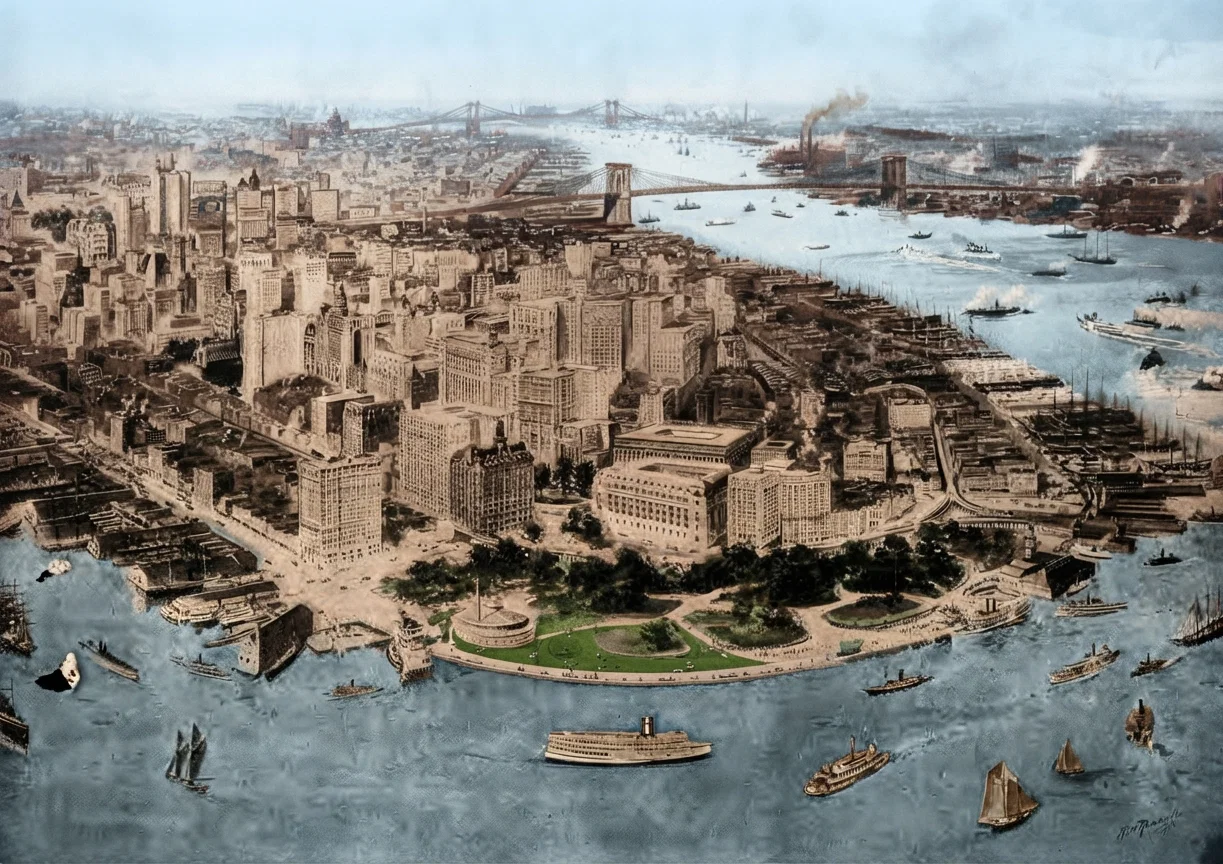
New York City, next to London the largest in the world, had a population in 1905 of 4,014,304 inhabitants. London's population in 1903 was 4,613,812. The statisticians for the New York Board of Trade and Transportation estimate that by 1925 New York will contain 6,760,000 souls. Its area is 327.9 square miles, a little greater than the combined extent of Chicago and Philadelphia, and almost twice that of London. From the extreme north to the south the distance is more than thirty miles.
The first European probably to visit the site of New York was Giovanni Verrazano, who came in 1524. In 1525 the Spanish navigator Gomez sailed into the harbor. By 1600 the French seem to have begun an extensive trade with the Indians along the Hudson. Henry Hudson explored the harbor in 1609, and four trading houses were built on Manhattan Island in 1613. The second ship built in America, the "Onrust," or "Restless," was built here in 1614.
Copyrighted 1904, 1905, by Moses King. LOWER NEW YORK, SKY-SCRAPERS, AND BROOKLYN BRIDGES.
In 1636 Peter Minuit bought the island from the Indians for goods valued at present rates of money at about $120, and built near the present Bowling Green a small fort, Fort Amsterdam. There was at that time a population of about two hundred, the settlement being called New Amsterdam. A church was organized in 1628, the first clergyman of which was Rev. Jonas Michaelius. The town was incorporated as a city in 1653, with a population of about 800, and a wall 2,340 feet long was built along what is now called Wall Street (whence the name), as a protection against the English and the Indians.
In 1664 the city was taken by the English and renamed New York. In 1673 the Dutch regained possession and called it New Orange. In 1674 the English again became possessors.
The first Inter-Colonial Congress was held in New York 1690. In 1725 the first newspaper, the New York Gazette, was founded.
New York's expenditures for the year 1901 footed up the vast sum of $156,397,573. It has one of the finest harbors in the world, being about five miles wide and six miles long. Previous to 1874 the city did not extend beyond Manhattan Island, now it embraces part of Queens County, the whole of Kings, Richmond, and some other territory. New York's greatest wonder is the city itself.