Modern Greece

4%

Pacific Press Publishing Company · Mountain View, California · Jul 22, 1908

FromSigns of the Times, Vol. 34, No. 30.

Read the full edition

Modern Greece

By Prof. W. E. Howell
GEOGRAPHICALLY, Greece appears as one of the small things of earth, being but the ragged extremities of southernmost Europe, and containing two and a half million inhabitants. If we accept Hellas in the extended sense in which the ancient Hellenes used the term, and in which, in truth, the modern also regard it,—including all the Greeks, wherever found,—we must multiply the population by four, for there are ten million Greeks around the shores of the Eastern Mediterranean and scattered to the uttermost parts of the earth.
Athens, the present capital of the kingdom of Greece, and the center of free Hellenism, is a modern built city of 130,000 people, and is rapidly growing. But Constantinople alone, the old metropolis of the Greek world after the division of the Roman empire, and still spoken of familiarly by all Greeks as "the city," contains 500,000 Greeks, 100,000 more than the Turks themselves. Alexandria, Egypt, since the time of the great conqueror who founded it and whose name it bears, has always been largely Greek, and is still.
There are more than 125,000 Greeks in the United States, about 20,000 of whom landed there during the past year; while the ubiquitous Greek merchant may be found in far-off Honolulu, Australia, and the islands of the Pacific, as well as in the Orient. If the Greeks should all return at once to their fatherland, every square mile of its territory would contain four hundred people. If all should stand abreast in a line, with outstretched arms, they would form a Greek equator half way round the globe.

Her History.

Historically, Greece stands second to none.
The student of history will never cease setting a high estimate upon the service rendered civilization by the ancient Greeks in the early impulse given to letters and art, in their energetic activity in intellectual and physical culture, and in their heroic, and successful turning back of the tide of Asiatic barbarity and despotism which sought to extend itself into Europe in the time of Darius and Xerxes. Even their idolatry was superior to that of many nations, since they never worshiped animals, as did the Egyptians, and never made their gods in hideous shapes like the Hindus and Chinese.
And not only this, but they pushed their own civilization into the western parts of Asia, and in the providence of God their language became the tongue in which our Saviour taught the eternal principles of holy living, and the medium thru which the New Testament, with its marvelous mysteries and revelations, was given to the world for all time. And who knows but that the untiring perseverance of many of the most intelligent modern Greeks in purging their language from its corruption during four hundred years of bondage to the Turk, and in endeavoring to restore it to its Xenophanean purity, is not within the divine purpose to keep alive a language to which have been entrusted the treasures of the Gospel in the last dispensation?
As to men of eminence, what nation, great or small, can produce a more splendid galaxy of illustrious characters than can Greece? One needs only to mention the names of Homer, Solon, Themistocles, Pericles, Phidias, Socrates, Demosthenes, and Alexander, to recognize men with scarcely a peer in their particular phases of greatness. The hardiness and pertinacity of the race is well attested by their heroic struggle for independence from the oppressive Turk (1821-9) and by the substantial progress they have made since their reestablishment as a separate nation, after seventeen centuries of servitude to foreign powers. As long as time and history continue, Greece and the Greeks will occupy no mean place in the attention of thinking men.

Greece Socially.

Socially, France is the ideal of modern Greece, especially of Athens, the hub around which revolves the wheel of the nation. Three fourths of the people in the capital city speak French. French is taught in some of the government and all the numerous private schools. French fashions prevail. French gold is the principal medium of exchange with foreign nations. French literature abounds in all the book-stores and libraries, and French skepticism, atheism, and evolution permeate society among the educated classes. This bond with the French was recently strengthened by the marriage of Prince George, the king's second son, to Princess Marie Bonaparte, of the royal line; and the Greeks stoutly maintain that Napoleon Bonaparte was of Greek descent.
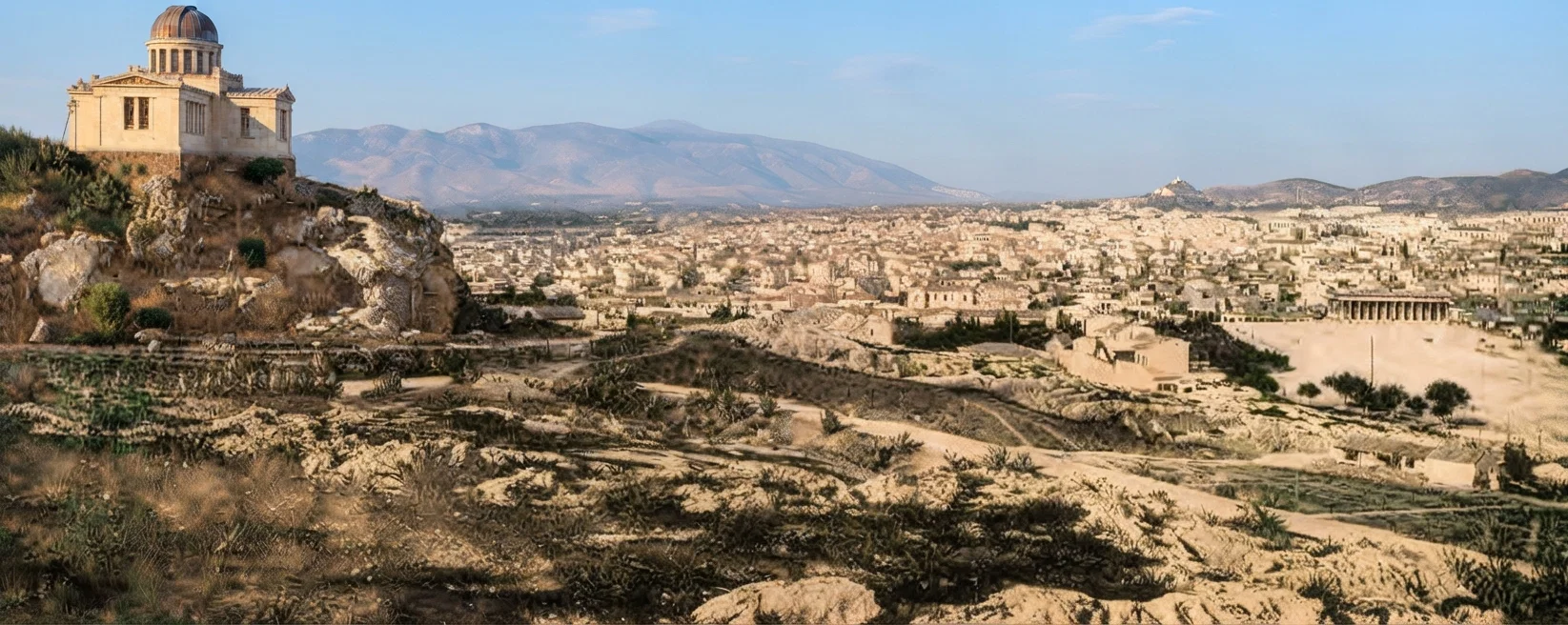
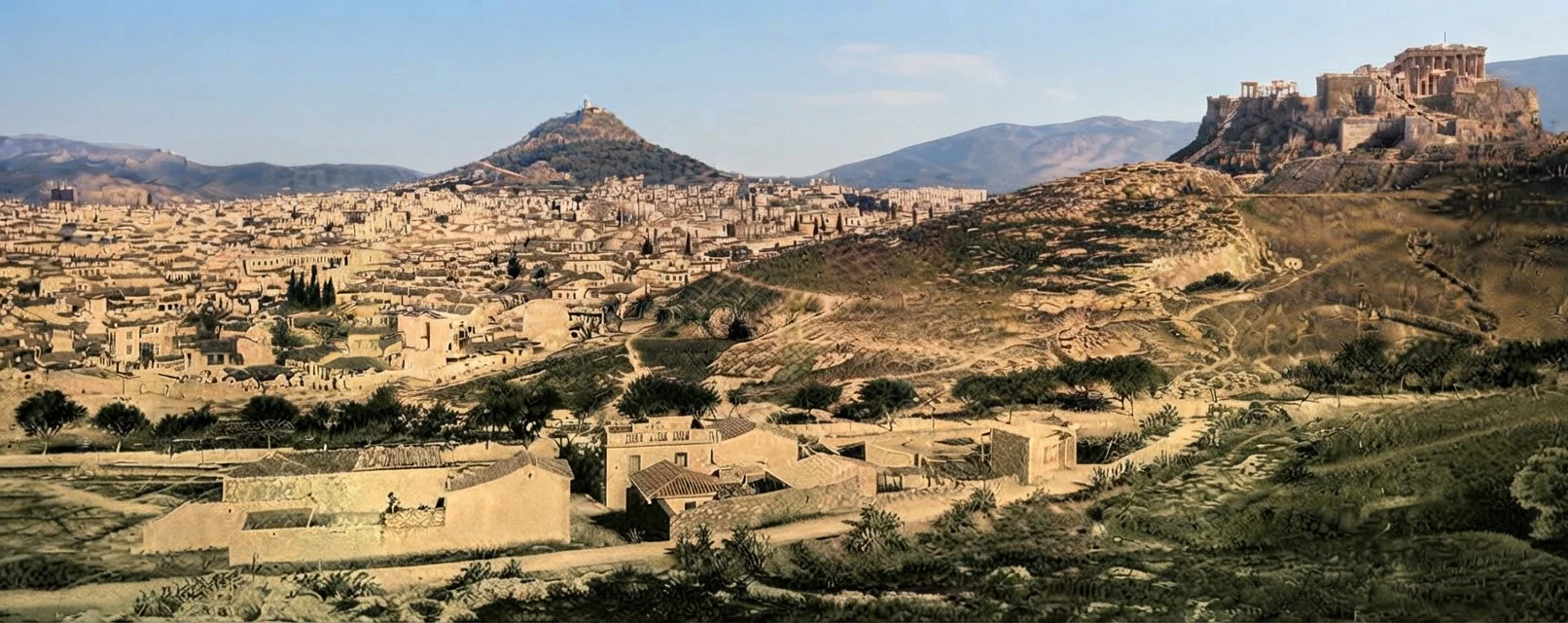
PANORAMA OF MODERN ATHENS.—(1) Parthenon, ancient temple of solid marble, dedicated to Athena, the protecting goddess of Athens; without question the most perfect of buildings. (5) The whole eminence on which Nos. 1 to 4 are situated, called the Acropolis. (6) Mars Hill (Areopagus), place of meeting for the highest ancient court and tribunal. (9) Syntagma, or Constitution Square, facing which are the chief tourist hotels. (10) Metropolitan Church. (11) Mt. Lycabettus, crowned with the Church of St. George, with a convent near the summit. (12) Ancient Theatre of Dionysius, the scene of the great dramatic contests. (13) The Odeon of Herodes Atticus, a theatre built in Roman times. (14) The modern city of Athens, which, unlike those on top of the Acropolis, and which still supplies the market to-day. The upper part of the ancient quarry is visible in the picture as a light patch on the side of the hill. The long street extending beyond the buildings in the foreground is St. Paul Street, which as it passes around the Acropolis takes the name, Street of Dionysius the Areopagite. The Stadium, now restored, is seen beyond the city.
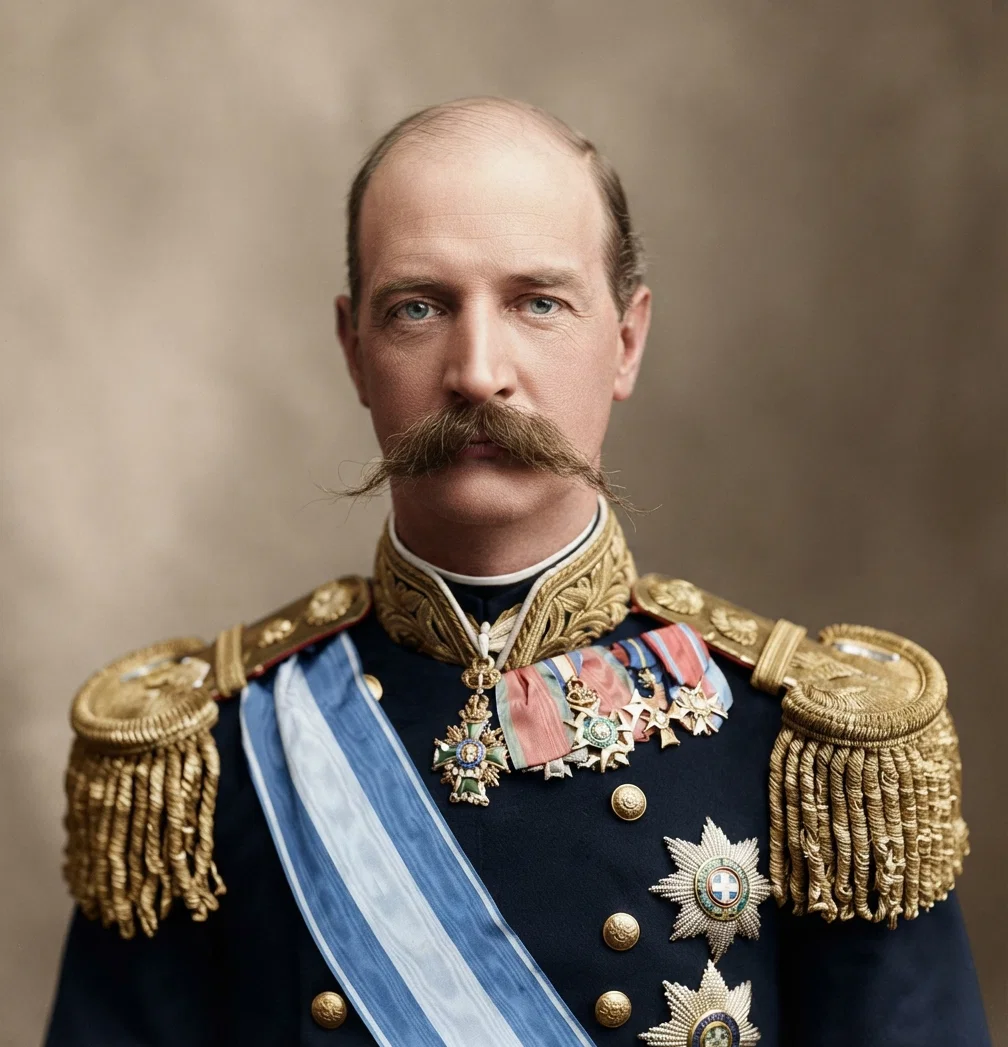
George I, King of Greece, 1863—, Son of Christian IX of Denmark, brother of King Haakon of Norway, and uncle to Czar Nickolas. He is a Lutheran.
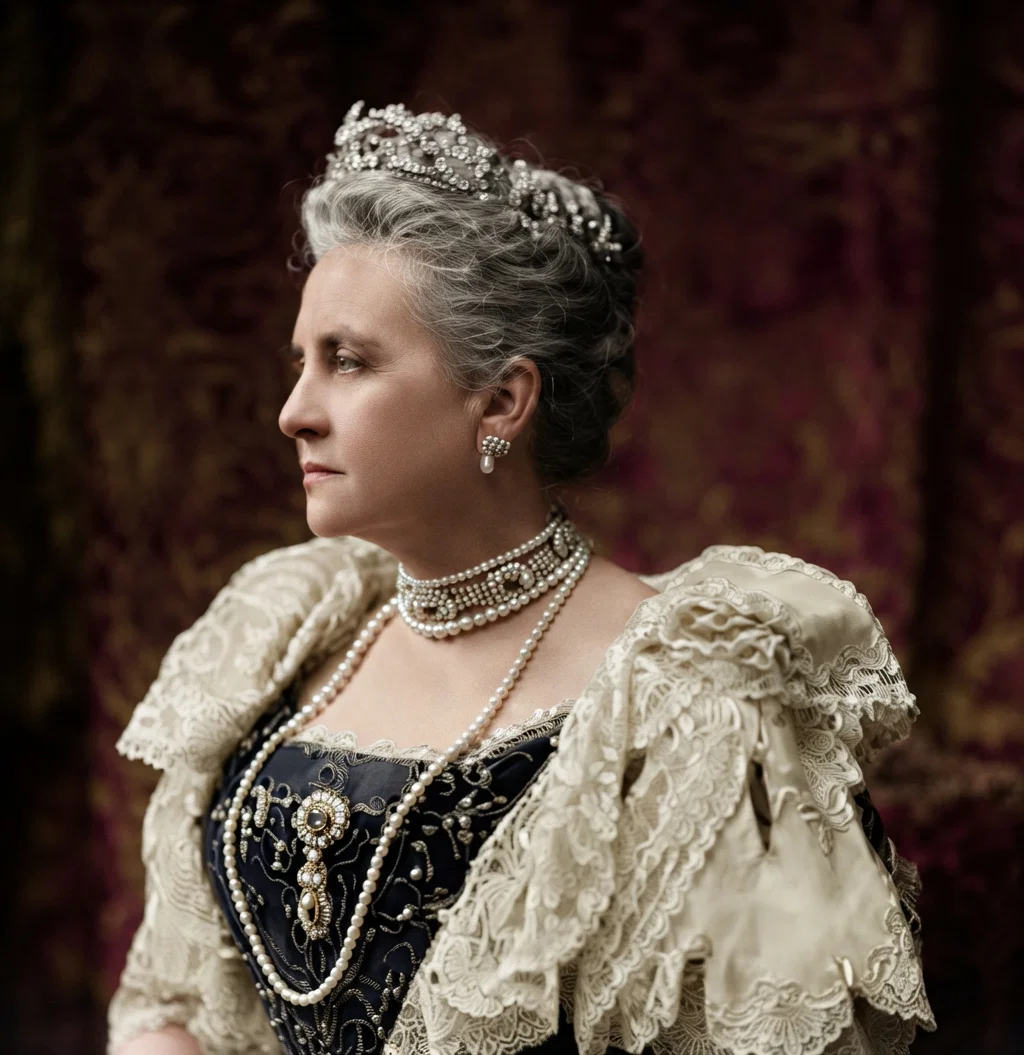
Olga, Queen of Greece, second cousin of the Czar of Russia, a Greek Catholic.
Social caste is well defined. A diplomat of nine years' residence in Greece has remarked that it is stronger here than in India. From the pluto-aristocrat at the top to the boot-black at the bottom, every one regards as his inferior the man whose lot for any reason has fallen in the next rank below. And from the lowest stratum to the highest every one caters in a servile way to his fellow being in the next gradation above. Nor is this idea of inequality, of being waited upon, any less noticeable among the common people than among the elite. For instance, there might have been observed the other day on the principal street of Athens a common dirt-begrimed workman, with a wrench in his hand, passing from post to post to turn off the gas from illuminating arches across the street. Altho free-handed himself, he had a waiter at his heels carrying a small hand-ladder which he would set up and take down at each post for his superior's use. Above the laboring classes no one is anybody who carries his own parcels while shopping or passing to and from a railroad station, or,in fact, who turns his hand to anything that could be called menial.
The Greeks are hospitable almost to a fault, both to one another and to strangers. When one is a guest of another, or even calls on an errand, he must invariably have some light refreshment. When friend meets friend on the street, they must drop into the ubiquitous coffee-house and take a sweetmeat or a drink while they chat for a few minutes. If you are inquiring your way in the town, busy men will accompany you or send some one with you to the next corner or even several blocks to set you on your way.
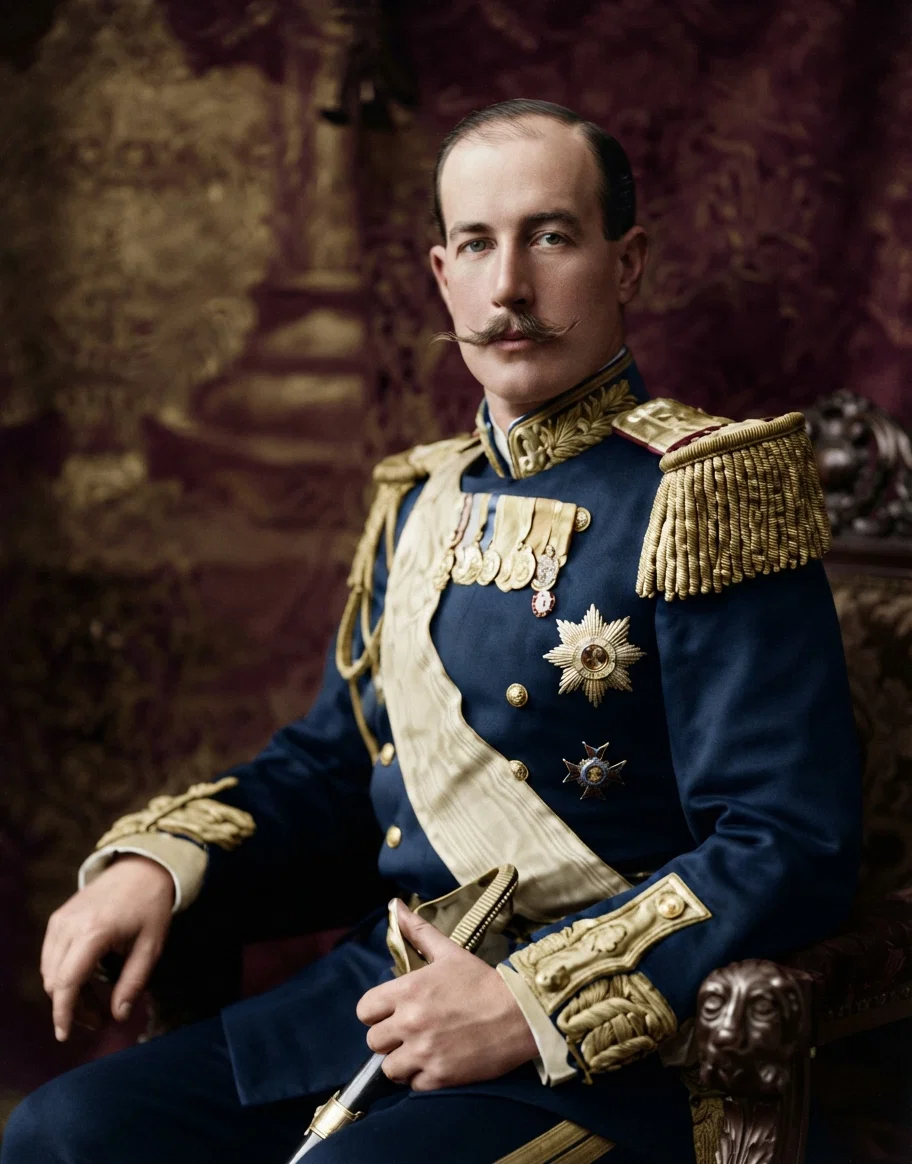
Prince George, second son of King George, formerly governor of Crete. Of fine physique and most kingly bearing of the king's five sons. Greek Catholic.

Political Greece.

Politically, the kingdom of Greece has the same ambitions and disappointments, perturbations and pacifications, sorrows and consolations, as do her more powerful neighbors. In servitude to others for seventeen hundred years, four hundred of these to the drastic Turk, she has now enjoyed independence for eighty years. Much of her present glory and no mean part of her income grow out of the relics, reminiscences, and reflections of the past. Her most bitter political enemy is Bulgaria, her most active and stubborn contestant for supremacy in old Hellenic Macedonia. She aspires and confidently expects to annex the principality of Crete to her territory in the near future. Her limitations, as well as her strength and safety, lie in the concert of the great powers. Her present and second king, George I, is now in the forty-fifth year of his reign, and looks young and vigorous still. Politics is the great topic of discussion, in the newspaper, in the coffee-houses, on the street corners, everywhere.

Greece Religiously.

Religiously, church and state are one. Every one is a member of the church. Every one calls himself a Christian, regardless of what his occupation or his daily life may be. Religion permeates everything, from the solemn deliberations of Parliament to the hawking of the most trivial article by the vender on the street. Religion regulates the class, quality, and season of many mercantile supplies, as also the daily bill-of-fare, because of the numerous feasts and fasts during the year. Religion appoints practically all the holidays, national and otherwise. Church ritual is a part of almost every public function. Religion calls to the church every day in the week, and often twice a day. The school-books are full of religion. The newspapers teem with it. Religion is in the very air.
But when we say "religion," what do we mean?—In a phrase, it is the observance of forms, feasts, and fasts. The buying of a taper, lighting and placing it before an icon, the kissing of a cross and a priest's hand, kissing and bowing before a picture or icon of Christ, Mary, or some saint, with the preference for Mary, and the making of the sign of the cross, not only while at worship in the church, but every time a church building or a chapel is passed on the street or on the train,—this is about the round of ordinary individual worship. In addition to this, on feast-days of importance, ritual and selections from the Gospels in the original Greek are read publicly, the same selections for the same appointed occasions, time after time, without explanation, with responses by the psalterers. During fasting seasons, varying in length from one to forty-eight days, certain articles of food are forbidden—a large item with which dealers in milk, butter, cheese, olive-oil, olives, and meat, have to reckon. Every day in the week is a feast day, of more or less importance, in memory of some revered person or event. The ritual for less important feasts the priest is allowed to read in his own home.
In short, this entire ceremonial system is one round of celebrating past events and of doing honor to canonized saints—a constant looking backward with little comfort or knowledge of the momentous future. It is a religion that perpetuates idolatry by the process of substitution—of Christian names and forms for those of pagan times; of Mary and the saints for the invisible gods and goddesses of the ancients; of images and pictures for statues and idols, with essentially the same abstentions and revelries at appointed seasons. And it produces the same crop of infidels, skeptics, agnostics, atheists, and devotees, as every other form of godliness without the power thereof.
monument of ancient art. (2) Propylaea (front gate) to the spacious top of the Acropolis. (3) Beulé Gate, later entrance. (4) Erechtheion, ancient palace of Athenian for general assemblies. (7) Mt. Hymettus, on whose sides and base is produced the world-famed honey of Hymettus. (8) Present palace of the king. (9) Palace Square on its side. (12) The University of Athens. (13) Mt. Pentelikon, which has supplied the famous Pentelic marble for so many noted buildings in the world, including the mountain. (14) The Theseion, ancient temple, the best-preserved edifice of the ancient Greek world. (15) Astronomical observatory, built in 1842. The first street fully restored and in use, lies behind the Acropolis. Ancient Athens also lay behind and immediately around the Acropolis.
Princess Marie, wife of Prince George, great-granddaughter of Lucian Bonaparte, brother of Napoleon the Great. Roman Catholic.
The missionary has this situation to face: The translation and circulation of the New Testament in modern Greek is forbidden by law; that of the Old Testament is opposed, the not absolutely prohibited. Proselyting is not permitted. Open public meetings are impracticable owing to disturbances by the populace. One door of entrance is open—a free press (outside the Bible itself), and one beam of hope and encouragement is discernible,—a few noble hearts are weary of the old regime and are seeking better things.
With this very cursory glance at the general situation in Greece, the presentation of special phases of interest in life among the Greeks must be deferred to another time.