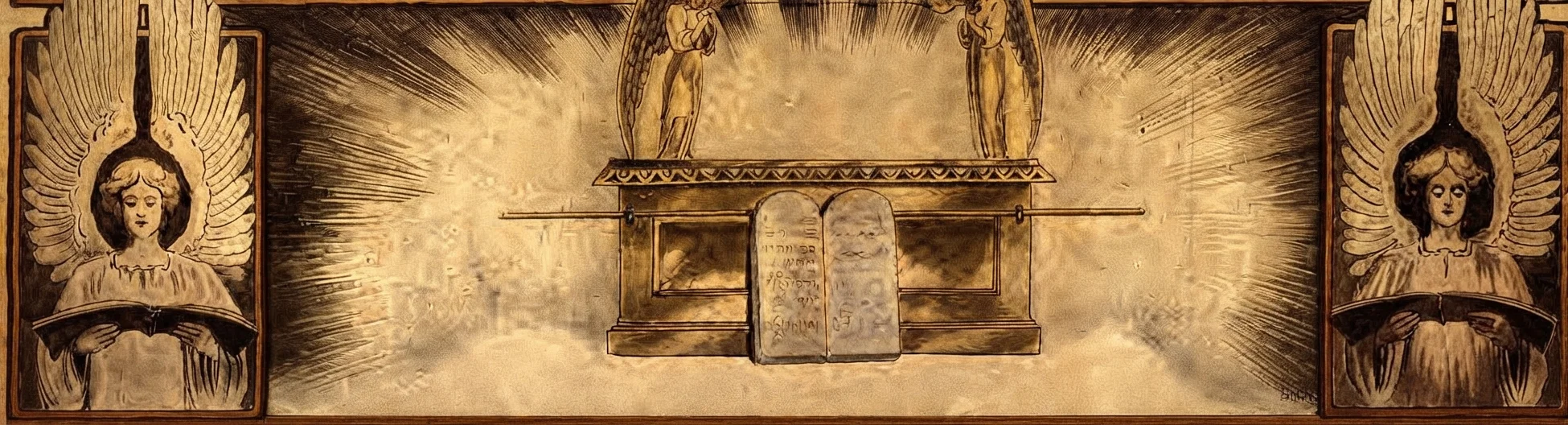
UNDER the Levitical priesthood, the center of all religious service was the sanctuary. This building consisted of two apartments, the first wherein was the altar of incense, the table of showbread, and the seven-branched golden candlestick. The other apartment contained the golden censer, and a chest, overlaid with gold (Heb. 9:2-5), which was called by different names, as, The Holy Ark (2 Chron. 35:3), The Ark of God (1 Sam. 4:17), The Ark of God's Strength (2 Chron. 6:41). The Ark of God's Covenant (Deut. 10:8), The Ark of God's Testament (Rev. 11:19), and The Ark of God's Testimony (Ex. 30:6).
By these several, yet similar, designations, it is at once discovered that the ark was the most important of all the vessels of the sanctuary. But the names by which this piece of furniture was distinguished do not alone point out its exalted position, or its noble import. In order to learn this, one must trace the sanctuary service through its various forms. Let us do this very briefly.
How the Sinner Became Free
When a sinner desired pardon for his transgressions, he brought a lamb to the door of the sanctuary, and, after laying his hand in confession on the victim's head, thereby transferring his sin from himself to the offering, he slew the lamb. Then by a certain process, the attending priest conveyed the sin thus received by the lamb into the first apartment of the sanctuary. Lev. 4:27-31; 6:25, 26. At the proper time, this sin was taken upon the high priest and conveyed by him into the second apartment, before the ark, where the atonement for that sin was completed. No sin was fully atoned for unless thus brought before the ark, and the service of the high priest there performed.
There was a sufficient reason for this service in behalf of sin before that ark within the sanctuary. That which gave it the title, Ark of God's Strength, was the law of God's government which it contained. It was the ark of God's testimony because the law it held testified of God's greatness, centering in His creative power. It was the ark of God's covenant, or testament, because the law therein was, and is, the basis of all God's promises to man. To violate any principle of that law was to deny the testimony of God concerning His greatness, to repudiate all claim to His covenant of grace, and to defy the greatness and power of His throne.
What the Transgression of That Law Is
In view of this it is not strange that the transgression of that law should be called sin. 1 John 3:4. Indeed, such a heinous thing should be called by a name more expressive of extreme wickedness if it were possible to find such a term. The fact is, however, that the word "sin," of itself, expresses the strongest condemnation known in the language of Inspiration. True, man has associated himself so much, and so intimately with sin, that the term has come to mean something only common, and of no very great consequence. But when one stops to think of what is involved in the transgression of a law which is the direct transcript of the infinite mind of Jehovah, he may then get some faint idea of the enormity of the first approach toward such transgression.
A step of this nature is, by the Word of God, designated sin. It was accounted the same in the days of the earthly sanctuary service. It was this character of sin which required the guilty Israelite to humble himself in the sight of all his people, by dragging before the door of the sanctuary an innocent victim, upon whose head he might confess his trespass. This was the requirement: "If any one of the common people sin through ignorance, while he doeth somewhat against any of the commandments of the Lord concerning things which ought not to be done, and be guilty; or if his sin, which he hath sinned, come to his knowledge; then he shall bring his offering, a kid of the goats, . . . and he shall lay his hand upon the head of the sin-offering, and slay the sin-offering." Lev. 4:27-29.
The Mercy-Seat
But as before stated, this was not enough to clear the sinner from his guilt. True, his act entered a stay of proceedings against the guilt discovered, which otherwise would end in death. Rom. 6:23. But before the entire at-one-ment with God could be found, the sin, in all its heinousness, must be brought before the law which had been transgressed. This law was enclosed in the ark, the cover of which was the mercy-seat of God. This seat was the throne of God, in figure, having under it the law of the Most High, as the ten pillars of His government.
Into this august Presence was brought every sin of every transgression, which had been confessed at the door of the sanctuary. The sprinkled blood of the sin-offering must be sprinkled before that transgressed law and the mercy-seat above it, as a testimony to the repentance of the sinner, before the sin could be blotted out.
That work was a figure or type of the work the Lord Jesus, as the world's High Priest, has to do for repentant sons of Adam. In that typical work the blood of animals was offered by earthly priests, but the Lord Jesus, our heavenly High Priest, offers His own blood to cleanse the guilty, yet repentant, soul. In the earthly sanctuary, the high priest presented the sins of the people before the law of Ten Commandments for the sinner's atonement because that law had been violated. That law was a copy of the one in heaven, before which Jesus must present the sins of the transgressor.
That heavenly law of Ten Commandments which defines sin must be satisfied of the sinner's repentance just the same now as then. Jesus, our great High Priest, enters the most holy place of the heavenly sanctuary, and there before the throne of God, and His broken law, pleads in behalf of the repentant sinner that his sins may be blotted out, so that he may become one with God, and thus be like Him. Without this service of our great High Priest, none would be acceptable in God's sight, but the wrath of God would abide upon them. Viewing this subject from such a standpoint, one can hardly refrain from exclaiming with the great apostle, "It is a fearful thing to fall into the hands of the living God." Heb. 10:31.