“LIFT up your eyes on high, and behold who hath created these things, that bringeth out their host by number: He calleth them all by names by the greatness of His might, for that He is strong in power; not one faileth.” Isa. 40: 26.
IN contemplating the starry worlds with whatever capabilities have been given us, we are permitted to follow, to the extent of our finite powers, the thoughts of the infinite Creator, who “calleth them all by names.” This exercise of our higher faculties imparts an inspiration and a spiritual uplift, and is moreover a source of keenest enjoyment.
The great constellation Taurus is now very near the meridian at eight o’clock, in this latitude. The Pleiades, or “seven stars,” shine forth with their gentle light in the shoulder of Taurus. They are also sometimes called the “Virgins of Spring,” because the sun enters this cluster in May, the season of buds and blossoms. God alludes to this fact when He challenges Job, “Canst thou bind the sweet influences of Pleiades?” Job 38: 31.
Below the Pleiades are the beautiful Hyades, in the face of Taurus. This cluster is readily distinguished by five stars so placed as to form the letter V, often called the harrow. The principal one of these stars, the brilliant Aldebaran, is very red, rivaling even the planet Mars, and is supposed to mark the eye of the infuriated animal of Egyptian or Chaldaic mythology. The Hyades present many fine doubles which are readily seen through a field-glass, and make this cluster surpassingly lovely.
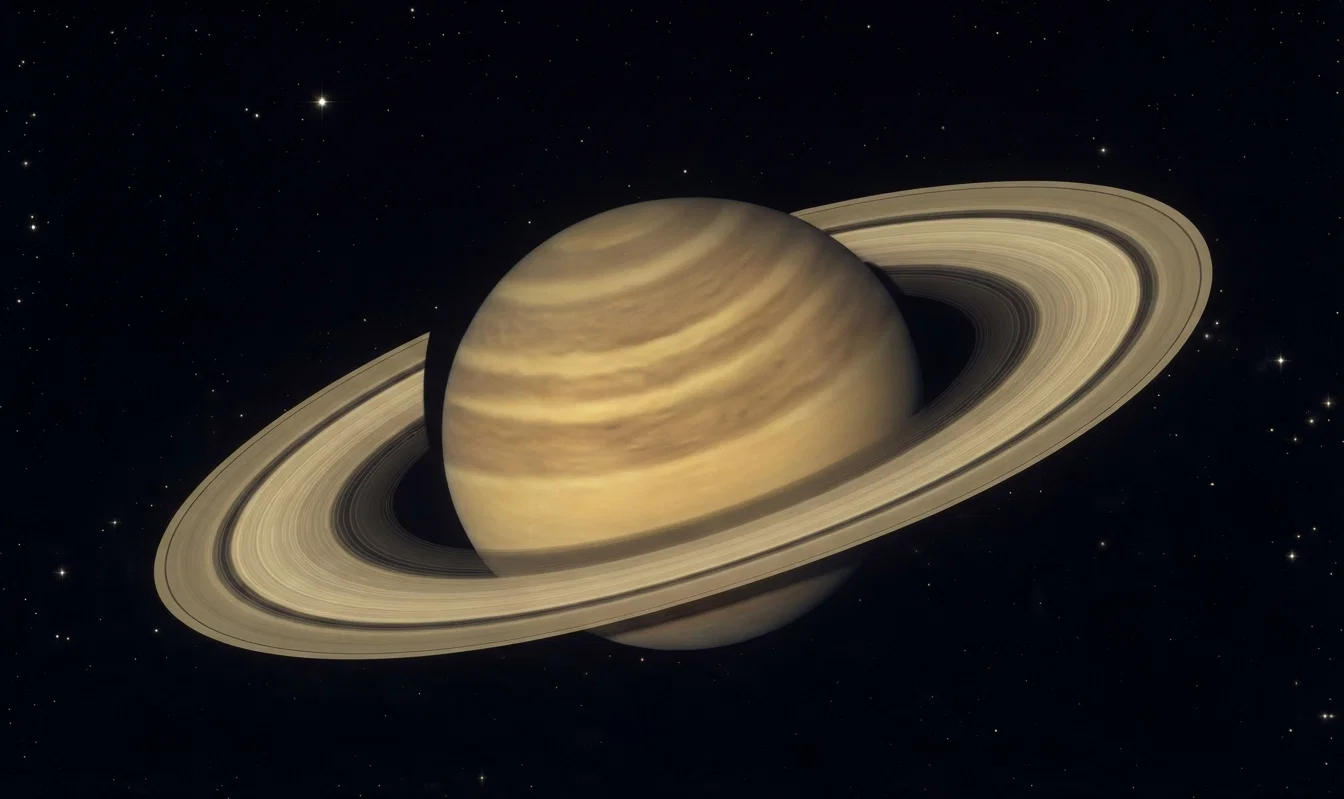
The beauties of Taurus are at the present time greatly enhanced by the presence of great Saturn, that far-distant world, the most wonderful object as yet observed by man in the solar system. This planet is visible to the unaided eye, as a bright star, somewhat pale in color. A moderate-sized telescope shows him away in the depths of space, surrounded by his rings, which seem to form a flat, luminous framework, or setting, a most beautiful and awe-inspiring object. A powerful instrument would show also the varied belts, five in number, and at least seven attending satellites.
Saturn is about nine hundred millions of miles distant from the sun. His diameter is about eighty thousand miles. Twenty-nine and one half years are required to accomplish his circuit around the sun. In the words of another: “There is no planet in the solar system whose firmament presents such a variety of splendid and magnificent objects as that of Saturn. The various aspects of the seven moons, one rising above the horizon, while another is setting, and a third approaching the meridian; one entering into an eclipse, and another emerging from one; one appearing as a crescent, and another with a gibbous phase; and sometimes the whole of them shining in the same hemisphere, in one bright assemblage; the majestic motions of the rings, at one time illuminating the sky with their splendor, and eclipsing the stars; at another, casting a deep shade over certain regions of the planet, and unveiling to view the wonders of the starry firmament;”—all these scenes bespeak the majesty and omnipotence of the divine Architect.
He who has created the starry worlds is “strong; not one faileth.” There is truest comfort in knowing that the infinite God, who holds celestial spheres in space, is also pledged to protect His children. Every trusting, believing soul who turns to Him becomes His especial care. Not one shall fail. “He shall never suffer the righteous to be moved.” Ps. 55: 22.