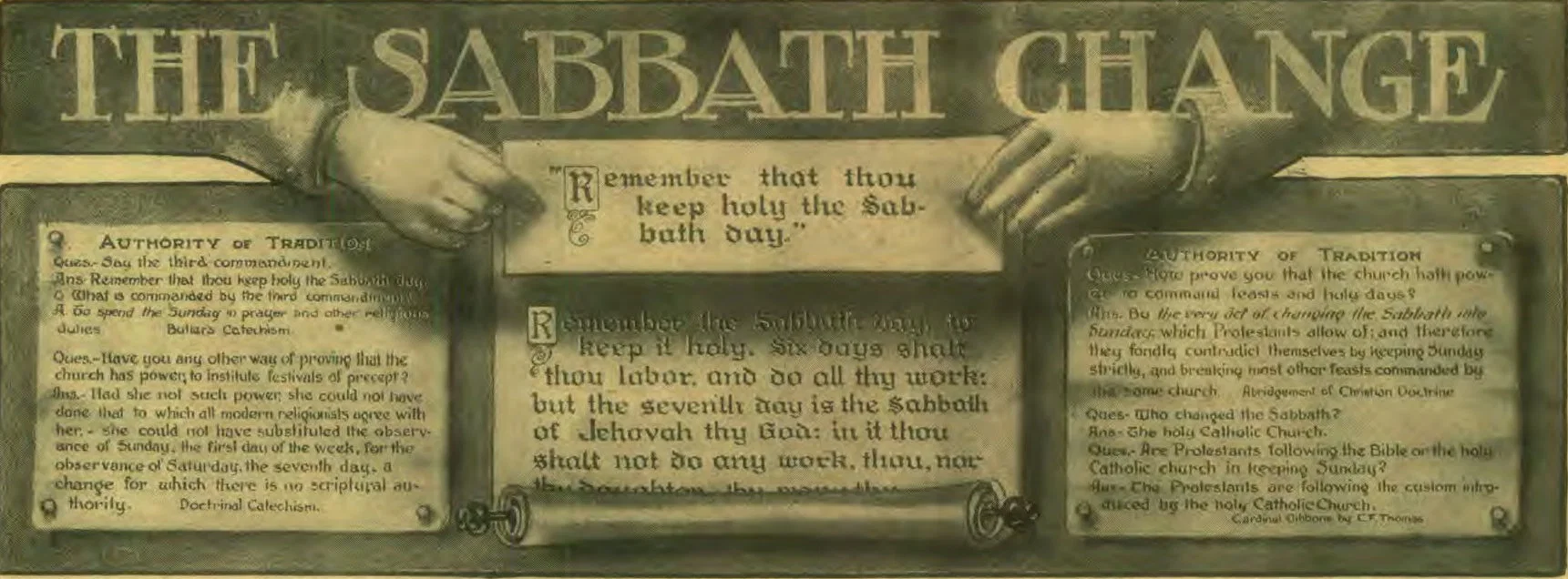
The Broken Hedge

4%

Pacific Press Publishing Company · Mountain View, California · Nov 8, 1905

FromSigns of the Times, Vol. 31, No. 45.

Read the full edition

The Broken Hedge

How the Change of the Sabbath Took Place

THE common understanding of the word "hedge" is a thicket of bushes surrounding a field for its protection. All sacred writers have used the word in the same sense. For example, God spoke through the prophet and His Son concerning His people, likening them to a vineyard, which He fenced in, that its fruit might be preserved to His acceptance. But when He looked for the expected, well-developed grapes, He found nothing but common, wild fruit. So disappointed was He at this result, that He felt justified in taking away the "hedge," that the whole vineyard might be freely entered, and its growth be either "eaten up" or entirely "trodden down." Isa. 5:1-6. Matt. 21:33.
In both of these instances God's people are represented as being hedged about for their protection. The only possible harm which could come to the people of God, is that which follows the failure to keep in mind Him who is both Creator and Benefactor of the race. 1 Peter 4:19. So long as the "hedge" of protection against this remains unbroken, God's people are safe from every outward foe.

God's Hedge to His People

It is just as necessary now to preserve a knowledge of God as Creator and Benefactor, in order to be kept from evil, as it was in the time of our first parents. God's law was given to "hedge" men "round about," that within its enclosure and influence, they might know only that which emanates from its Author. That law is so "exceeding broad" (Ps. 119:96) that he who fully imbibes its unadulterated sentiment receives the mind of Him who spoke its unalterable decrees.

The Author of the Law

It is the rule of every state or nation, in making its laws, to append to these the authority by which they may be put in operation. Otherwise they are absolutely inoperative, for the reason that he whose life is to be regulated thereby can not possibly know to whom he is amenable, because he does not know the extent of the law's authority. It must be the same regarding God's law. Somewhere in connection with it must be revealed its Author, or else it can not enlighten men concerning the scope of its jurisdiction, and the power of its sovereign Defender.
This point is clearly stated in the Word. Recalling what He had done for that people who had forgotten their heavenly Benefactor, God says: "I gave them My Sabbaths, to be a sign between Me and them, that they might know that I am the Lord that sanctify them." Eze. 20:12. Thus we find the Sabbath commandment occupying the place of honor in God's law, in that it is the only one of the ten which absolutely identifies God, and accords Him the honor of being Creator of the heavens and earth, and hence He who has authority to command obedience from all in heaven above, and in the earth beneath.
True knowledge of the great God is therefore gained only by recognition of the Sabbath of the Ten Commandments. When this command is heeded, the entire law becomes a "delight" and comfort, because it settles forever the duty of him who would honor God. In this way the law of Ten Commandments becomes a "hedge" round about men to preserve them from the evil of the world.

The Hedge Broken

This hedge has, however, been broken. The law of God has been made void. Ps. 119:126. This was not done by faith in Christ, tho some have maintained that this is the result of faith. But true faith in Christ fully establishes the law. Rom. 3:31. Referring to the time just prior to the great battle of the day of the Lord, the prophet looks forward to that time and says of Israel: "Ye have not gone up into the gaps, neither made up the hedge for the house of Israel to stand in the battle in the day of the Lord." Eze. 13:5. On the other hand, the prophet charges the Israel of that time with seeing vanity and lying divination, saying the Lord saith, when the Lord has not sent them.
This appears a grievous charge, so grievous indeed, that God says that those who are guilty shall not be counted among His people nor have any part with them. Verse 9. Speaking of this matter at length in chapters 20 to 22, the prophet says the difficulty is that the people hide their eyes from His Sabbaths, and so He is profaned, or irreverently regarded, among them. Chapter 22:26. The Lord then goes on to say that He sought for a man among them to make up the hedge and stand in the gap thus made, showing that the disregarded Sabbath—the breach made in God's law—is the "broken hedge" which, before being broken, was intended for the protection of God's people.

The Beginning of Departure

Just how the Sabbath of God's law came to be ignored by professed Christendom is plainly written on the page of history. The "day of the sun," or Sunday, was observed by ancient heathen as a pagan festival. Rome, at the zenith of its power in the days of Christ, observed this pagan day, and to be consistent with its laws, which forbade any one having a religion of his own, under penalty of death or banishment, that government persecuted those who did not pay due regard to their solar holiday.
Under this stress, Mosheim says that when the second century dawned, it found the Christian church so far yielded to the mysteries of Paganism as to imitate its forms, even to turning the face toward the sun in worship.—"Ecclesiastical History," Century 2, part 2, ch. 4, pars. 5 and 7.

Constantine and Sunday

This pago-Christianity soon became the dominating influence in the church, and the Emperor Constantine (still a heathen in fact) "assumed to himself" the "external administration of the church." (Ibid., Century 4, part 2, ch. 2, par. 4.) Under these circumstances the emperor was prepared to dictate the policy to be pursued by the church, when differences arose as to the duty of men regarding a day of worship. The controversy over the question became so acute that he felt obliged to interfere, and in March of the year 321, issued the following edict: "Let all the judges and town people, and the occupation of all trades, rest on the venerable day of the sun; but let those who are situated in the country, freely and at full liberty, attend to the business of agriculture, because it often happens that no other day is so fit for sowing corn and planting vines; lest, the critical moment being let slip, men should lose the commodities granted by Heaven."
Two years later, Constantine professed conversion to Christianity. But his pagan proclivities led him to refuse to surrender the day so long dedicated to the worship of the sun, and he therefore brought that heathen holiday forward as a fitting day of rest under Christian worship. Nicephorus declared that the emperor "directed that the day which the Jews considered the first day of the week, and which the Greeks dedicated to the sun, should be called the Lord's day."—Quoted in Elliott's "Horae Apocalypticae," fifth edition, vol. 4, p. 603.

The Church of Rome and the Sabbath

Sylvester, the bishop of Rome, endorsed the name "Lord's day," as thus applied, and so conferred that title upon the first day of the week, in behalf of the church.—"Historica Ecclesiastica, per Ludovicum Lucium," Century 4, ch. 10, pp. 739, 740.
This, however, provoked a protest from many, in consequence of which the Council of Laodicea was convened in 364, from whence the following edict issued: "Because Christians ought not to Judaize, and to rest on the Sabbath, but to work in that day, which many did refuse at that time to do. But preferring to honor the Lord's day, there being a great controversy among Christians which of the two days . . . should have precedency. If they desired to rest, they should do this as Christians. Therefore if they shall be found to Judaize, let them be accursed from Christ."—"Dissertations of William Prynne," pages 33, 34.
When the Reformation called Protestantism into existence, it failed to reform the people on the point of the Sabbath day, and so the churches of to-day are observing the first day as an heirloom of Paganism, filtered through the Papacy. It originated with a people who knew not God, and came into prominence as the mark of apostasy from God. Without understanding it, the churches of to-day are assisting to maintain this breach in God's law, made by the heathen world, and so refuse to take part in repairing the "broken hedge," that it may be a protection to God's people in the battle of the day of the Lord. There are those, however, who are not satisfied with their present standing, whom it is hoped may be induced to heed the call of God for this time, to make up the hedge for that fast-approaching day.