AFTER a very pleasant, interesting and not at all monotonous sea voyage of eighteen days on the S. S. "Airlie," we reached Soerabaya, Java. Four stops of several hours each were made at Brisbane, Cairns, Thursday Island, and Port Darwin. This enabled us to go ashore at different times and do some sight-seeing. With the exception of the first afternoon and night, the weather during the entire voyage was all that could be desired. The captain, crew, and passengers were very kind and affable; we were supplied with an abundance of health foods, and, but for the omnipresent smoker, life on board ship would have been very enjoyable. While the passengers' time was spent in eating, drinking, smoking, reading novels, or doing nothing, we found real pleasure in reading, writing, studying Malay, and translating "Early Writings" into Fijian.
Sunday evening, October 18, we cast anchor in the harbor, a short distance from Soerabaya. Soon punt-like boats, called sampans, were coming out to us from every direction filled with natives. They swarmed around the ship like ants, shouting, jabbering, yelling. They came on board and begged to carry our luggage ashore, but met with disappointment as few wished to go that night. Soon some coal barges came along side, and then there was a great scattering in all directions, some going back to land, while others fastened their boats by ropes to the stern of our ship and waited in them until morning, with the hope of catching the first customers. As it was very hot, we remained on deck, and slept as well as we could under the noise of machinery and the unloading of coal. A large number of ships, steamers, and smaller vessels lay at anchor close at hand, while beyond was the city with its thousands of glimmering gaslights. We could hardly realize that we had at last reached the "land of the people of the East."
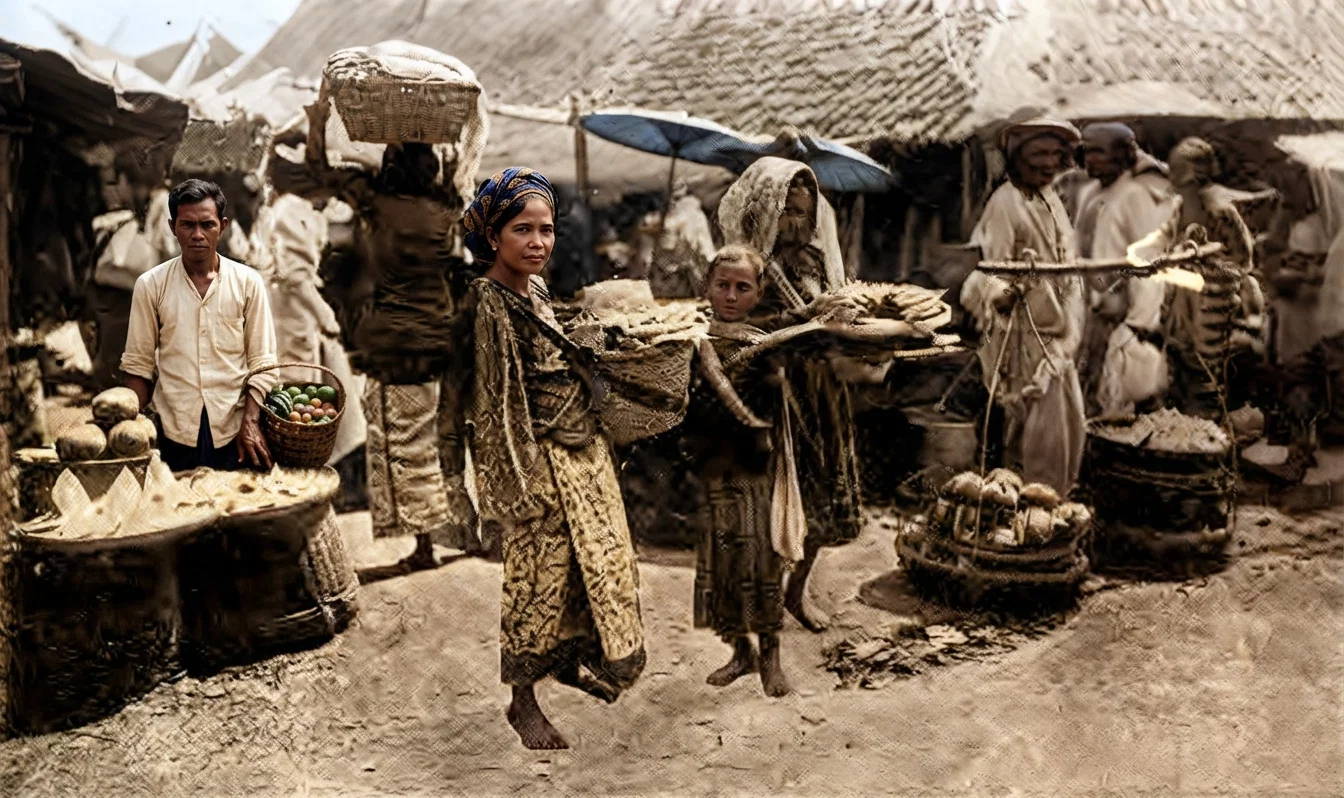
A Market Day in Soerabaya
Early next morning we were pleased to see Brother and Sister Fox, their two sons, Miss Tunheim, Sister Geen Sims, and a lady friend who came on board. Sister Tunheim appeared quite thin and worn as she had just recovered from a fortnight's severe attack of malarial fever.
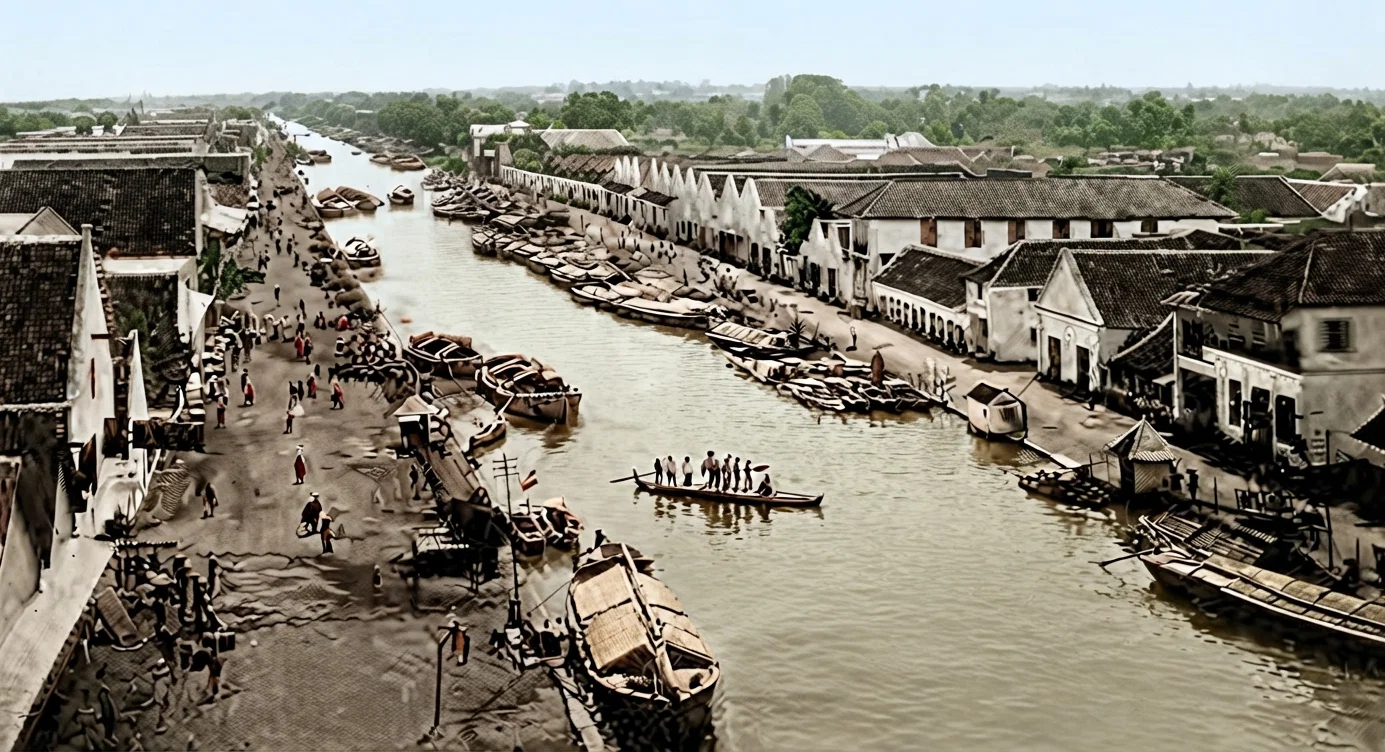
A River Scene in Soerabaya
Soon ourselves and luggage were transferred to a sampan and we started for the shore. These Malay boatmen take one stroke with the oar while sitting, the next standing, and so on. So they are continually jumping up and sitting down. Soerabaya being on a level with the sea, but little can be seen from the water. Leaving the harbor we ascended a canal or river for a short distance, and landed on the stone steps of a custom house. This river flows through the city and receives some of the drainage of the city, but not all, as most of the drains stay where they are, or go where they will. The water is thick and dirty with filth of every kind. This is no drawback to the natives, however, as we saw many of them enjoying a morning bath. In fact, hundreds of them live on the river in floating bamboo rafts and boats, upon which are rude shelters or huts. Here they cook, eat, sleep, bathe, and wash clothes.
After we were passed through the customs, which was a very easy ordeal, and entered the city, we could have almost declared that we had suddenly fallen off the earth and had landed on a new planet. We hardly knew which way to turn our heads, for everything seemed so startling and strange. But as Brother and Sister Fox had invited us to go with them to their home, and as it is contrary to the custom of this country to walk, our attention was called to the numerous vehicles for hire about the customs building. Here are little two-wheeled, covered docarts, drawn by tiny Arabian ponies, and driven by the brown-skinned Javanese, who sit cross-legged in the front seat, while the passengers sit behind with their backs to the driver. They are not large enough to accommodate our party, so we take a kosong, a four-wheeled carriage with two seats facing each other behind the driver.
It is only seven thirty in the morning, but the streets are thronged with people, shops are open, and business is in full swing. What a motley crowd! Here are rich Chinese merchants, dressed in white European suits with coat buttons made of gold coins, and with long queues, into which is braided either white, blue, red, or black silken thread; common Chinese pedlers with large cone-shaped straw hats, black, baggy pantaloons and coat, trotting along with huge baskets of wares, suspended from bamboo poles carried across the shoulders; small shop-keepers, rolling in fat, and trying to keep cool by dispensing with shirt and coat; Chinese boys, in white coats and military caps, on their way to school. Here come a few Dutchmen on bicycles. The heat does not seem to reduce them in flesh. What crowds of Javanese men and women, and how small they are! But look at the immense loads that the women carry on their heads, and how the men struggle along under huge baskets, boxes, and bales! The men are not much over five feet in height and the women are13shorter. The men have long hair coiled in a knob at the back of the neck, and tie up their heads with a colored handkerchief, leaving the corners flaring out like wings behind their ears. The women wear their straight, shiny, black hair combed smoothly back and pinned up in a coil at the back of the head. The men's clothing consists of short coat and a sarong (a piece of cloth fastened around the waist and reaching to the feet), or a pair of cotton knee-pants. The women also wear a sarong, and a bright-colored jacket called a kabaiya, and go bare-headed and barefooted. There are also many tall Arabians, who are Mohammedans we know, by their stiff, handsome turbans, gay sarongs, silk coats, and pointed slippers, turned up at the toes.
There is a tram-line on one side of the street, and here come the tram-cars, three in number, first, second, and third class. They are drawn by a dummy locomotive, and the drivers are Javanese, while the guards are either Eurasians or Javanese. One man on the locomotive spends all his time ringing the bell to warn people of the approach of the tram. We pass a very large, awkward-looking, two-wheeled cart, drawn by two bullocks. It is filled with big, fat pigs, each animal incased within a cylinder-shaped basket, and laid on top of another like a load of wood. We can not but pity the poor things in the bottom of the cart.
After passing a few large buildings and some white Dutch houses, we turn into a narrow street. There are no footpaths either here or in the broader streets. The street is full of vehicles, traveling restaurants, pedlers, etc. Native shops are lined along the edge where the footpaths ought to be. They are only sheds or verandas filled with natives' costumes, tinware, prints, sandals, wooden shoes, and toilet articles. It is very hot, but that is nothing compared with the dreadful and varied smells that greet one at every turn. To the new arrival they are almost unbearable. But one must become accustomed to that if he is to labor in Soerabaya. At first it may put him to the inconvenience of unswallowing the germs he has taken in, but he may finally overcome this difficulty, as the writer has learned by experience.
From this, our first ride, and from all subsequent trips through Java, we conclude that the chief business and pleasure in life of this people is that of eating. No one need go hungry in this country, for in all the alleys, by-ways, and narrow lanes, as well as every few feet along the business streets, are seen numerous eating places, traveling restaurants, fruit and vegetable markets, and drink stands. This peripatetic restaurant affords much amusement to the curious traveler. This consists of a small clay stove, filled with coals, upon which rests a clay cooking vessel, and is suspended from one end of a bamboo pole. From the other end of the pole hangs a small, square cupboard, containing food and dishes. The proprietor rests the pole on his shoulder and trots along the street until he meets some hungry customer, when down goes the restaurant, the coals are fanned into a flame, and in a few minutes a meal is served right in the street. The bill of fare may include chicken or beef soup, dried fish, steamed rice served with all sorts of hot, peppery mixtures, black coffee, and many queer native dishes, nearly all of which are fried in a vessel of boiling oil.
Farther on we see a Chinese merchant sitting by the street-side having his head shaved, while others are extracting with tweezers the few straggling hairs adorning their chins. It seems an unwritten law that a large portion of men must shave, and where nature has failed to supply a growth on the face, they take it from the top of the head. Many new, strange, and startling sights greeted our eyes, but the half can not be told.
At last we alighted from the kosong onto the stone steps of Brother Fox's house. Brother Fox conducts a night-school for Chinese young men, to whom he is teaching English. Later we had the privilege of meeting with these pupils, and Mr. Fulton gave them a Bible-reading on "True Religion Compared with Idolatry," which Brother Fox interpreted into Malay, the language spoken by the many thousands of Chinese of the cities of Java. They are bright-faced, intelligent-looking lads. One who has been employed in a bank is planning to give up his position at an early date to enter the school at Singapore.
While there are many things to interest us in this great city, the matter of greatest interest is how we can carry the third angel's message to these 200,000 people, many of whom are dying of fever and other diseases. Let us pray that God will send forth laborers into this part of the harvest-field. A Dutch worker is much needed for the cities. The workers here need the prayers of God's people. They have great difficulties that these in the homeland know nothing about.