OUR LONDON LETTER

5%

Pacific Press Publishing Company · Mountain View, California · Feb 21, 1906

FromSigns of the Times, Vol. 32, No. 8.

Read the full edition

OUR LONDON LETTER.

Change of Government.

Review of the Conservative Regime.

ENGLAND found herself at the opening of the year 1906 in the throes of a general election. Altho the health of the Tory Government had been in a somewhat precarious state for more than a year, yet the end came with unexpected suddenness. Only a few days previous to the Prime Minister's resignation, prominent supporters of his ministry were asserting that there was no reason whatever for expecting an early dissolution. It is well known, however, that Chamberlain has been desirous of an appeal to the country, and some recent, very plain utterances of his, relative to the fiscal question, probably had much to do with Mr. Balfour's precipitate action.
For ten years the country has been under Tory rule without interruption, and if we except the brief Liberal administration which came to an end in 1895, the whole period of Tory domination is twenty years. What has this meant to England? In what direction has the country been moving during this time? Has there been advancement or retrogression? No doubt the answers will be various; but one thing is certain, if the ideals of such statesmen as Bright, Cobbet, and Gladstone were in the line of England's highest interests, then the tendency of the last twenty years has been a retrograde one. So-called imperialism has figured large in the political arena. The army and navy budget has assumed alarming proportions, and leading newspapers standing close to the government have come out openly and advocated compulsory military training. Naval expenditures have more than doubled in this decade, and the army, tho generally acknowledged to be in a far from efficient condition, has not lagged behind in the matter of expense. In short, the regular military outlays have reached a point of extravagance well-nigh unbearable.

A Retrograde Policy.

Since the South African War the foreign policy of the government has been generally pacific, tho the newspapers have done what they could to embroil the country in a war with Germany or Russia. In its home affairs, the Tory Government has certainly shown a retrograde policy. The Brewers' Bill put a check on the gradual reduction of licenses by which the drink evil was slowly, but steadily, being forced back. The notorious Education Bill virtually handed over the country's educational system to the control of the Church of England clergy, and brought about the interesting situation which exists to-day, when children of non-conformist parents, attending schools supported by public taxes, are taught that the state church is the only true church, and all non-conformists are heretics. Is it to be wondered at that thousands of parents have become passive resisters refusing to pay such taxes, and preferring to go to jail rather than yield obedience to so unjust a law?
Finally the Chamberlain faction sought to urge upon the country a protective tariff, holding up this as an infallible remedy for all the evils of the country at home, and a sure means of cementing stronger bands with the colonies. Needless to say, the public has not taken kindly to the new fiscal policy, which indeed Balfour and his immediate supporters never assumed as part of the government policy, tho some of them expressed their sympathy with it.

The Liberal Platform.

Such, in brief, is the record of the last few years. We now have a Liberal cabinet handling the reins of government confirmed by a general election, tremendously sweeping in its Liberal and labor majorities.
The question of greatest interest at present is the platform of the Liberal party. Sir Henry Campbell-Bannerman, the new premier, in his recent speech at Albert Hall laid down Peace, Retrenchment, and Reform as the basis of the administration. Equal rights for all and special privileges for none, is another leading war-cry of the Liberals, in the carrying out of which in actual practise they expect to mend the Education Act on the one hand, and on the other see to it that huge corporations are not fostered by protective tariffs till they get entirely beyond control, and hold the country in their grasp. The party is also committed to social reforms, mainly in the direction of enlightened temperance, labor, and land legislation. As for Irish Home Rule, the rock upon which the Liberal party of former times stranded, the prime minister is rather chary of talking on the subject; but he has said that Ireland is to manage her own home affairs as, and when, the way may open, or words to this effect.
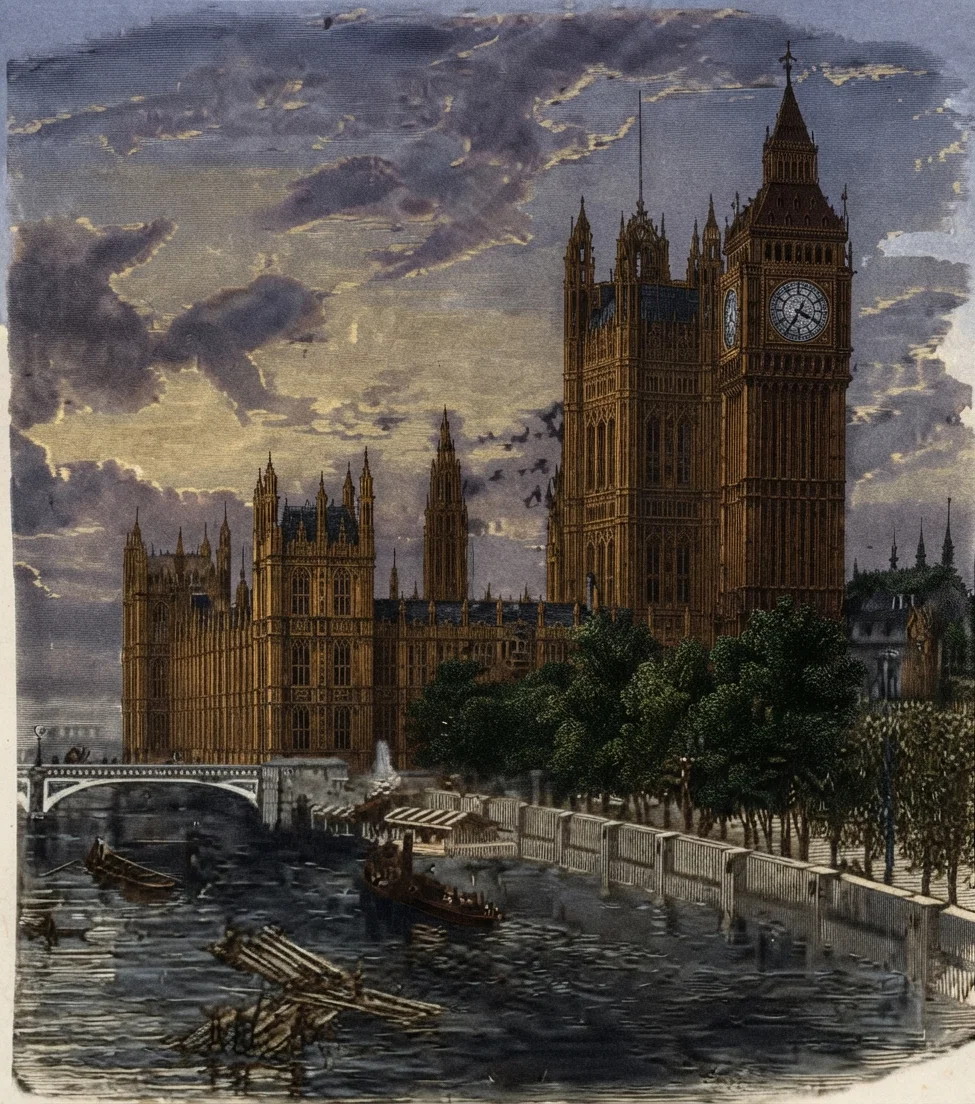
Houses of Parliament.
The make-up of the Liberal Cabinet is generally admitted to be above criticism. Such names as Sir Edward Grey, the new Foreign Secretary; Lord Elgin, the Colonial Secretary; Mr. Haldane, the War Secretary; Mr. Morley, the Secretary for India; Mr. Lloyd George, President of the Board of Trade; and Mr. Augustine Birrell, of Education, inspire the respect and confidence of all classes. The choice of John Burns as President of the Local Government Board is also a very popular one. Mr. Burns is the first Labor Member of Parliament to occupy a seat in the cabinet. Labor members, it may be said in passing, go to Parliament to represent the interests of laboring men, and being nearly always without private means, are paid a moderate salary by their constituents, the other members of Parliament serving without pay.
Mr. Campbell-Bannerman himself is not a brilliant man, but he has Scotch tenacity and grit, and withal an immense amount of tact. Born in 1836, he is the same age as Mr. Chamberlain, and twelve years older than Mr. Balfour. He has been in Parliament since 1868, and has held various government positions, serving twice as Secretary of War. As leader of the Opposition he has kept the confidence of his own party, and has made few, if any, personal enemies. His selection of colleagues has met with general approval, and the feeling in London, and quite generally throughout the country, seems to be that the Conservative Party has been in power long enough, and it is time the Liberals had a chance. The outlook seemed good for a Liberal victory, and the results have more than justified the outlook. Joseph Chamberlain is a man of tremendous energy and initiative, as well as a practised campaigner; he has had a strong backing in certain quarters, but apart from his own local field, his defeat has been overwhelming. Balfour has not displayed those qualities of leadership which the country seems to demand at the present time; he is too much of a compromiser.
It is perhaps too early to forecast the influence of a Liberal regime upon the religious development of the country. The Tory party stands for the privileged classes, including the established church. Liberalism, on the other hand, is pretty much permeated with the leaven of nonconformity. It is a fact of some significance that the leading members of the present cabinet are in favor of disestablishment, that is, of depriving the Episcopal Church of official recognition and state support, and leaving it to be maintained by its members the same as other denominations. Such a move, which would have the support of a considerable number within the church, could hardly fail to forward the cause of true religion in the kingdom, since it would make for a higher spirituality among the clergy, and for individual convictions on the part of the members.

The Present Religious Condition of England

is one of transition. Among thoughtful leaders of opinion there is a good deal of unrest and dissatisfaction. The shackles of time-worn creeds are being broken. Men are awakening to the fact of the fallibility of the clergy, and the human origin of much they have held as sacred. It is time to proclaim the Gospel in its purity and simplicity, and lead men to the Cross. While the country as a whole is marked by religious indifference, there is excellent evidence that multitudes are in the valley of decision, awaiting the appeal of the living messenger to decide for God and eternity.

Social Conditions in England

are gradually approaching the critical stage, if indeed they have not already reached it. Ever since the South-African War non-employment has been a great and growing evil. The bill passed by the late government was only a make-shift, and is proving a poor one at that. The work-houses are full to overflowing; London never had such a lot of paupers to deal with as in the present year. The relief problem presents some peculiar difficulties. It is next to impossible to help the worthy man, who is out of employment through no fault of his own, without rendering like aid to a large number of unprincipled, shiftless, ne'er-do-wells who sink lower and lower in the scale of self-respect and respectability the more they are assisted financially. It is to be hoped that John Burns, the new president of the Local Government Board, who combines with real sympathy for the poor a good deal of practical common sense and political sagacity, will be able to devise a plan which will at least better the present situation.Trade-unions were not in much favor with the late Tory Government, which they helped to expel. Under Liberal rule their power is sure to increase, and this may not unlikely lead to untoward developments. On the whole, the immediate outlook presents interesting possibilities in a number of directions, and is well worth careful study.