Causes and Extent of Present European Conflict—The Economic Problem—Political and Religious Factors—The Alliances and Alinements of the Strife
By MILTON C. WILCOX
delegates to the twenty-first World's Peace Congress are getting ready to attend that great meeting in Vienna, Austria, September 15 to 19, war breaks out between Austria and Servia, which threatens to involve, if it has not already involved, all Europe.
IMMEDIATE CAUSE OF WAR
On June 29, Archduke Ferdinand, the heir to the Austrian throne, and his wife, were assassinated at Sarajevo, by a Servian student. Examination of the assassin seemed to trace the deed to a Servian propaganda. Acting upon this, Austria presented to Servia an ultimatum consisting of five demands. The ultimatum was presented Thursday, July 23, and a reply was demanded by six o'clock on Saturday evening. The demands, quoted from the Independent of August 3, were:
1. An apology by the Servian government, in its official journal, for all Pan-Servian propaganda, and for the participation of Servian army officers in it, and warning all Servians in the future to desist from anti-Austrian demonstrations.
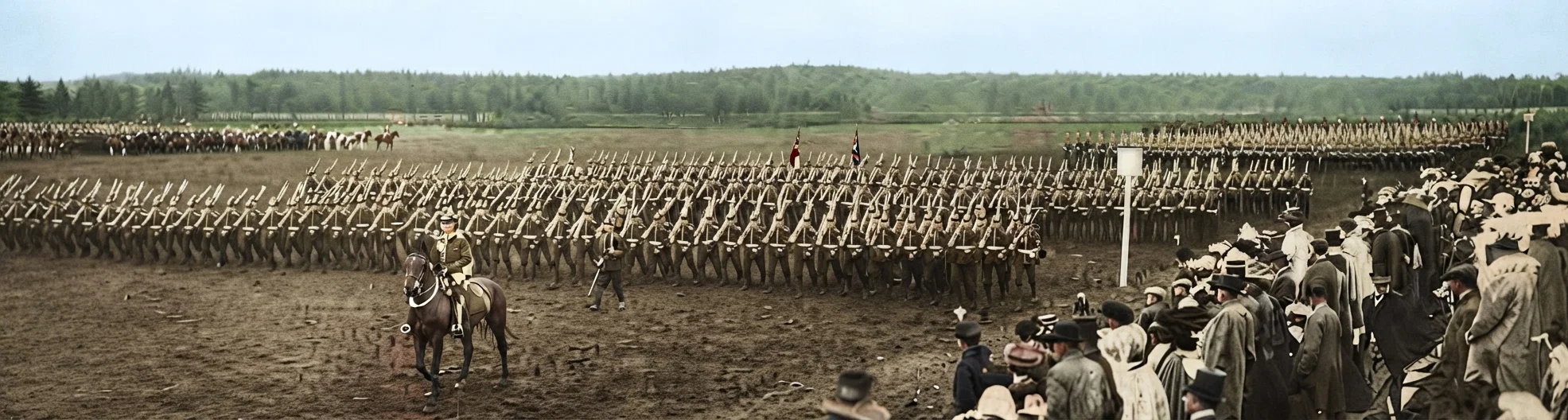
BRITISH TROOPS DRILLING AND MOBILIZING. Copyright Gale and Polden.
2. That orders to this effect be issued to the Servian army.
3. That Servia dissolve all societies capable of conducting intrigues against Austria.
4. That Servia curb the activities of the Servian press in regard to Austria.
5. That Austrian officials be permitted to conduct an inquiry in Servia, independent of the Servian government, into the Sarajevo plot.
Servia replied, accepting all the terms except the fifth. It would not allow Austrian officials to conduct investigations in Servia. It did not deem this "in accordance with international law and good neighborly relations." Servia asked that this demand and other details be referred to the Hague—certainly a very reasonable thing; for although Servia was not a signatory to the Hague convention, Austria was. This request Austria refused, called the reply unsatisfactory, and declared war.
There is more back of the war than this, but the assassination of Archduke Ferdinand was the immediate cause of its outbreak.
ECONOMIC REASONS
First, there is an economic cause. Servia has a very small territory and a large population in a mountainous country, four fifths of which is uncultivated, much of it in oak forests, a large part of it being without either mineral or maritime wealth. Its area is 23,661 square miles, its population 4,000,000; revenue, $24,000,000; expenditures, $22,000,000; debt, $128,078,000; annual interest, $6,269,000. In other words, Servia has the area of West Virginia, the population of Ohio, and the debt of New York.498
Her wealthier or what might be called upper classes have been killed off, driven away, or forcibly proselytized by the Ottomans. She has few capitalists or great landowners. The people are Slavs by race. They have the culture of the Orient. Eight tenths of the adults are illiterate. Most of them espouse the Greek Orthodox faith. They are frugal, hard-working, independent, democratic, and patriotic.
About the only thing they can do for a living is to raise grain and meat for export. Their hogs fatten on acorns, in the oak forests. But Mohammedans and Jews in the south do not eat pork. Almost the only market, therefore, for their product is the big, rich country of Austria, north of the Danube. But Austria has placed tariff rates upon the importation of meat from Servia, until they are almost prohibitive. Frequently they are raised for a short time upon the ground that the flesh is diseased — often pure supposition. The German writers called this schwein-politic — pig politics.
Thus Austria has reduced Servia to a condition of economic dependence. This was one of the great reasons why Servia wanted seaboard during the recent Balkan war; but when she had fought her way to the sea, so as to obtain a port on the Adriatic, she was shut out from that by the manufacture of the Albanian principality. She wanted to become a nation independent of Austria commercially.
POLITICAL AND RELIGIOUS CAUSES
But there is more than that. More than five hundred years ago, there was a Serb chieftain called "Stefan the Daring," who conquered nearly all the Balkan peninsula, assumed the title of "emperor of the Romans," and thought to erect again the great Eastern Empire. He was conquered. Yet while Servia has dwindled, the old national dreams remain. But Austria has destroyed the possibility of such a Servian empire, or even one including the Servian race alone. By the annexation of Bosnia and Herzegovina in 1908, more than half of the Serbs were placed on the north side of the Danube, within the territory of Austria; and while some writers tell us that the northern Serbs are more prosperous than the southern, yet the Serbs themselves there tell us that they are taxed far beyond what they were under Mohammedan rule, that their children are forced to attend the Roman Catholic schools, that they can not sing their old songs, and that their press is muzzled. Consequently there is worked up continually among this small but patriotic people a tremendous resentment against Austria, who, they feel, would blot them out of existence. The assassination of Ferdinand, in Sarajevo, June 27, by the young Serb, was but an object-lesson of the slumbering race and religious hatred that has dwelt in the Servian breasts for years.
EDUCATION IN REVOLUTION
Another thing: This young Servian who slew Ferdinand and his wife, had learned in his own land these very ways of getting rid of unpopular rulers. Of Servia's eight rulers of the last hundred years, three have been assassinated, and four deposed by revolution or the threat of one. King Peter, who now sits upon the throne, owes his position to the officers of his army, who in 1903 entered the palace by night and murdered King Alexander and Queen Draga, the premier, the minister of war, and two of the queen's brothers, and King Peter himself lives in constant expectation that something of the sort may come to him.
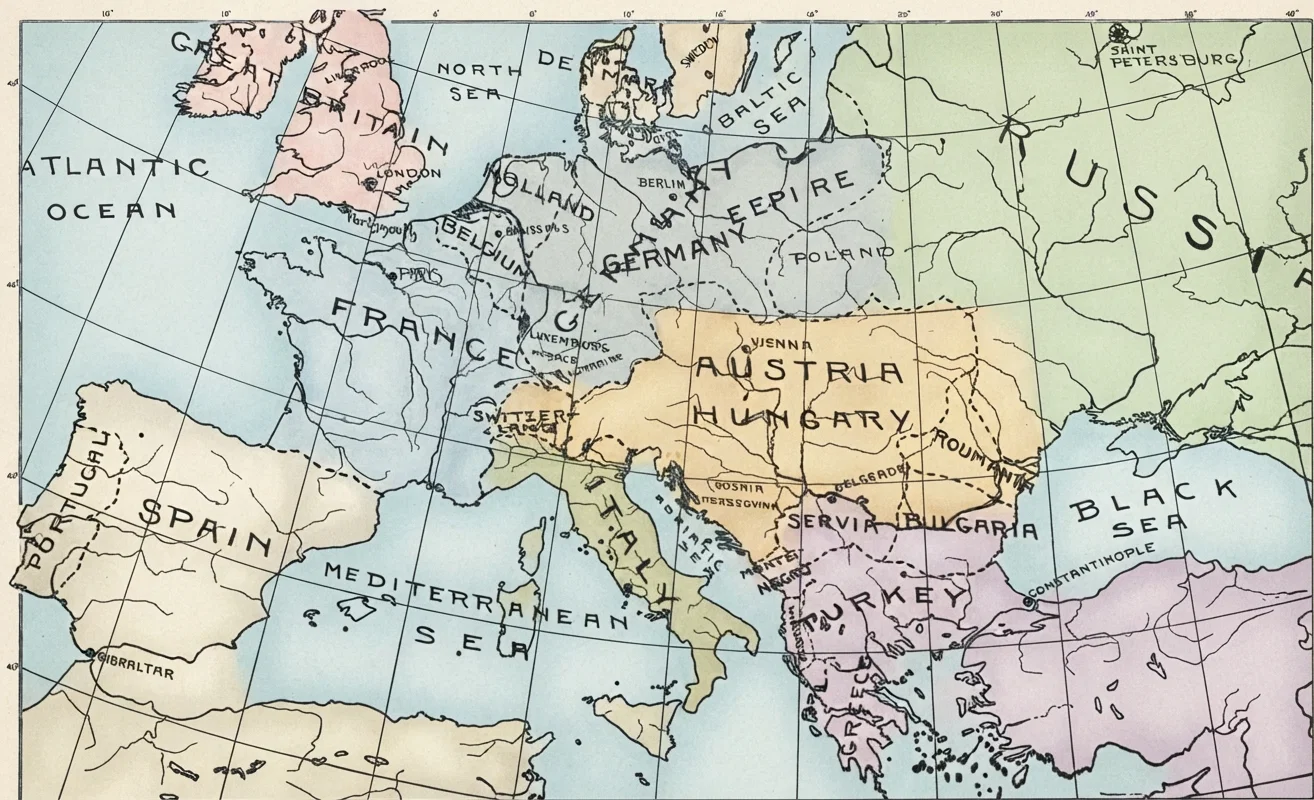
FIELD OF EUROPEAN WAR
Austria's demand that there should be no more hatching of conspiracies in Servia was reasonable, but it can not be said that Austria's demand that this thing should be settled in a way which would humble Servia as a nation is reasonable. Certainly a great power like Austria should not use force and compulsion in an unjust way upon a little power that has struggled as has Servia. This, without question, could have been settled by arbitration; and the one hundred years of peace between two of the greatest powers of earth, with the longest political boundary-line between them that there is in the world, upon which there has not been a soldier or a fort or a man-of-war, gives the lie to all the contentions that war is needed to settle difficulties between nations. It is in this very year that the centenary of peace between England and United States of America is celebrated.
A EUROPEAN WAR
Now the war is on. There are reports from the heart of Europe, but very little can be told of these. The strongest kind of censorship is placed upon the press. It is not the object of this article to give details of this struggle. We simply point out what the effect may be and how much may be involved by it.
There has been for some time in Europe what is called the concert of the powers in order to maintain the peace of Europe. This grew out of the Berlin treaty. Several of the smaller governments were made perpetually neutral. Among these are Belgium, Holland, Switzerland, Denmark, Luxembourg — a little principality lying south of Belgium. All the nations are pledged to preserve the neutrality of these powers. Great Britain has preeminently pledged the neutrality of Belgium. Her very safety depends upon it. Later, Europe has been3divided into two great triples, so to speak. We have the Triple Alliance, consisting of Germany, Austria, and Italy. We have the Triple Entente—Great Britain, Russia, and France. These two alliances have been so nearly balanced that they would seem to assure the peace of Europe, and they have for a number of years. But when Austria made her demands upon Servia, and those demands were not met to the letter, without reasonable waiting, Austria entered Servia. There seems to be little question that she did this by previous German consent. Russia must be humbled or restrained. The killing of Ferdinand offered the occasion.
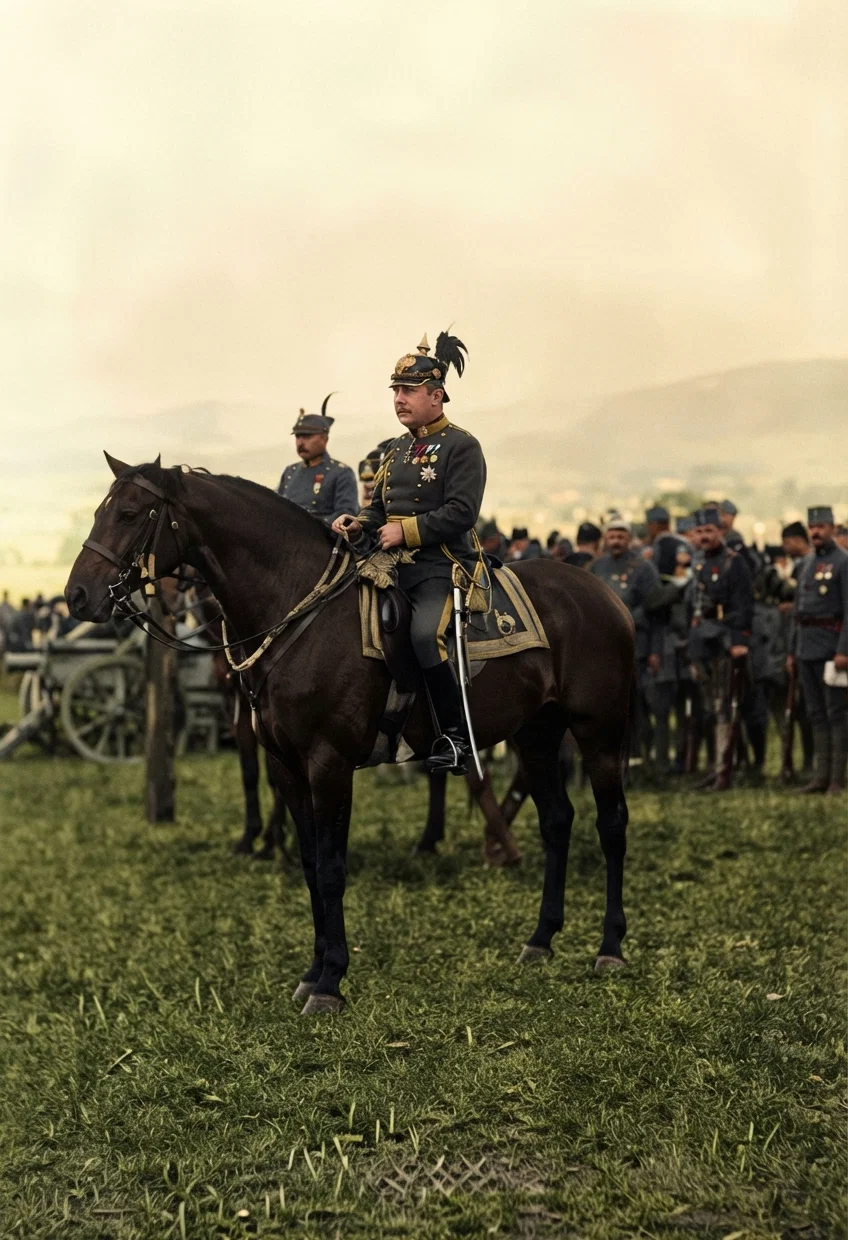
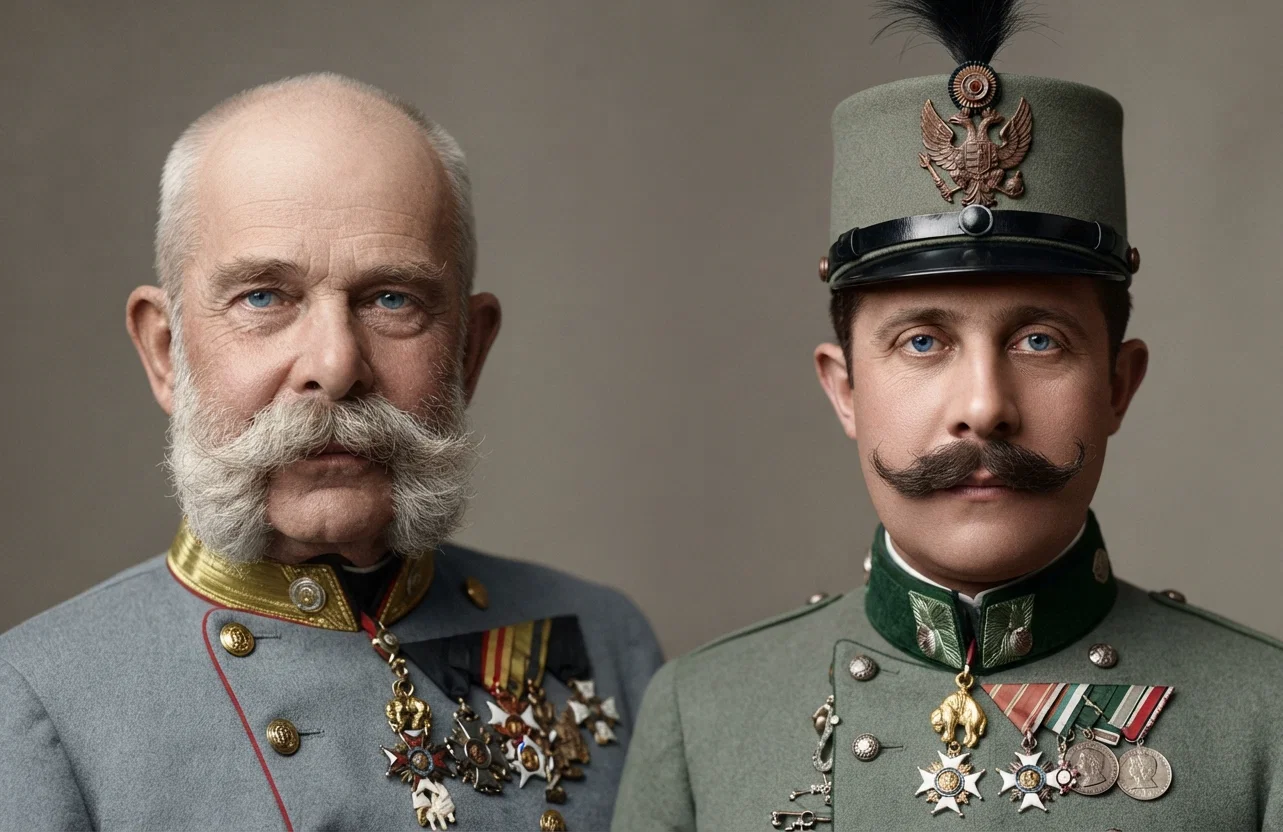
EMPEROR FRANCIS ARCHDUKE FERDINAND
GERMANY, RUSSIA, FRANCE, ENGLAND, ITALY, JAPAN
Germany, who also has interests in the near East, in response to her ally, demanded that other powers should keep hands off. Russia, who is herself a Slav nation, and who has interests and ambitions in the Balkans, intimated that she would stand by Servia. France, of course, in alliance with Russia, would be bound to stand by Russia if she were called upon so to do. Demands were made upon both Russia and France, by Germany, that they should not mobilize their armies—a demand which the London Times characterizes as utterly unreasonable, and one which the dignity of nations would not permit these powers to accede to. At the same time, that Germany made demands upon France and Russia that they should not mobilize, she herself was mobilizing her troops.
According to the latest despatches at this writing, Germany has already entered France, Russia has entered Germany, England has done all in her power to secure peace. Sir Edward Grey, the British premier, has put forth special effort, by asking Germany and France and other powers to join with him for peace. In this he has been unsuccessful. Just now it looks as though England herself would be forced into this war by her guaranty of the neutrality of Belgium and Luxemburg, inasmuch as German troops have entered the territory of both of these little powers on their way to France.
Italy has signified her intention to remain neutral. Whether she will be able to continue in this attitude, owing to her alliance with Austria and Germany, is questionable. Of course it may be that in her old enmity to Austria, which is not dead by any means, she will break with these two powers, and remain entirely neutral, or else join with the Triple Entente.
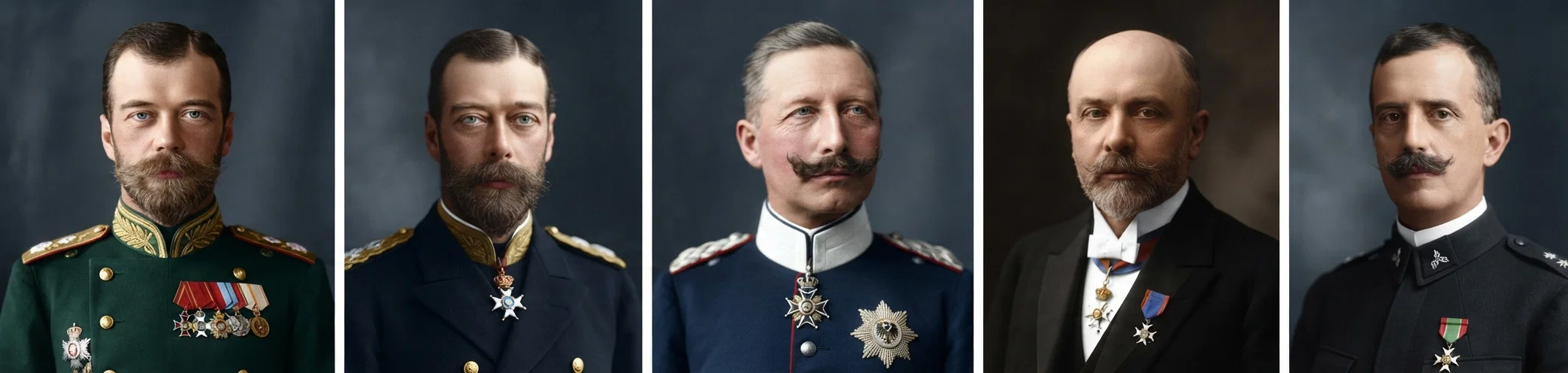
CZAR NICHOLAS KING GEORGE EMPEROR WILLIAM PRESIDENT POINCARE KING VICTOR EMMANUEL
RULERS OF THE POWERS INVOLVED
If the little Balkan powers, largely consisting of Slavs, stand together with the Triple Entente, and Japan unites with them, it will be a fearful struggle on the part of the Teutonic powers of Germany and Austria to meet the forces alined against them. The war may be carried to the far East, and all the eastern continent involved in it.
President Wilson is doing all in his power to keep matters quiet, preserve the neutrality of the United States, and eliminate just as much of the strife from the commerce of the world as a neutral power in the position of this country can. Whether he will be able to accomplish this, remains to be seen. Whether the United States, set, in God's providence, so far away from the European conflict, can fulfil this mission of peace to which she has committed herself, is a question.
A PITIABLE THING
We can not prophesy what the outcome will be. No one can. It is a pitiable thing, however, that in this twentieth century, after nearly two thousand years of the teaching of Christianity, what are called the "most civilized" and "Christian" nations of earth can not settle such differences in a friendly, amicable, just, and wise way. It certainly show this,—that they have never themselves drunk at the great fountain of peace which flows from the heart of God. They do not know His peace, therefore can not know peace among themselves. Of this, however, we may be assured regarding the continuance of the war,—that God has a work yet to do in this world before the great and final conflict comes. "The Most High ruleth in the kingdom of men, and giveth it to whomsoever He will"; and while we may pray for peace—and it is well to pray for it—pray for rulers, as we are enjoined to do, our object ought to be that God's work may be done, and that His own children may be preserved in harmony with His will till His work is finished.