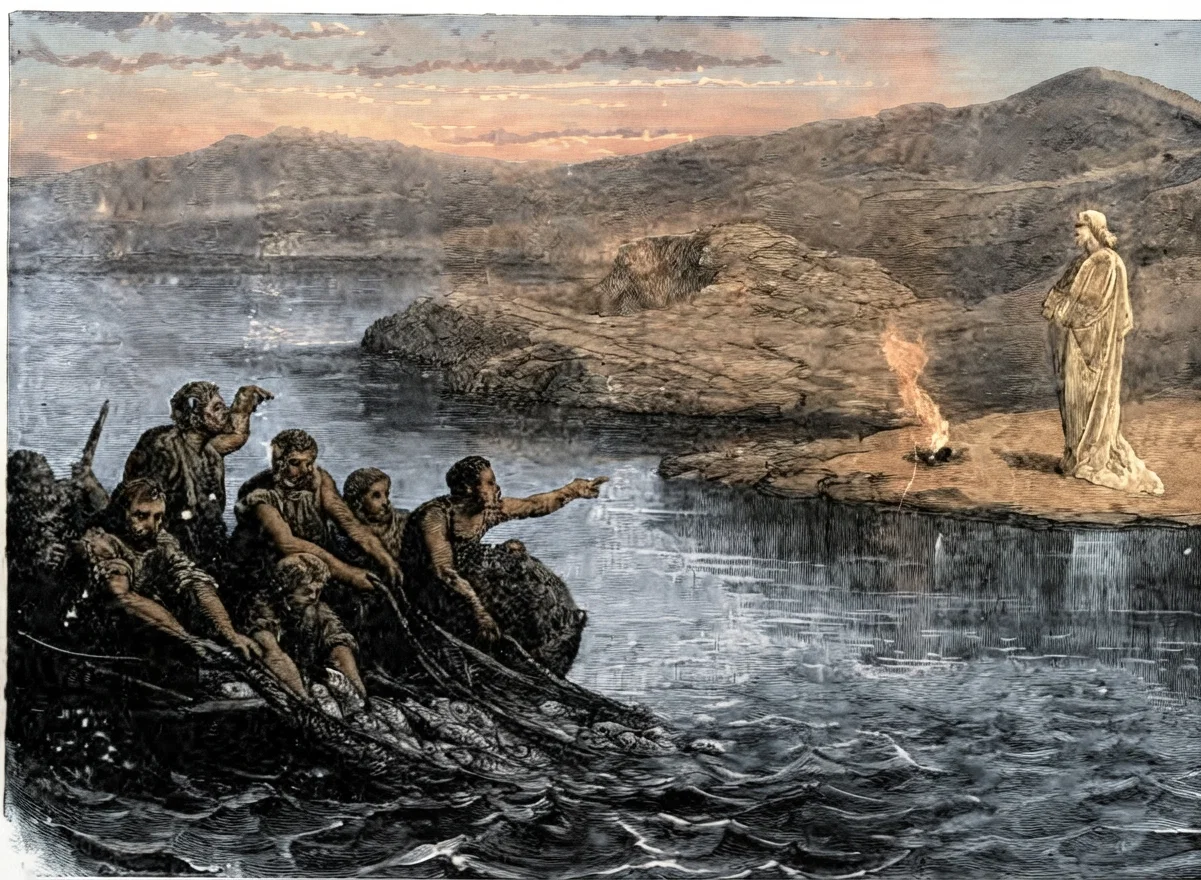
The Narrative.—Our illustration presents a boat-load of men on the sea hauling in a net full of fishes, and on the adjacent shore a single watcher standing by a small fire. The figure on the shore is Jesus of Nazareth; the men in the boat, seven of His disciples. The sea is that of Galilee. The time is after His resurrection. The narrative runs thus:
"After these things Jesus manifested Himself again to the disciples at the sea of Tiberias; and He manifested Himself on this wise. There were together Simon Peter, and Thomas called Didymus, and Nathanael of Cana in Galilee, and the sons of Zebedee, and two other of His disciples. Simon Peter saith unto them, I go a-fishing. They say unto him, We also come with thee. They went forth, and entered into the boat; and that night they took nothing. But when day was now breaking, Jesus stood on the beach; yet the disciples knew not that it was Jesus. Jesus therefore saith unto them, Children, have ye aught to eat? They answered Him, No. And He said unto them, Cast the net on the right side of the boat; and ye shall find. They cast therefore, and now were not able to draw it for the multitude of fishes." John 21:1-6.
Doubt and Perplexity.—The brief story has its important lessons, some of which we wish to notice. Jesus had told the disciples after His resurrection that He would meet them in Galilee, and it was to keep this appointment that the disciples were here. They were not yet fully enlightened. They did not yet understand the nature of Christ's kingdom. They knew He had risen from the dead, that he lived a conqueror; but what they were to do, where they were to go, they did not yet know. As they returned to Galilee, the home of their early life, the old recollections and associations of their former life as fishermen returned. Not knowing the prospect before them, they seem to have concluded that it was best for them to return to their old occupation.
Looking Backward.—They evidently had forgotten the scene three years before, when, fishing on the same sea, they had heard the voice of the Master saying, "Come ye after Me, and I will make you to become fishers of men." Mark 1:16-20. Doubtless they had felt confirmed in the truth of these words on more than one occasion as the great crowds had followed their Master and them; but now all men had forsaken Him, and even one of the twelve had proved a traitor. What could be better or wiser than for them to return to their old occupation, and again earn their living by fishing? They must have reasoned somewhat after this sort, forgot the command of the Master, and followed their own devices.
Human Schemes.—Simon Peter makes the proposition, "I go a-fishing." The other disciples, ready to fall in with the old occupation, said, "We also come with thee." The result of that purely human plan and human effort is thus given: "They went forth, and entered into a ship immediately; and that night they caught nothing." Alas, how many times has the experience been repeated! God has called His church, given His own divine directions, His own divine organization, His own divine means and equipments, and told His servants to go forward, whether His leading was visible or invisible. But how often have they become discouraged, lost sight of the Master, forgotten His commands, directions, and means, and started out for themselves. They have some beautiful society in theory. Some Simon has said, "I go," and he has found others ready to say, "We also go with thee." They have adopted their own plans and methods and means, and have toiled, oftentimes through days and nights and years and centuries, and have accomplished nothing; and when the Master has asked, "Children, have ye any meat?" they could only answer, "No."
Apart from Christ.—Without Christ we can do nothing. Human wisdom, human effort, human expedients, human organizations, human might, coupled even with former successful experience, without Christ will accomplish nothing for God. Man may praise and flatter, may admire the beautiful fabric we have reared, but without Christ it is hollow, vain, empty. "Without Me ye can do nothing," are His words to all. This was the important lesson conveyed in His delicate question, "Children, have ye any meat?"
With Christ.—But with Christ the story is different, the scene changes. His words ring across the water and thrill the souls of the disciples with a deeper meaning than had similar words on a former occasion (see Luke 5:4): "Cast the net on the right side of the ship, and ye shall find." There is no particular significance in the term "right side," except its definiteness. It was the right-hand side; they probably were then fishing on the left-hand side, and had doubtless fished all around the boat. Jesus might have said the left-hand side; the result would have been the same. Where He commanded to cast the net, there were fish to be caught. Either side if commanded by Him was the right or true and only place, and either side without Him was the wrong side. It all rested in His word, in His instruction. In the command of God is all-potency. It is itself a promise. What He commands, however impossible it may seem, will be accomplished if we will but submit to it.
The Great Twofold Lesson.—The result of obedience to Christ's command was a net full of fishes, and a welcome meal waited the weary fishers on the shore. Their duty in Galilee was to wait for the Saviour, not to return to the old life; but they went a-fishing in their own wisdom, and caught nothing. They went back from the exalted mission of being fishers of men to fishers of fish. They turned from the service of Christ to the service of self.4And the service of self proved, as it always proves, fruitless. The great twofold lesson of the narrative is that apart from Christ man can do nothing, and following Christ's command always brings success. Fishing themselves for themselves, there was no success; fishing in the same sea, by the same boat, in the same place, at the command of Christ, there was success. O, that the servants of God would but heed the Master's teaching, simple and unreasonable tho it seems! Toiling all night—the best hours for fishing—in their own strength and wisdom, they may think that with the dawning morning and the seemingly barren sea there is no further use to fish for souls; but let them by simple faith say with the disciples of old, "Nevertheless at Thy word I will let down the net." Luke 5:5. "No word of God shall be void of power." Child of God, trust the word of the Master. Do His service in His way, and you will reap the sure harvest.